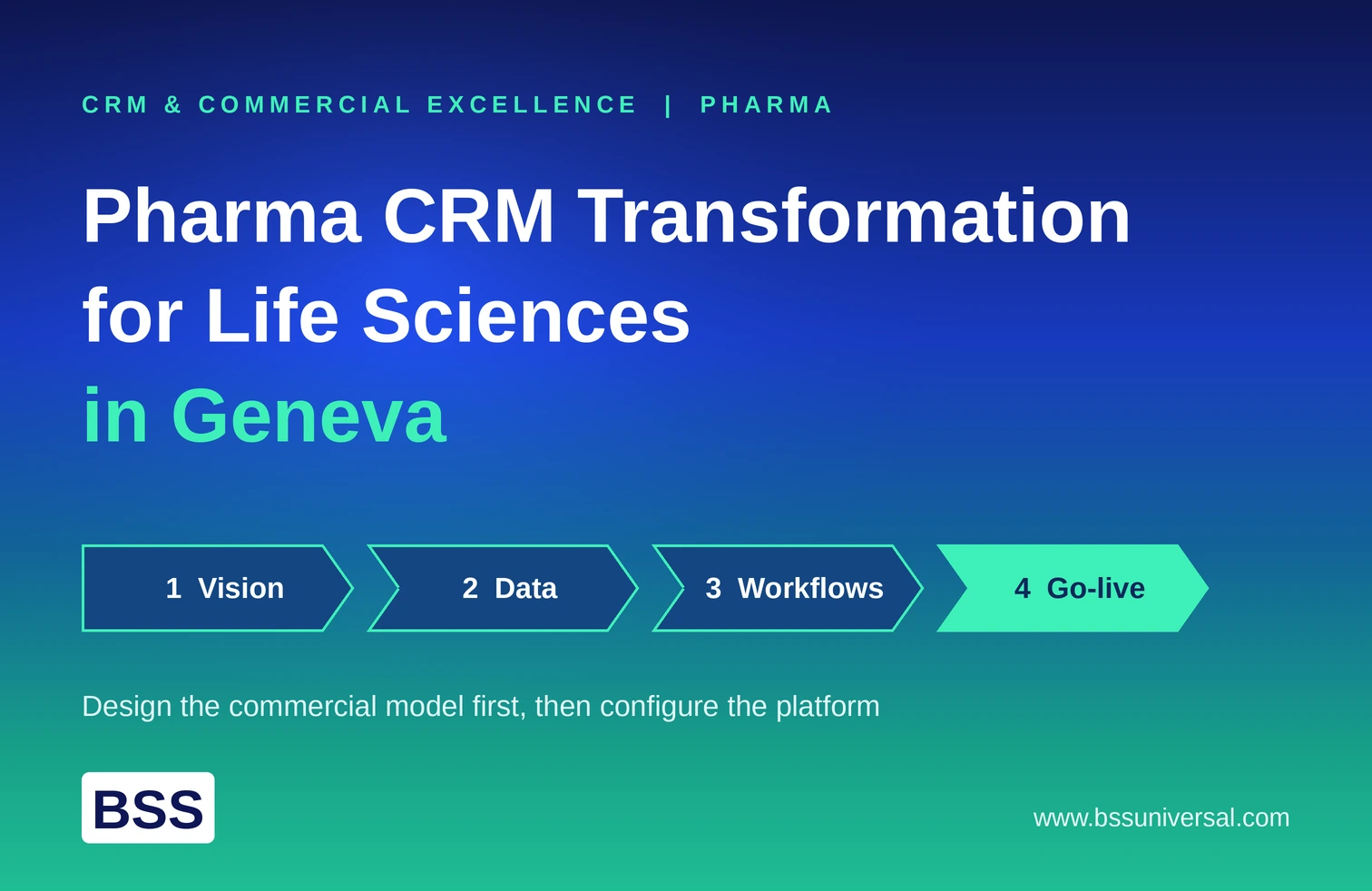
Pharma CRM Transformation for Life Sciences in Geneva
Pharma CRM transformation is the process of redesigning how a life sciences company manages customer data, engagement, and commercial workflows, and then rebuilding that model on a modern CRM platform. For Geneva-based pharma and biotech teams, it is now both a business opportunity and a deadline-driven project. BSS Universal's CRM practice helps life sciences organizations improve HCP/customer engagement and commercial operations by fixing the data, workflows, and governance behind the platform, not just the platform itself.
This guide explains what is driving CRM change in life sciences, how to design the commercial model before choosing technology, which workflows to redesign first, and how to stay compliant under Swiss and European rules.
What Pharma CRM Transformation Means
Pharma CRM transformation is a change program that covers commercial strategy, customer data, process design, compliance controls, and technology together. It is different from a platform migration, which only moves existing records and settings to a new system. A transformation uses the move to improve how teams engage healthcare professionals (HCPs) and other customers.
A complete program usually covers:
- Commercial vision: How the company wants to engage HCPs, institutions, and patients over the next five years
- Customer data: One governed view of HCPs, organizations, interactions, and consent
- Workflows: Field, medical, marketing, and customer service processes that run on the CRM
- Channels: Rep visits, remote calls, email, portals, and events working as one plan
- Compliance: Approved content, consent, audit trails, and privacy controls
- Intelligence: Analytics and AI that help teams decide whom to engage, when, and how
Why Geneva Life Sciences Teams Are Changing CRM Now
Life sciences teams in Geneva and the wider Lake Geneva region are changing CRM now because of two pressures at the same time: a platform transition in the market and a widening gap in HCP engagement. Each pressure alone would justify a review. Together they make it hard to delay.
The Platform Transition
Many life sciences companies run Veeva CRM, which was built on the Salesforce platform. Veeva has stated in its SEC filings that it did not renew its platform agreement with Salesforce when it expired in September 2025. It has also stated that it is migrating customers to Vault CRM, built on its own Vault platform, and that Veeva CRM will be supported until September 2030. At least one industry source reports an earlier end-of-support date of December 2029, so teams should confirm current dates directly with their vendor.
Organizations on the legacy product therefore face a decision. Options include Veeva Vault CRM, Salesforce Life Sciences Cloud, or another platform.
The Engagement Gap
PwC's May 2026 analysis, based on US research, describes a growing relevance gap between pharma and physicians. It reports that 82% of pharma executives believe their digital outreach is effective, while only 28% of HCPs agree, and that about 97% of digital outreach goes unanswered. PwC also reports that more than half of accessible physicians meet with three or fewer pharma companies, which concentrates access among a few preferred partners.
These figures come from US data, so Geneva teams should test them against their own markets. The direction is still useful. HCPs want relevant, timely, and low-effort interactions, and generic outreach is losing ground.
Start with the Commercial Vision, Not the Platform
The commercial vision should come before platform configuration. A CRM configured around today's engagement model will repeat today's results. PwC makes a similar point, warning against copying current processes onto a new system and advising companies to design the future front office first.
A useful vision answers these questions:
- Which customers matter most, and how do they prefer to be engaged?
- Which interactions should be automated, which should be human, and which should be both?
- What data is needed to personalize engagement while respecting consent?
- Which measures show that engagement is improving, beyond call counts?
- What will the customer base look like in five years?
Decisions about segmentation are especially important. Many teams segment HCPs only by prescribing behavior. PwC recommends also considering how each HCP makes decisions and what kind of interaction helps them, such as scientific evidence, quick self-service access, peer input, or institutional context.
Commercial Workflows to Redesign First
The best first workflows to redesign are those where better data and clearer process directly improve HCP interactions.
HCP Segmentation and Omnichannel Engagement
Omnichannel engagement in pharma means coordinating rep visits, remote contact, email, portals, and events into one plan for each HCP. The CRM holds the plan, the consent status, and the interaction history, so no channel works alone.
Key design points:
- A single HCP profile that shows all interactions across channels
- Consent and channel preferences stored with the profile and respected in every journey
- Segmentation that includes decision style, not only prescribing volume
- Clear rules for which channel leads in which situation
Field Pre-Call Intelligence
Pre-call intelligence gives reps a short, accurate briefing before each interaction. It can include recent interactions, content already shared, access status, and relevant topics. This makes calls more specific and respects the HCP's limited time.
The value depends on data quality. A briefing built on duplicate or outdated records will reduce trust in the system.
Medical Information and MSL Workflows
Medical teams need to capture scientific exchanges, route medical information requests, and share insight across functions. A well-designed CRM lets medical affairs track interactions and questions while keeping them separate from promotional activity, as compliance rules require.
Approved Content and Compliance Workflows
Content workflows connect approved materials to the people and channels allowed to use them. Medical, legal, and regulatory (MLR) review should feed approved content into the CRM, so field and digital teams use only current, compliant assets. Clear version control and expiry rules reduce risk.
[INTERNAL LINK: CRM and commercial excellence for life sciences]
Build the Customer Data Foundation First
A customer data foundation is the governed set of HCP, organization, interaction, and consent data that every CRM workflow depends on. Without it, personalization, analytics, and AI produce unreliable results. Most pharma CRM delays come from data problems found late.
The foundation should include:
- Master data: One trusted record for each HCP and each organization, with duplicates resolved
- Integration: Reliable connections to ERP, marketing automation, content, safety, and data platforms
- Consent management: Clear records of permissions by person and channel
- Data quality rules: Standard formats, required fields, and ongoing monitoring
- Access and audit: Role-based access and records of who changed what
How BSS Universal's Team Handles This
BSS Universal's Data Migration and Integration team starts by auditing where customer data actually lives, including legacy CRM records, spreadsheets, and connected systems. The team cleanses duplicates, standardizes fields, and maps data to the new model, then runs test migrations in a staging environment to check record counts and field mapping before the real move. Governance and security rules are documented alongside the data model, so compliance is not added at the end. Findings are reported in plain language so commercial and IT leaders can agree on priorities.
Choosing a Platform Path
The right CRM platform depends on a company's existing systems, commercial model, integration needs, and long-term data strategy, not on a single feature list. There is no universal answer, and a sound decision weighs several factors. BSS Universal focuses on Salesforce implementations, so its guidance is strongest there, but the criteria below apply to any option.
Main paths to compare:
- Veeva Vault CRM: Suits organizations already invested in the wider Veeva ecosystem, where a single vendor suite across commercial, medical, and regulatory systems is a priority. The platform is newer than Salesforce's, and business logic must be rebuilt in Vault's own tools.
- Salesforce Life Sciences Cloud: Suits organizations that want a flexible platform with a broad partner ecosystem and strong data and AI capability, including Agentforce and Data 360. It often fits companies that need deep customization or want to unify commercial, service, and marketing data on one platform.
- Other or hybrid approaches: Some organizations keep specialized tools alongside a core CRM, for example for partnering or alliance management.
Criteria to weigh:
- Current investment in other life sciences systems
- Integration needs with ERP, data platforms, and content systems
- Customization needs beyond standard processes
- Total cost, including migration, licenses, and support
- Data and AI strategy over the next five years
- Vendor roadmap, support commitments, and exit options
Compliance, Privacy, and Swiss Rules
Compliance in pharma CRM means controlling how HCP and patient-related data is collected, used, and shared, and how promotional and medical activity is separated and recorded. Geneva-based teams must consider Swiss data protection law, European rules where they apply, and the codes and laws governing HCP interactions. Compliance should be designed into the CRM from the first workshop.
Key areas to cover:
- Data protection: The revised Swiss Federal Act on Data Protection (FADP) governs personal data processing. Companies handling EU data may also need to meet GDPR duties.
- Data location and hosting: Teams should confirm where data is stored and processed, and whether cross-border transfers are covered by the right safeguards.
- Marketing consent: Rules on electronic marketing and consent vary by channel and country, so consent records must be accurate.
- Promotional and HCP interaction rules: Swiss therapeutic products law and industry codes affect how companies interact with HCPs. Legal and compliance teams should confirm requirements for each activity.
- Content approval: MLR review and version control should control which content reaches field and digital channels.
- Security: ISO 27001 is a recognized standard for managing information security, and a partner's certification shows a tested security management system.
- AI oversight: Where AI supports engagement, define human review points and escalation rules before launch.
This article is general information and not legal advice. Companies should confirm requirements with their own legal, compliance, and regulatory teams.
How BSS Universal Approaches Pharma CRM Transformation
BSS Universal approaches pharma CRM transformation as a phased program, so complexity stays manageable and decisions are made once and documented. Each phase has a clear output, and a dedicated client point of contact works with the executive sponsor and steering committee from day one. This prevents scope from being renegotiated mid-project.
A typical program follows these steps:
- Governance and sponsorship: Name an executive sponsor with real decision rights, form a steering committee, and set measurable goals and a minimum viable first phase
- Current and future state mapping: Review how work happens today and design which tasks are automated, which need human review, and which stay manual
- Data model and security design: Design objects, integrations, and access rules before configuring fields, with audit trails and consent controls for regulated work
- Migration and cleansing: Audit, cleanse, map, and test-migrate data in a staging environment
- Configuration, integration, and testing: Build and test in sandboxes, with user acceptance testing led by real end users
- Training and change management: Deliver role-specific training and name internal champions in each team
- Phased go-live and hypercare: Launch by business unit or region, with check-ins at day 7, day 14, and day 30
- Continuous improvement: Keep an enhancement backlog and review adoption and governance on a regular schedule
BSS Universal's lead vertical is Life Sciences, Pharma and Healthcare, and its delivery is ISO 27001 certified. [INTERNAL LINK: Salesforce implementation checklist for complex enterprises]
How BSS Universal's Team Handles This
Where AI is part of the program, BSS Universal sequences it behind the core Salesforce go-live. The AI and Automation team activates agents on a narrow set of use cases first, with human-in-the-loop review, before expanding scope. The Responsible AI and Governance function defines agent boundaries and escalation rules in advance. This keeps the first release focused and gives commercial and compliance teams time to build trust.
What Pharma CRM Transformation Costs
The cost of a pharma CRM transformation depends on the number of users, countries, integrations, and data sources, and on how much process redesign is needed. A single-region program costs much less than a global one. Budget should cover more than software licenses.
Main cost drivers:
- Platform licenses and environments
- Data migration and cleansing: Often a large share of effort
- Integration: Connections to ERP, content, marketing, and data platforms
- Validation and compliance: Testing and documentation for regulated use
- Training and change management: Adoption effort that decides whether the CRM gets used
- Support and enhancement: Ongoing changes after go-live and platform release updates
Common Risks and How to Avoid Them
The most common risks in pharma CRM transformation are copying old processes, late data work, and weak adoption. Each is avoidable with early planning.
- Lift-and-shift migration: Moving old processes to a new system keeps old problems. Design the future model first.
- Late data cleanup: Data issues found during testing delay go-live. Audit data in the first phase.
- Compliance as an afterthought: Consent, audit, and content controls added late cause rework. Involve compliance from the start.
- Underfunded training: Teams revert to old habits when training is thin. Build role-based training and champions.
- Big-bang launch: Launching everywhere at once concentrates risk. Phase go-live by region or business unit.
Getting Started
The best way to start is with a short discovery phase that reviews the commercial vision, current systems, data quality, and platform options. This gives leadership a clear and low-risk plan before major spending. A focused first release can then prove value with real users.
A practical first set of actions:
- Name an executive sponsor and a commercial owner for the program
- Confirm current CRM contract and support dates with the vendor
- Define the target engagement model for the next five years
- Audit HCP, organization, and consent data
- Compare platform paths against agreed criteria
- Select a first release that can reach users and be measured
To plan your CRM transformation with a team that understands life sciences commercial operations, [INTERNAL LINK: talk to a BSS Universal CRM consultant] and share your goals.
Frequently Asked Questions
What is pharma CRM transformation?
Pharma CRM transformation is a program that redesigns commercial workflows, customer data, and engagement models, then rebuilds them on a modern CRM platform. It goes beyond moving data to a new system. The aim is better HCP engagement and more efficient commercial operations.
Why are life sciences companies changing CRM platforms?
Many companies are changing CRM because Veeva has stated it is moving customers from Veeva CRM, built on Salesforce, to its own Vault CRM, with support for the legacy product set to end around 2030. HCP engagement is also changing, so companies want better data, omnichannel plans, and AI support. Confirm exact dates with your vendor.
What is the difference between a CRM migration and a CRM transformation?
A migration moves existing data and settings to a new platform with few changes. A transformation redesigns processes, data, and engagement models and then builds them on the new platform. Transformation takes more effort but avoids repeating old problems.
How should a pharma company choose between Veeva Vault CRM and Salesforce Life Sciences Cloud?
Compare both against the same criteria: existing life sciences systems, integration needs, customization needs, total cost, data and AI strategy, and vendor roadmap. Organizations deeply invested in the Veeva suite may favor Vault CRM, while those needing flexibility and a broad data and AI platform often consider Salesforce. A structured assessment gives the clearest answer.
How does Swiss data protection law affect a pharma CRM?
The revised Swiss Federal Act on Data Protection (FADP) applies when a CRM holds personal data, such as HCP or patient-related information. Companies need a lawful purpose, accurate consent records, and strong security. Those that also process EU data may need to meet GDPR requirements.
How long does a pharma CRM transformation take?
Timelines depend on the number of countries, users, integrations, and the quality of existing data. A phased program with a focused first release shows results sooner than a single large launch. Multi-country programs typically take several months or longer.
Where does AI fit in a pharma CRM program?
AI can support pre-call briefings, content personalization, and routine information requests once data foundations and governance are in place. It should be added in small, controlled steps, with human review for sensitive tasks. Sequencing AI behind the core CRM go-live lowers risk.