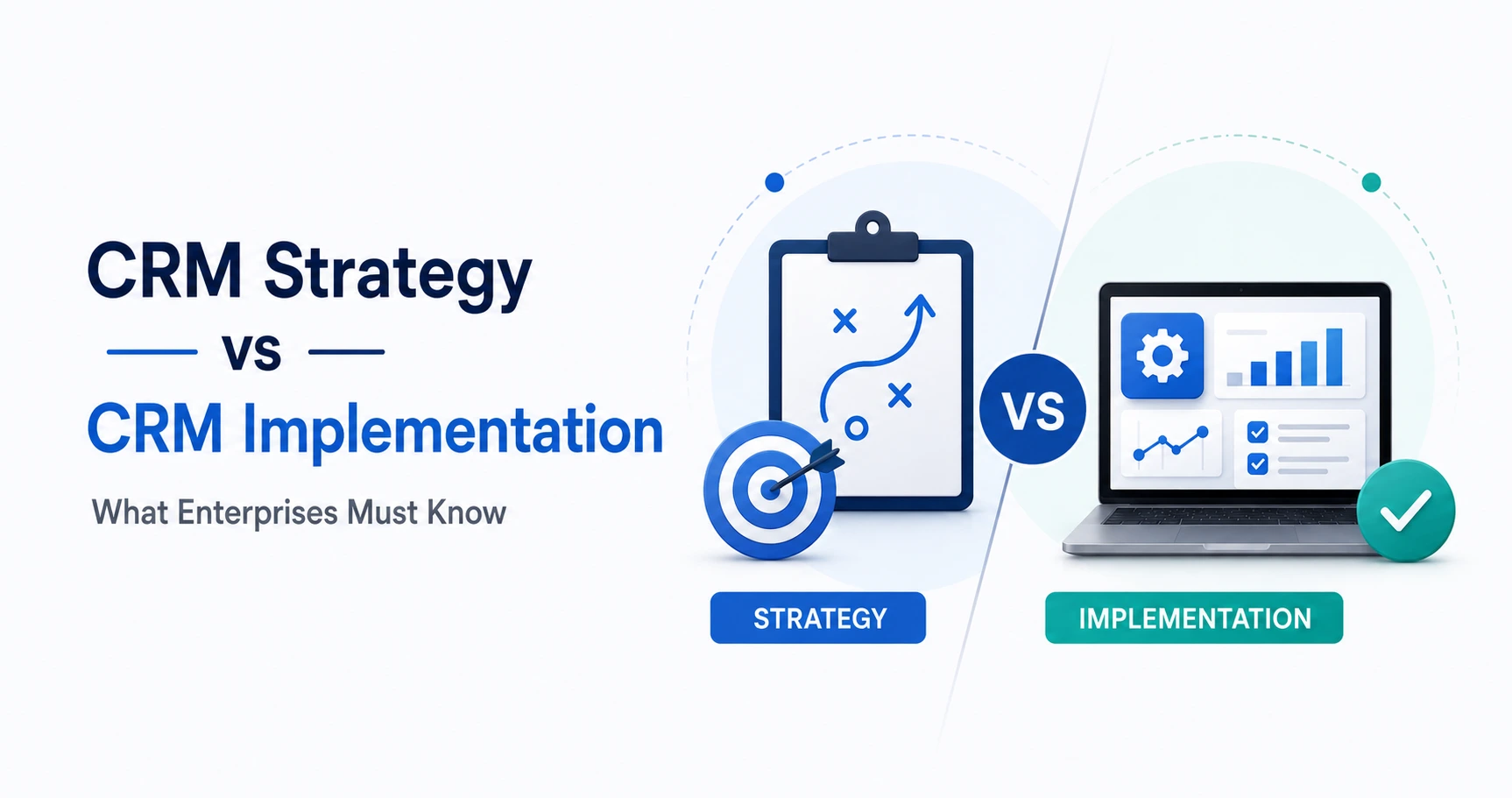
CRM Strategy vs CRM Implementation: What Enterprises Must Know
Introduction
I have seen enterprise organizations invest millions in CRM platforms with the expectation that technology alone would transform customer engagement, sales performance, and operational efficiency. Yet many of those initiatives fail to deliver meaningful business outcomes—not because the software is inadequate, but because the organization mistakes CRM implementation for CRM strategy.
According to industry observations reflected in enterprise CRM transformation initiatives, organizations that align CRM investments with customer experience, revenue growth, and operational objectives achieve significantly stronger commercial outcomes than those focused solely on system deployment. Likewise, modern platforms such as Salesforce and Microsoft Dynamics 365 are increasingly being used as strategic business enablers rather than simple customer databases (Source: BSS Universal CRM Commercial Excellence Framework).
The reality is that a CRM platform cannot fix disconnected processes, fragmented customer journeys, or poor organizational alignment on its own. Success begins long before software deployment. It starts with a clear vision, a structured CRM roadmap, and a comprehensive understanding of how customer relationships contribute to long-term business growth.
That distinction is where many enterprises struggle—and where understanding CRM strategy vs implementation becomes essential.
Why Enterprises Are Struggling With CRM Transformation
Across industries including life sciences, healthcare, financial services, manufacturing, and technology, executives face a growing gap between customer expectations and organizational capabilities. Customers expect personalized interactions, seamless experiences, and consistent engagement across every touchpoint. Meanwhile, many enterprises still operate with disconnected systems, siloed teams, and fragmented customer data — a gap that often stems from weak CRM-driven sales and marketing alignment across departments.
A SaaS organization may deploy an enterprise CRM platform but continue struggling with customer retention because onboarding processes remain disconnected from customer success teams. A manufacturing company may implement a sophisticated CRM system while sales teams continue using spreadsheets because workflows do not reflect actual selling processes. Financial institutions often invest in advanced CRM technologies but fail to achieve visibility because customer information remains spread across multiple systems.
The common pattern is not technology failure. It is a lack of alignment between business strategy and execution. Organizations frequently treat CRM as an IT project when it should be viewed as a commercial transformation initiative.
Until leadership teams recognize that CRM strategy and CRM implementation serve different but interconnected purposes, many transformation programs will continue delivering less value than expected.
CRM Strategy Defines Business Success Before Technology Exists
CRM strategy is not about selecting software. It is about defining how customer relationships will support business growth, commercial transformation, and operational excellence.
An effective CRM strategy establishes business objectives, customer engagement priorities, revenue targets, governance structures, and performance metrics before any platform decisions are made. It aligns leadership teams around a shared vision for customer experience and defines how CRM will contribute to broader organizational goals.
Enterprise CRM planning increasingly centers on understanding customer journeys, buying behaviors, lifecycle stages, and communication preferences. Organizations that prioritize these strategic elements create stronger foundations for long-term CRM success. According to the BSS Universal CRM framework, successful CRM strategies support revenue growth, customer retention, forecasting accuracy, operational efficiency, and cross-functional collaboration.
A well-defined CRM roadmap also provides structure for future growth. It outlines implementation phases, technology requirements, integration priorities, and optimization milestones that guide the organization through the entire CRM lifecycle.
So what does this mean for CEOs, CIOs, CTOs, and business leaders? It means CRM investments should begin with business questions, not technology questions. Leaders must first determine what commercial outcomes they want to achieve and then build CRM capabilities that support those objectives.
CRM Implementation Turns Strategy Into Operational Reality
While CRM strategy defines the destination, CRM implementation builds the road to get there.
Implementation focuses on deploying, configuring, integrating, and operationalizing CRM technology within the enterprise environment. This includes software configuration, workflow design, user access management, system integration, data migration, testing, deployment, and employee onboarding.
One of the most common implementation mistakes is excessive customization. Many organizations attempt to recreate every legacy process inside a new CRM platform, creating complexity that slows adoption and reduces scalability. Successful implementation balances business requirements with usability and long-term maintainability. Organizations planning large-scale deployments can benefit from following a structured approach outlined in enterprise CRM implementation guide, which helps align implementation activities with long-term business objectives and growth strategies.
Enterprise CRM implementation also requires seamless integration with ERP systems, marketing automation platforms, customer support applications, financial systems, and analytics tools. Without integration, customer data remains fragmented and visibility remains limited. User adoption plays an equally important role, as even the most advanced CRM platform delivers little value if employees do not use it consistently. Many organizations overcome these obstacles by addressing common CRM implementation challenges and adopting modern practices that improve adoption, integration, and operational effectiveness across departments.
User adoption plays an equally important role. The most advanced CRM platform delivers little value if employees do not use it consistently. Effective onboarding, role-specific training, workflow documentation, and ongoing support are critical components of implementation success.
So what does this mean for executive leadership? CRM implementation should never be viewed as a standalone technology deployment. It must be managed as a business enablement initiative where operational execution directly supports strategic objectives.
Enterprises Need Strategy and Implementation Working Together
The debate between CRM strategy and implementation often creates a false choice. Enterprises do not need one or the other—they need both operating in alignment.
Organizations that prioritize implementation without strategy frequently experience low adoption, weak ROI, inefficient workflows, and limited business impact. The technology functions correctly, but it lacks direction. Conversely, organizations with strong strategic visions often struggle when execution fails to support planned outcomes.
The most successful enterprises view CRM as a lifecycle rather than a project. Strategic planning establishes goals, platform selection supports business requirements, implementation operationalizes processes, adoption drives usage, and continuous optimization sustains performance — often achieved by optimizing CRM through RevOps to keep strategy and execution moving in step.
This lifecycle approach creates a framework where customer experience, sales excellence, marketing effectiveness, and operational efficiency reinforce one another. According to the BSS Universal CRM lifecycle model, organizations that integrate strategic planning, implementation, adoption, and optimization achieve stronger commercial transformation outcomes than those treating CRM as a one-time deployment.
For C-level leaders, the implication is clear. CRM success should be measured not by deployment milestones but by customer retention, revenue performance, forecasting accuracy, process efficiency, and business growth.
AI Is Reshaping Both CRM Strategy and CRM Implementation
Artificial Intelligence is fundamentally changing how organizations approach CRM planning and execution. From a strategic perspective, AI enables businesses to anticipate customer needs, identify growth opportunities, predict churn risks, and create highly personalized engagement strategies. CRM is evolving from a system of record into a system of intelligence that supports proactive decision-making. Organizations embracing this shift often follow an Intelligent CRM Transformation Guide to modernize customer engagement and operational processes while preparing for future growth. Businesses seeking a broader framework for aligning CRM with commercial performance can also explore the complete guide to CRM commercial excellence. Ready to align CRM strategy with implementation and accelerate business growth? Discover CRM & Commercial Excellence Solutions designed to support enterprise transformation, customer engagement, and revenue excellence initiatives.
On the implementation side, AI-powered capabilities are automating lead assignment, customer segmentation, workflow routing, sales forecasting, reporting, and customer engagement. Modern CRM platforms increasingly include predictive analytics, intelligent automation, and real-time recommendations as core functionality.
Organizations that incorporate AI readiness into enterprise CRM planning gain significant advantages. Predictive customer insights improve decision-making. Intelligent forecasting enhances revenue planning. Automation reduces administrative burden. Personalization strengthens customer relationships at scale.
So what does this mean for enterprise executives? AI should not be treated as a future enhancement. It should be incorporated into CRM strategy and implementation planning from the beginning. Businesses that prepare today will be positioned to capitalize on the next generation of intelligent CRM ecosystems.
Conclusion
The enterprise CRM landscape is shifting faster than ever. Customer expectations continue to rise, competitive pressures continue to intensify, and emerging technologies such as AI are redefining how organizations engage with customers and manage commercial operations.
I believe the companies that act now will be the ones that build sustainable competitive advantages over the next decade. They will recognize that CRM strategy and CRM implementation are not interchangeable concepts. Strategy provides the vision, roadmap, and commercial alignment. Implementation provides the execution, operationalization, and scalability required to realize that vision.
Organizations that successfully connect both disciplines create stronger customer experiences, improve CRM adoption, enhance forecasting accuracy, increase operational efficiency, and drive long-term business growth.
The future belongs to enterprises that approach CRM as a strategic commercial transformation initiative rather than a software deployment project.
Ready to align CRM strategy with implementation and accelerate commercial excellence? Explore BSS Universal's CRM & Commercial Excellence Solutions, or Contact Our CRM Experts to get started.