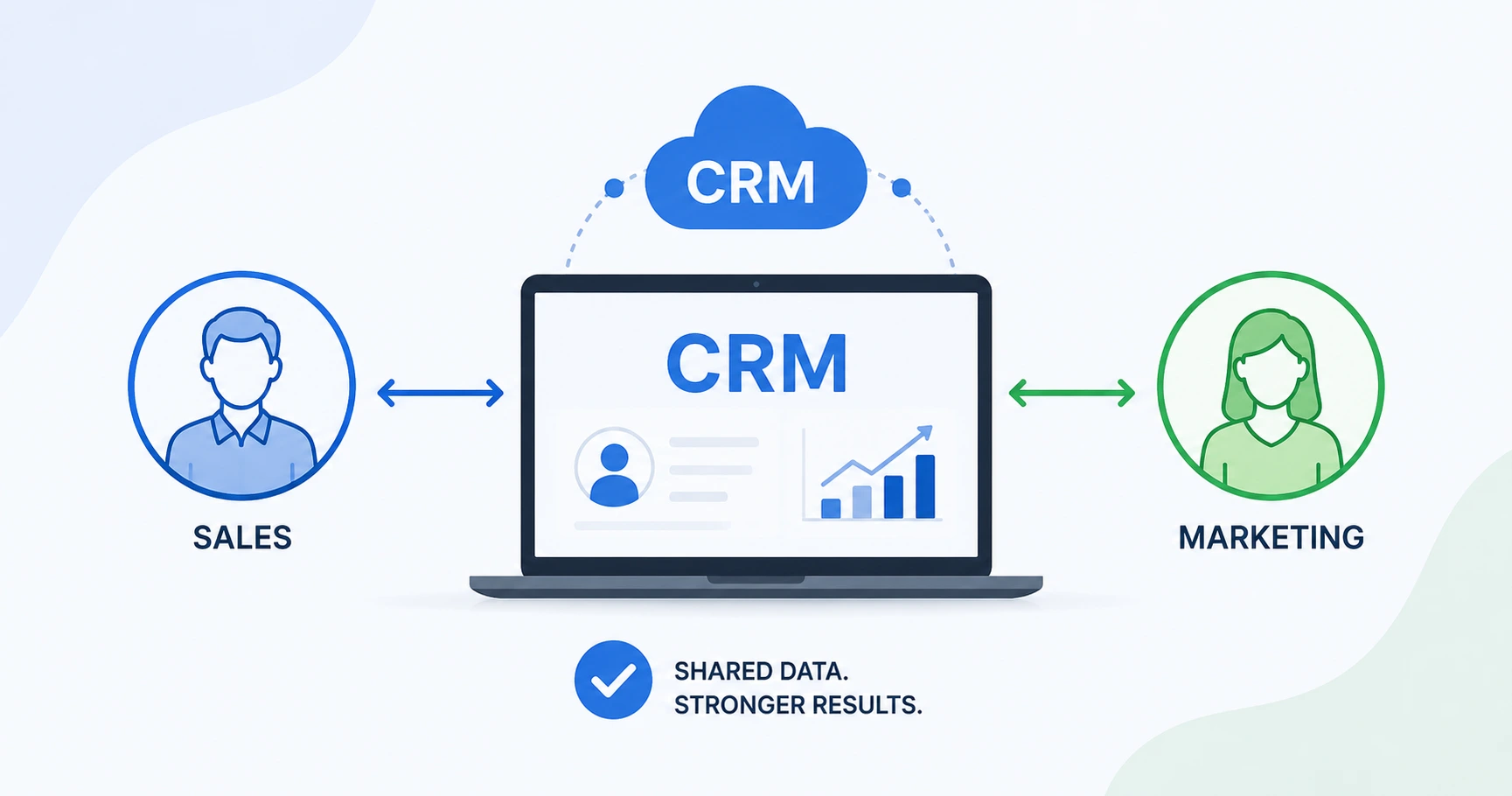
How CRM Drives Sales & Marketing Alignment in Enterprises
Introduction
I have worked with organizations across multiple industries, and one challenge consistently appears regardless of company size or geography: sales and marketing teams often operate with different priorities, different metrics, and different views of the customer. While marketing focuses on generating demand, sales concentrates on converting opportunities into revenue. The result is frequent friction, miscommunication, and missed growth opportunities.
Industry observations suggest that enterprises with unified CRM ecosystems achieve stronger visibility across the customer lifecycle, improve lead qualification processes, and create more predictable revenue outcomes. Organizations increasingly rely on platforms such as Salesforce, HubSpot, and Microsoft Dynamics 365 to centralize customer data, automate workflows, and connect revenue-generating teams through shared processes and reporting. Businesses looking to strengthen these capabilities can explore CRM Commercial Excellence Solutions to align sales, marketing, customer success, and revenue operations around a unified growth strategy. Many of these initiatives begin with CRM strategy versus implementation to ensure both vision and execution move together from day one.
As enterprises across the United States, Saudi Arabia, the UAE, and the broader MENA region accelerate digital transformation initiatives, CRM sales and marketing alignment has evolved from a departmental objective into a boardroom priority. The challenge is no longer acquiring technology—it is ensuring sales and marketing operate as one coordinated revenue engine.
Why Enterprises Are Struggling With Sales & Marketing Alignment
Despite significant investments in enterprise technology, many organizations continue to struggle with alignment because their processes remain fragmented. Marketing teams often measure success through campaign performance and lead volume, while sales teams focus on pipeline progression and closed revenue. These disconnected objectives create operational gaps throughout the customer journey.
A healthcare technology provider may generate hundreds of leads through digital campaigns, but without clear qualification criteria, sales teams spend valuable time pursuing prospects that are not ready to buy. A manufacturing company may have extensive customer data across multiple platforms, yet sales representatives lack visibility into marketing engagement history. Similarly, a financial services organization may experience delayed lead handoffs because departments rely on disconnected systems and inconsistent workflows.
The underlying issue is not effort. Both departments are working toward growth, but they are often doing so independently. Without a unified framework for customer engagement, organizations struggle to deliver consistent experiences and maximize revenue opportunities.
Modern CRM platforms address this challenge by providing a shared environment where customer data, performance metrics, and workflows operate as part of a connected revenue strategy.
CRM Creates a Single Source of Truth Across the Customer Journey
One of the most transformative capabilities of enterprise CRM platforms is their ability to establish a single source of truth. When sales and marketing teams work from separate systems, customer information becomes fragmented, leading to inconsistent messaging and poor decision-making. A centralized CRM ecosystem provides complete visibility into customer interactions, including campaign engagement, website activity, email behavior, purchase history, and sales conversations. Organizations that follow CRM data management best practices are better positioned to maintain accurate customer records and support stronger collaboration across departments.
A centralized CRM ecosystem provides complete visibility into customer interactions, including campaign engagement, website activity, email behavior, purchase history, and sales conversations. According to the BSS Universal CRM alignment framework, centralized customer data improves collaboration by ensuring every department operates from the same real-time information source.
Platforms such as Salesforce, HubSpot, and Microsoft Dynamics 365 are widely used to support this enterprise-wide visibility. Marketing teams can understand how prospects interact with content, while sales teams gain immediate access to engagement signals that indicate buying intent.
So what does this mean for CEOs, CIOs, and business leaders? It means organizational decisions become more accurate because every team shares the same customer intelligence. Instead of debating data quality or lead ownership, departments can focus on accelerating growth and improving customer outcomes.
RevOps Turns CRM Alignment Into a Scalable Revenue Engine
Revenue Operations, commonly known as RevOps, has emerged as one of the most important frameworks for enterprise growth. Rather than allowing sales, marketing, and customer success teams to function independently, RevOps aligns them around common objectives, processes, and performance metrics.
CRM systems serve as the operational foundation of RevOps by connecting customer data, communication channels, reporting structures, and workflow automation into a single environment. The BSS Universal RevOps framework identifies shared revenue goals, process standardization, data consistency, and cross-functional collaboration as essential components of sustainable growth, an approach explored further in RevOps and commercial excellence.
Consider a SaaS organization managing complex subscription lifecycles. Without RevOps, marketing may optimize for lead generation while customer success focuses on retention and sales concentrates solely on acquisition. CRM-enabled RevOps brings these functions together, creating visibility across the entire customer lifecycle.
So what does this mean for enterprise leadership? Revenue growth becomes more predictable because every customer-facing team contributes toward the same strategic objectives. Operational silos diminish, forecasting improves, and customer lifecycle management becomes more effective.
Lead Management Is Where CRM Alignment Delivers Immediate Business Value
Lead management represents one of the clearest examples of how CRM sales and marketing alignment improves business performance. Without a structured process, leads frequently become lost, delayed, or mishandled during transitions between departments.
Modern CRM systems establish clearly defined stages across the customer journey, from visitor and lead through Marketing Qualified Lead (MQL), Sales Qualified Lead (SQL), opportunity, and customer. This standardized framework creates accountability while ensuring every team understands where prospects are positioned within the buying process.
CRM automation further strengthens alignment through automated lead routing and intelligent lead scoring. Prospects can be assigned automatically based on territory, industry, company size, or buying intent. Lead scoring models evaluate engagement signals such as website visits, content downloads, email interactions, and demo requests to prioritize high-value opportunities (Source: BSS Universal Lead Management Framework).
So what does this mean for executives responsible for growth? Sales teams spend less time pursuing low-quality prospects, marketing gains confidence in qualification standards, and customers receive faster, more relevant engagement throughout their buying journey.
Marketing Automation and AI Are Redefining Alignment in 2026
The next evolution of CRM sales and marketing alignment is being driven by marketing automation and artificial intelligence. These technologies enable enterprises to scale engagement while maintaining personalization and operational efficiency. Artificial Intelligence extends these capabilities further through predictive lead scoring, intelligent workflow automation, personalized customer recommendations, and predictive revenue forecasting. Organizations exploring AI CRM Customer Experience Growth are leveraging AI-powered insights to improve customer engagement and optimize commercial operations.
CRM-integrated marketing automation platforms allow organizations to nurture prospects through personalized email sequences, behavioral triggers, retargeting campaigns, and automated workflows. At the same time, sales teams gain access to real-time engagement insights such as email opens, webinar participation, and website activity.
Artificial Intelligence extends these capabilities further through predictive lead scoring, intelligent workflow automation, personalized customer recommendations, and predictive revenue forecasting. According to the BSS Universal AI CRM framework, AI-driven systems help organizations identify high-conversion opportunities, automate repetitive tasks, and improve forecasting accuracy across the revenue pipeline. This directly supports CRM strategies that improve revenue by connecting predictive intelligence with day-to-day sales execution.
For a healthcare provider, this could mean identifying patients most likely to engage with a specific service offering. For a manufacturing enterprise, it could involve predicting purchasing behavior among distributors. For a financial institution, AI may highlight customers most likely to respond to cross-selling opportunities.
So what does this mean for business leaders? Enterprises that embrace AI-powered CRM alignment gain the ability to make faster decisions, engage customers more effectively, and scale revenue operations without proportional increases in operational complexity.
Conclusion
The enterprise landscape is shifting faster than traditional organizational structures can adapt. Customers expect seamless experiences, personalized engagement, and consistent communication regardless of which department they interact with. Businesses that continue operating with disconnected sales and marketing functions will find it increasingly difficult to compete.
I believe the companies that act now will establish stronger competitive advantages over the next decade. By combining CRM platforms, RevOps frameworks, marketing automation, and AI-driven intelligence, organizations can transform separate departments into a unified revenue engine capable of delivering predictable growth and superior customer experiences.
CRM sales and marketing alignment is no longer simply about improving communication between teams. It is about creating a connected commercial ecosystem where customer data, operational processes, and strategic objectives work together to drive measurable business outcomes. Organizations seeking a broader framework for achieving this transformation can explore The Complete Guide to CRM Commercial Excellence in 2026 to understand how leading enterprises are building scalable, customer-centric growth strategies.
Organizations that prioritize alignment today will be far better positioned to navigate the demands of 2026 and beyond.
Ready to unify sales, marketing, and customer success through a modern CRM strategy? Explore BSS Universal's CRM & Commercial Excellence Solutions, or Contact Our CRM Experts to get started.