Revenue Operations (RevOps): The Future of Commercial Excellence
Introduction
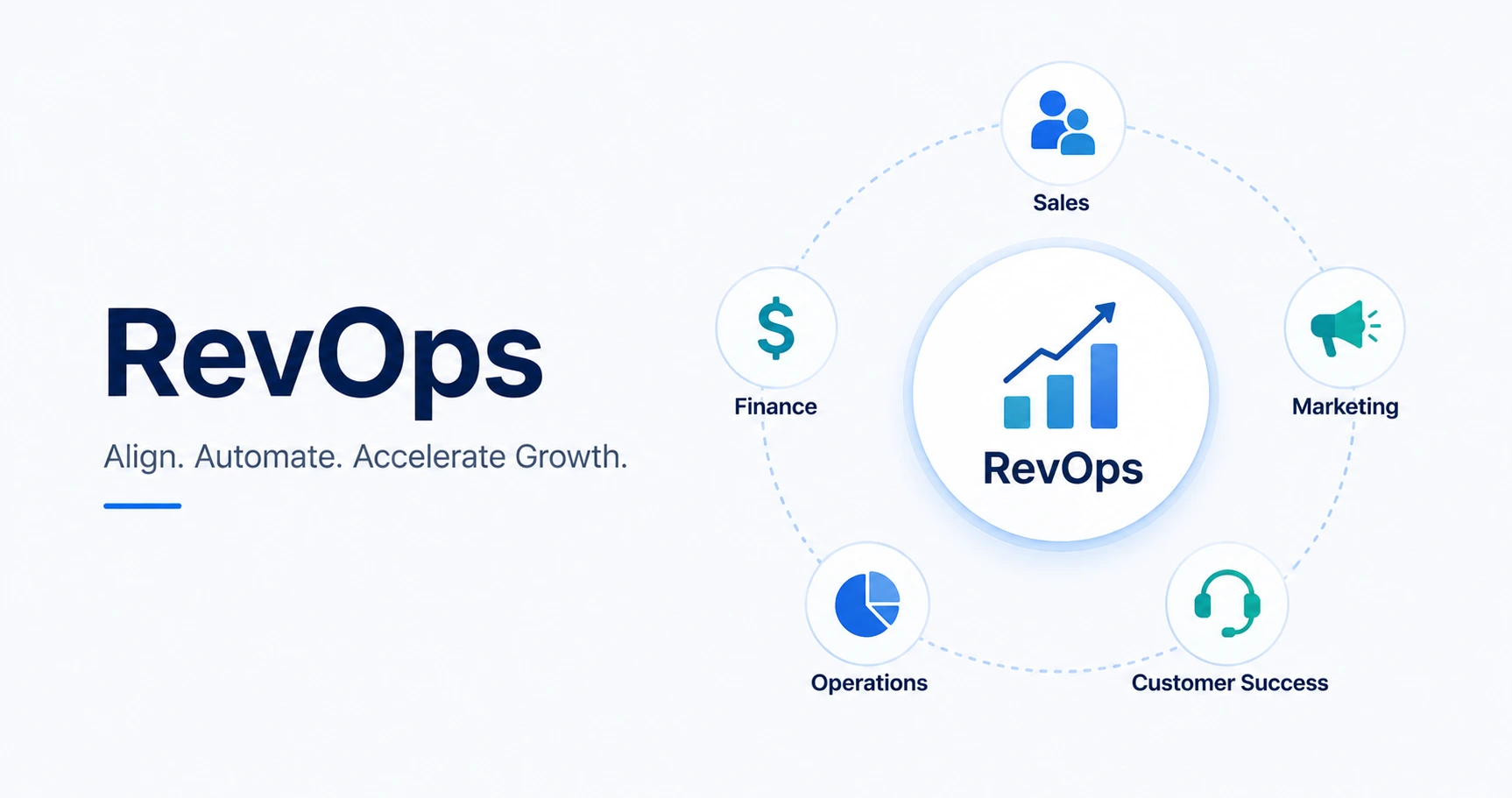
I have observed a significant shift in how enterprise organizations approach growth. The most successful companies are no longer optimizing individual departments in isolation. Instead, they are building integrated revenue ecosystems that connect sales, marketing, customer success, finance, and operations around a single objective: predictable revenue growth.
According to Revenue Operations best practices, organizations that align revenue-generating teams through shared systems, processes, and data gain stronger forecasting accuracy, improved operational efficiency, and greater visibility into the entire customer lifecycle. The RevOps framework also highlights the growing importance of metrics such as Customer Acquisition Cost (CAC), Customer Lifetime Value (CLV), Net Revenue Retention (NRR), and pipeline velocity in measuring commercial performance. Organizations seeking to build these capabilities can explore CRM Commercial Excellence Solutions to create scalable revenue operations frameworks that support sustainable growth.
As enterprises across healthcare, life sciences, financial services, manufacturing, technology, and government sectors continue scaling globally, traditional operational models are becoming increasingly difficult to sustain. Disconnected teams, fragmented customer data, and inconsistent reporting create obstacles that directly impact growth.
This challenge has led many executive leaders to embrace Revenue Operations (RevOps) as the foundation for modern commercial excellence.
Why Modern Enterprises Are Struggling With Revenue Alignment
Customer expectations have evolved faster than most organizational structures. Buyers expect seamless experiences across every interaction, yet many enterprises continue operating through disconnected departments with separate objectives and technologies.
A healthcare provider managing patient engagement, onboarding, and support may struggle when customer information is fragmented across systems. A financial services organization may face forecasting challenges because sales, marketing, and customer success teams rely on different reporting methods. A technology company scaling internationally may encounter operational inefficiencies when lead management, customer onboarding, and account expansion processes lack alignment.
The underlying problem is not a lack of talent or technology. It is the absence of a unified operational framework connecting every stage of the customer journey.
Traditional operational structures often create silos where marketing focuses on lead volume, sales focuses on pipeline generation, and customer success prioritizes retention independently. This disconnect frequently leads to inconsistent customer experiences, delayed handoffs, revenue leakage, and poor forecasting visibility.
Revenue Operations addresses these challenges by aligning teams, processes, systems, and data around shared revenue outcomes.
RevOps Transforms CRM Into a Strategic Revenue Engine
Many organizations still view CRM platforms primarily as sales management tools. RevOps changes this perspective by positioning the CRM as the central hub for commercial operations.
Within a RevOps model, the CRM becomes the single source of truth for customer relationships, pipeline activity, forecasting, customer engagement, and performance reporting. Instead of supporting only sales teams, the CRM serves marketing, customer success, finance, and leadership functions simultaneously. Organizations looking to maximize CRM performance often implement an approach centered on optimizing RevOps through CRM to improve operational efficiency, reporting accuracy, and revenue visibility across departments.
The Revenue Operations framework identifies CRM management, revenue analytics, process optimization, and performance reporting as core components of successful RevOps programs. Platforms such as Salesforce, HubSpot, Zoho CRM, Microsoft Dynamics 365, and Pipedrive increasingly support end-to-end revenue management across the customer lifecycle.
So what does this mean for CEOs, CIOs, and Chief Digital Transformation Officers?
It means commercial decisions can be based on unified customer intelligence rather than fragmented departmental reports. Leadership gains complete visibility into pipeline health, customer acquisition performance, retention trends, and expansion opportunities through a centralized revenue platform.
Explore how BSS Universal helps enterprises build revenue-centric CRM ecosystems that support scalable growth.
GTM Alignment Creates Predictable Revenue Growth
One of the most powerful outcomes of a RevOps strategy is go-to-market alignment. Organizations often struggle because departments pursue different objectives, measure performance differently, and operate through disconnected workflows.
RevOps creates a framework where marketing, sales, customer success, and operations work toward shared revenue goals. Rather than measuring success through isolated departmental metrics, teams focus collectively on customer acquisition, retention, expansion revenue, and customer lifetime value. Businesses that want to strengthen revenue generation often adopt CRM strategies that drive revenue to improve pipeline performance, forecasting accuracy, and customer engagement.
The RevOps model emphasizes cross-functional KPI tracking, standardized workflows, unified customer data, and common reporting structures. This alignment improves lead quality, accelerates pipeline progression, and strengthens customer relationships throughout the lifecycle.
For example, a distribution and supply chain organization managing complex enterprise accounts can improve customer transitions between marketing campaigns, sales engagement, onboarding, and ongoing account management through standardized RevOps processes. Similarly, a pharmaceutical company can align commercial teams around customer engagement and lifecycle management rather than isolated departmental activities.
For executive leaders, GTM alignment delivers greater accountability, improved collaboration, and more predictable growth outcomes. Revenue generation becomes a shared organizational responsibility rather than a collection of disconnected activities.
Learn how BSS Universal enables GTM alignment through integrated RevOps strategy, CRM optimization, and operational transformation.
KPI Tracking and Revenue Visibility Drive Better Decisions
Commercial excellence depends on visibility. Without accurate performance measurement, leadership teams struggle to identify risks, forecast growth, and allocate resources effectively.
Revenue Operations introduces a structured approach to KPI tracking across the entire customer lifecycle. Instead of relying solely on sales pipeline reports, organizations gain access to broader revenue intelligence through metrics such as Customer Acquisition Cost, Customer Lifetime Value, Net Revenue Retention, pipeline velocity, churn rate, and lead-to-customer conversion rates.
According to the Revenue Operations framework, these metrics provide organizations with a comprehensive understanding of operational performance, customer profitability, and revenue efficiency. Real-time dashboards and centralized reporting further enhance visibility by connecting data across departments. Organizations seeking a broader roadmap for commercial transformation can reference the guide to CRM commercial excellence to understand how revenue operations, analytics, and customer-centric strategies work together.
The result is a more accurate and reliable forecasting environment. Leadership teams can identify pipeline risks earlier, evaluate campaign effectiveness more effectively, and make informed investment decisions based on live performance indicators.
So what does this mean for Managing Directors and Business Unit Heads?
It means decisions become proactive rather than reactive. Revenue visibility allows organizations to optimize performance continuously, reduce uncertainty, and improve strategic planning across global operations.
Discover how BSS Universal helps organizations implement KPI frameworks and revenue analytics that improve commercial performance.
Sales, Marketing, and Service Integration Creates Competitive Advantage
The most successful enterprises recognize that customer experience does not belong to a single department. Every interaction contributes to revenue growth, customer loyalty, and long-term value creation.
Revenue Operations enables sales marketing service integration by connecting customer-facing functions through shared systems, processes, and data. This creates a more consistent experience from initial engagement through onboarding, support, renewal, and expansion. This kind of cross-functional connectivity is a natural extension of sales and marketing alignment through CRM, applied across the full customer lifecycle rather than just the top of funnel.
The RevOps framework highlights technology integration as a critical pillar of commercial excellence. CRM platforms, marketing automation systems, analytics tools, ERP platforms, customer support software, and billing systems work together within a connected operational ecosystem.
As AI-powered analytics, predictive forecasting, and hyper-automation continue evolving, integrated revenue operations will become increasingly important. Future-focused organizations are already leveraging unified revenue platforms to automate lead routing, customer onboarding, renewal management, and performance reporting while maintaining complete visibility across the customer lifecycle.
For executive leadership teams, sales marketing service integration is no longer an operational enhancement. It is becoming a competitive necessity that supports customer-centric growth and sustainable commercial performance.
Partner with BSS Universal to modernize customer engagement and build integrated revenue operations for long-term business success.
Conclusion
The commercial excellence landscape is shifting faster than traditional operational models can adapt. Organizations can no longer rely on disconnected systems, siloed teams, and fragmented reporting structures to support sustainable growth.
The companies that act now will build unified revenue ecosystems that align sales, marketing, customer success, finance, and operations around shared business objectives. Through revenue operations CRM, organizations gain stronger forecasting capabilities, better KPI tracking, improved GTM alignment, and greater visibility into every stage of the customer journey. Leaders evaluating long-term transformation initiatives can also explore CRM strategy vs implementation to better align technology investments with commercial objectives and growth strategies.
As AI, automation, real-time analytics, and customer-centric business models continue transforming global markets, Revenue Operations will become one of the defining capabilities of high-performing enterprises.
Organizations seeking to modernize commercial excellence, improve revenue predictability, and accelerate growth should explore how Business Solutions & Services (BSS Universal) can help design and implement a scalable RevOps strategy through CRM & Commercial Excellence Solutions built for the future, or Contact Our CRM Experts to get started.