The Complete Guide to CRM & Commercial Excellence in 2026
Introduction: Why CRM & Commercial Excellence Matters More Than Ever
I have observed a significant shift in how enterprise organizations approach growth. The highest-performing businesses are no longer winning solely through superior products, pricing strategies, or market reach. They are winning because they have built intelligent commercial ecosystems that combine customer data, operational efficiency, and revenue intelligence into a single strategic framework.
Industry trends indicate that organizations adopting AI-powered CRM platforms are moving beyond traditional customer management toward fully integrated commercial operations. According to enterprise CRM evolution trends highlighted by leading platforms such as Salesforce and Microsoft Dynamics 365, modern CRM systems now support predictive analytics, automated workflows, real-time decision-making, and personalized customer engagement at scale. Organizations seeking to maximize these capabilities often invest in Sales Excellence Through CRM Strategies That Improve Revenue to strengthen sales performance, improve customer visibility, and accelerate sustainable growth across the enterprise. Understanding CRM strategy vs CRM implementation is often the first step enterprises take before committing to a full-scale rollout.
At the same time, customer expectations continue to rise. Buyers expect seamless experiences, faster responses, personalized engagement, and consistent interactions across every touchpoint. Businesses that fail to connect sales, marketing, customer success, and service operations risk losing visibility into customer behavior and revenue opportunities.
The challenge for executives is no longer whether to invest in CRM. The real challenge is transforming CRM from a technology platform into a strategic engine for commercial excellence and sustainable growth.
Why Enterprise Organizations Are Struggling With Commercial Transformation
Across industries—from life sciences and healthcare to financial services, manufacturing, and SaaS—organizations face a common challenge: customer expectations are evolving faster than internal commercial operations.
Many enterprises still operate with fragmented systems, disconnected teams, and siloed customer data. Sales teams often manage pipelines independently, marketing departments run campaigns without complete customer visibility, and customer service teams lack access to critical account information. The result is an inconsistent customer experience and reduced commercial effectiveness. Organizations addressing these challenges frequently focus on How CRM Drives Sales & Marketing Alignment in Enterprises to create stronger collaboration between departments and improve customer engagement across every touchpoint.
A healthcare provider managing multiple patient engagement channels may struggle to maintain a unified customer view. A manufacturing organization with a complex distributor network may find it difficult to coordinate sales intelligence across regions. Likewise, a SaaS company focused on recurring revenue may face challenges identifying churn risks early enough to intervene effectively. Many of these organizations turn to a step-by-step CRM implementation guide to bring structure and consistency to what is otherwise a fragmented rollout process.
The gap between what customers expect and what businesses can deliver continues to widen when CRM systems function only as databases rather than strategic decision-making platforms. Closing this gap requires a comprehensive approach that aligns technology, processes, people, and commercial strategy around a shared customer-centric vision.
CRM Has Evolved From a Database Into a Strategic Growth Engine
Traditional CRM systems were designed primarily as repositories for customer information. Their purpose was straightforward: store contact records, track opportunities, and generate basic reports. While valuable at the time, these systems were largely reactive and offered limited support for future business decisions.
Modern CRM commercial excellence takes a dramatically different approach. Today's intelligent CRM platforms function as active growth engines capable of guiding sales execution, forecasting revenue, automating customer engagement, and identifying opportunities before competitors recognize them. This shift is at the core of what many refer to as intelligent CRM transformation, where systems evolve from static records into active decision-making tools.
The evolution from basic CRM to intelligent CRM can be seen in platforms such as Salesforce and Microsoft Dynamics 365. Modern solutions provide predictive lead scoring, AI-driven forecasting, workflow automation, personalized customer journeys, and real-time business intelligence. According to the CRM transformation framework outlined in modern enterprise CRM models, organizations are increasingly leveraging AI, analytics, and automation to drive revenue optimization and customer lifecycle management.
So what does this mean for CEOs, CIOs, CTOs, and business leaders? It means CRM can no longer be viewed as an operational tool owned by a single department. It has become a strategic business asset that influences revenue growth, customer retention, forecasting accuracy, and long-term competitive advantage.
Explore CRM and Commercial Excellence solutions designed to transform CRM into a revenue-generating business engine.
Data-Driven Decision Making Is Becoming the Foundation of Commercial Excellence
Organizations today generate customer data from websites, email campaigns, support systems, mobile applications, social media channels, and sales interactions. The challenge is not collecting data—it is converting data into actionable commercial intelligence.
CRM commercial excellence places data-driven decision making at the center of business strategy. Rather than relying on assumptions or fragmented reporting, leadership teams gain access to unified customer insights that support faster and more accurate decisions.
Modern CRM environments enable organizations to identify high-value opportunities, forecast revenue performance, analyze customer behavior patterns, optimize marketing investments, and improve resource allocation. Businesses using integrated CRM ecosystems can transform customer data into a strategic advantage rather than an administrative burden.
A financial services organization, for example, can use CRM analytics to personalize advisory services. A retail enterprise can identify purchasing patterns and deliver targeted offers. A manufacturing company can improve demand forecasting and distributor performance through centralized reporting.
So what does this mean for executive leadership teams? It means business growth increasingly depends on the ability to turn customer intelligence into commercial action. Organizations that fail to establish strong data foundations will struggle to compete against more agile, analytics-driven competitors.
Discover how intelligent CRM analytics can improve forecasting, customer visibility, and commercial performance.
AI Is Redefining Commercial Execution Across the Enterprise
Artificial Intelligence has emerged as one of the most transformative forces in CRM commercial excellence. Rather than simply automating repetitive tasks, AI enables businesses to predict outcomes, recommend actions, and personalize engagement at unprecedented scale.
Modern AI-powered CRM systems help organizations identify conversion-ready leads, predict customer churn, optimize sales activities, automate communications, and improve forecasting accuracy. AI also supports intelligent workflow automation that reduces administrative burden and allows employees to focus on higher-value commercial activities. This is a core element of AI-powered CRM customer experience, where every interaction becomes more relevant and timely.
The integration of predictive analytics, conversational AI, intelligent automation, and personalized engagement capabilities is helping organizations move from reactive customer management toward proactive revenue generation. According to current CRM evolution models, AI-powered forecasting, lead scoring, customer segmentation, and engagement optimization are becoming standard capabilities within enterprise CRM ecosystems.
Consider a SaaS provider managing thousands of customer accounts. AI can identify usage patterns that indicate churn risk and trigger proactive retention campaigns automatically. Similarly, a healthcare technology company can leverage AI-driven insights to improve customer engagement throughout complex buying journeys.
So what does this mean for senior decision-makers? AI is no longer a future capability. It is becoming a critical requirement for organizations seeking to improve efficiency, customer experience, and revenue performance in increasingly competitive markets.
Commercial Excellence Requires Organizational Alignment, Not Just Technology
One of the most common misconceptions in CRM transformation is the belief that technology alone will solve commercial challenges. In reality, successful CRM commercial excellence depends on aligning people, processes, data, and technology around shared business objectives.
Organizations frequently encounter obstacles such as poor data quality, low user adoption, siloed departments, overcomplicated workflows, and weak strategic alignment. Even the most advanced CRM platform cannot deliver measurable value when these underlying issues remain unresolved. Successful organizations begin by assessing CRM maturity, defining commercial objectives, standardizing customer data, aligning departmental KPIs, and implementing structured governance frameworks. Establishing strong data foundations through CRM Data Management Best Practices for Enterprise Success and adopting RevOps Commercial Excellence Strategies for Growth can significantly improve CRM effectiveness, forecasting accuracy, and operational performance — an approach rooted in RevOps-driven commercial excellence. Businesses looking to accelerate transformation can also explore CRM & Commercial Excellence Solutions designed to align technology, processes, and revenue operations around long-term growth objectives.
Successful organizations begin by assessing CRM maturity, defining commercial objectives, standardizing customer data, aligning departmental KPIs, and implementing structured governance frameworks. They focus on creating shared accountability across sales, marketing, customer success, and operational teams.
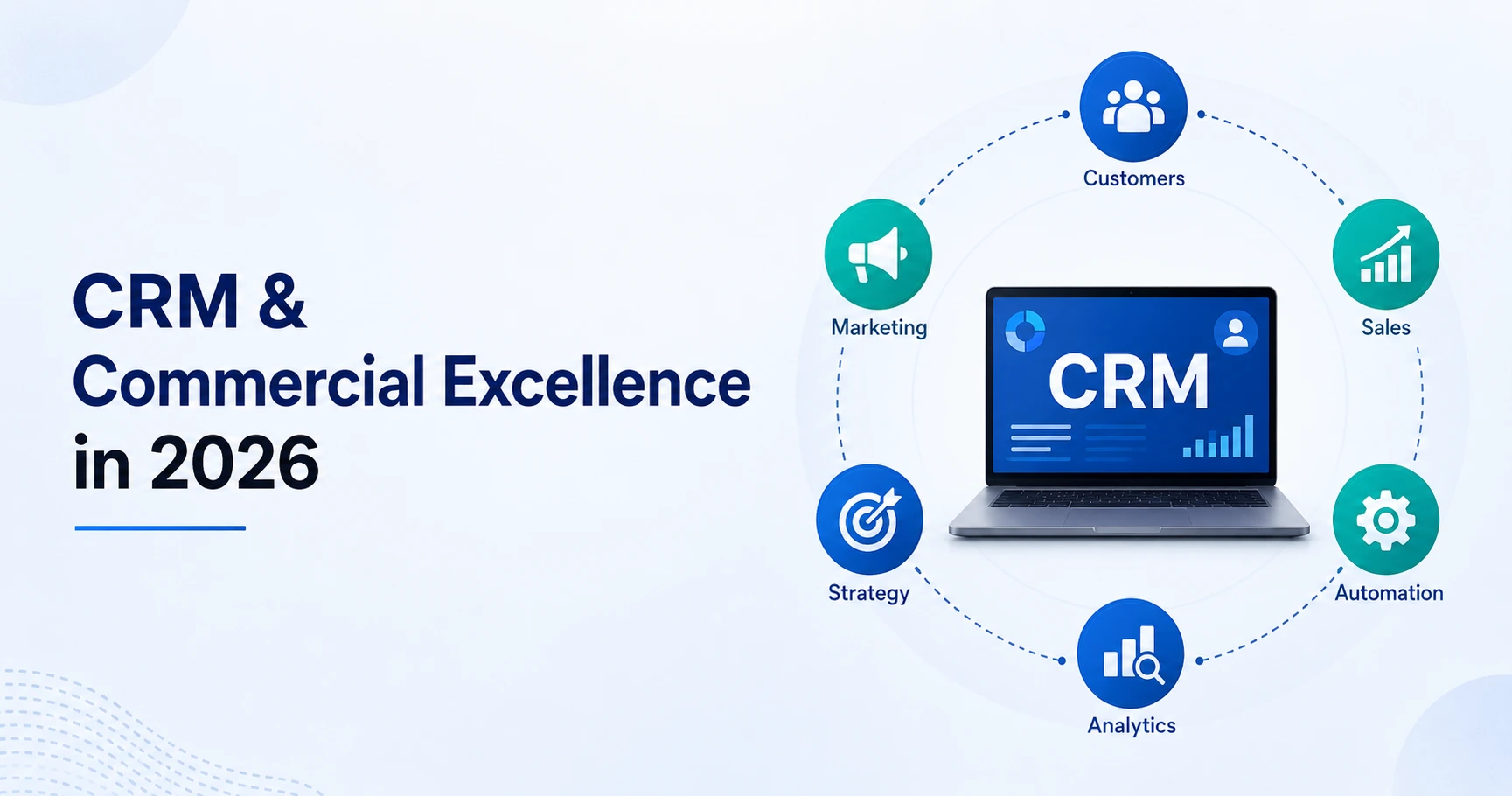
The CRM Commercial Excellence Framework highlights several critical success factors, including commercial strategy development, integrated platform deployment, analytics enablement, automation implementation, and continuous optimization. These elements ensure that CRM becomes embedded within everyday decision-making and operational execution.
So what does this mean for executive leaders? Sustainable CRM success requires cultural transformation alongside technological modernization. Organizations that align teams around common goals consistently outperform those that rely solely on software implementation.
Conclusion
The commercial landscape is shifting faster than many organizations can adapt. Customer expectations continue to rise, data volumes continue to expand, and competitive pressures continue to intensify across every industry.
I believe the companies that act now will gain a significant advantage over those that delay CRM modernization. The future belongs to organizations that treat CRM not as a software platform, but as a strategic capability that connects customer intelligence, commercial execution, automation, and growth.
CRM commercial excellence has become the foundation for sustainable revenue performance, stronger customer relationships, improved forecasting, and enterprise-wide operational efficiency. As AI, predictive analytics, automation, and unified customer data platforms continue to evolve, organizations must position themselves to capitalize on these opportunities.
Businesses that invest in structured CRM transformation today will be better equipped to scale globally, improve customer experiences, and build lasting competitive advantages in 2026 and beyond. At BSS Universal, we help organizations turn this vision into an executable roadmap — feel free to Contact Our CRM Experts to discuss where your organization stands today.
FAQs
What is CRM commercial excellence in a business context?
CRM commercial excellence is a strategic approach that aligns CRM systems, business processes, data, and commercial strategy to improve revenue growth, customer experience, and operational performance.
How does CRM strategy support modern business growth?
A strong CRM strategy enables organizations to improve customer visibility, streamline sales operations, strengthen marketing alignment, and make more informed business decisions.
How does enterprise CRM improve commercial transformation?
Enterprise CRM platforms centralize customer data, automate workflows, improve forecasting, and provide real-time insights that support scalable commercial transformation.
Which industries benefit most from CRM-driven sales excellence?
Industries including SaaS, financial services, healthcare, life sciences, retail, manufacturing, telecommunications, and professional services benefit significantly from CRM commercial excellence initiatives.
What are the main challenges in CRM commercial transformation?
Common challenges include poor data quality, low user adoption, siloed departments, overcomplicated systems, and weak alignment between CRM initiatives and business objectives.