CRM Implementation Guide 2026 for Enterprise Growth
Introduction
I have observed that many organizations invest heavily in CRM technology but fail to achieve the business outcomes they expected. The problem is rarely the software itself. More often, it stems from poor planning, fragmented data, weak user adoption, and a lack of alignment between technology and business strategy.
Industry research suggests organizations generate approximately $8.71 to $9.50 in return for every dollar invested in CRM platforms. Businesses leveraging CRM solutions are also significantly more likely to exceed their sales goals, often achieving revenue increases between 21% and 30%. At the same time, historical implementation failure estimates remain as high as 55%, largely due to poor data quality and inadequate user training. Organizations seeking to maximize CRM ROI can explore CRM & Commercial Excellence Solutions to align implementation efforts with long-term business growth objectives.
As enterprises across the United States, Saudi Arabia, the UAE, and broader MENA region accelerate digital transformation initiatives, CRM implementation has become a strategic business priority rather than a technology project. The organizations achieving the highest returns are treating CRM as a commercial transformation platform that connects customer engagement, sales execution, analytics, and operational decision-making.
The challenge is no longer selecting a CRM platform. The challenge is implementing it successfully. Many enterprises improve implementation outcomes by addressing common CRM implementation challenges, helping teams avoid costly mistakes and accelerate user adoption.
What Is CRM Implementation?
CRM implementation is the structured process of planning, configuring, integrating, deploying, and optimizing a Customer Relationship Management platform to support business objectives, improve customer engagement, automate workflows, and drive revenue growth. Successful CRM implementation extends beyond software deployment by aligning people, processes, data, and technology to create measurable business outcomes and long-term adoption.
Why Organizations Struggle With CRM Implementation
Many enterprises approach CRM implementation as an IT project when it should be viewed as a business transformation initiative. Modern customer expectations demand seamless experiences across sales, marketing, service, and digital channels. However, many organizations continue to operate with disconnected systems, fragmented customer data, and inconsistent workflows.
Data silos remain one of the biggest barriers to CRM success. Customer information is often spread across spreadsheets, legacy databases, ERP platforms, marketing systems, and service applications. Without integration, organizations struggle to create a unified customer view.
Technology complexity creates another challenge. Enterprises frequently customize platforms excessively before establishing core processes. This leads to increased implementation costs, slower adoption, and reduced business value.
User resistance also remains a significant obstacle. Even the most advanced CRM platform can fail when sales, service, and marketing teams view it as an administrative burden rather than a productivity tool. This explains why many organizations continue to experience disappointing outcomes despite investing in leading platforms such as Salesforce, Microsoft Dynamics 365, SAP, Oracle, and ServiceNow.
CRM Strategy Must Come Before CRM Technology
The most successful CRM implementations begin with business objectives rather than software features. CRM serves as an enterprise software platform, customer engagement platform, and commercial operations platform that supports revenue growth and customer lifecycle management. Organizations that clearly understand the distinction between planning and execution often achieve better outcomes through CRM strategy vs CRM implementation, ensuring technology investments remain aligned with commercial goals.
Organizations should first identify operational bottlenecks, customer experience challenges, and commercial performance gaps. Leadership teams must define measurable outcomes such as increased sales productivity, improved customer retention, enhanced forecast accuracy, or reduced administrative effort.
Industry guidance consistently emphasizes the importance of stakeholder alignment across sales, marketing, customer service, IT, and executive leadership. Without shared ownership, implementation projects often lose momentum during deployment.
CRM improves customer engagement by centralizing customer data. CRM enables sales automation through workflow automation and lead management processes. CRM supports omnichannel experiences by connecting customer interactions across channels.
For executive leaders, this means CRM implementation should be treated as a strategic revenue growth initiative rather than a technology procurement exercise.
CRM Migration and Integration Determine Long-Term Success
Data quality frequently determines whether a CRM implementation succeeds or fails. Organizations often underestimate the complexity of CRM migration, assuming data can simply be transferred from one platform to another.
Successful CRM migration begins with data cleansing. Duplicate records, incomplete customer profiles, outdated contacts, and inconsistent formats must be addressed before migration occurs. Clean data improves reporting accuracy, customer insights, and business intelligence capabilities.
CRM integration is equally critical. Modern enterprises operate complex technology ecosystems that include ERP systems, marketing automation platforms, customer service applications, analytics solutions, and financial systems.
CRM integration improves process visibility across departments. ERP integration improves operational alignment between customer-facing and back-office functions. Analytics enables data-driven decisions by transforming customer interactions into actionable insights.
Organizations that establish a unified source of truth gain significant advantages in customer journey management, commercial analytics, and customer lifecycle management. Many enterprises adopt principles from the intelligent CRM transformation guide to create connected CRM ecosystems that improve visibility, integration, and decision-making across departments.
The result is a connected enterprise capable of making faster, more informed decisions while reducing manual work and duplicate data entry.
CRM Deployment and Rollout Require Change Management
Technology deployment is only one phase of implementation. The broader challenge involves ensuring organizational readiness and user engagement.
CRM deployment typically includes user acceptance testing, workflow validation, system configuration reviews, and production launch activities. However, deployment alone does not guarantee adoption.
CRM rollout introduces the platform to business users through training, communication, governance, and support programs. Organizations often benefit from phased rollouts that begin with pilot teams before expanding across departments.
Research indicates CRM platforms can save employees between five and ten hours per week while shortening sales cycles by eight to fourteen days. These benefits are only realized when employees actively use the system.
Role-based training is particularly important. Sales teams require guidance on opportunity management and pipeline management. Service teams need support with customer service management and case workflows. Executives need visibility into dashboards, forecasting, and commercial performance metrics.
For leadership teams, the key takeaway is simple: change management should receive the same level of investment as technology implementation.
CRM Adoption Is the Real Measure of Success
Many organizations celebrate implementation completion while overlooking the most important phase: CRM adoption.
CRM adoption transforms software into a business capability. Without consistent usage, even the most sophisticated CRM platform becomes an expensive database.
Organizations should establish adoption metrics that measure login frequency, opportunity updates, data quality scores, workflow utilization, and reporting usage. Executive sponsorship plays a critical role in reinforcing these behaviors.
Analytical CRM capabilities further strengthen adoption by providing meaningful insights. Organizations can track customer lifetime value, marketing ROI, net new revenue, churn rates, customer retention, and pipeline velocity.
The emergence of AI-powered CRM is accelerating this trend. Industry estimates indicate generative AI capabilities are now integrated into approximately 65% of CRM systems. AI improves forecast accuracy by 30% to 40% while supporting lead prioritization, workflow automation, customer research, and predictive analytics.
Organizations that continuously optimize adoption gain far greater value than those focused solely on deployment milestones.
CRM Implementation in Life Sciences, Healthcare & Pharmaceutical Organizations
Life sciences, healthcare, biotechnology, pharmaceutical, and medical device organizations face unique CRM challenges due to regulatory requirements, complex stakeholder ecosystems, and evolving customer engagement models.
Healthcare providers and pharmaceutical companies require CRM platforms capable of supporting compliance, customer engagement, commercial excellence, and omnichannel communication. Customer interactions often span healthcare professionals, patients, payers, distributors, and regulatory stakeholders.
CRM platforms help these organizations improve customer experience while maintaining governance and data integrity. Customer analytics enables better engagement strategies, while AI-powered CRM supports predictive insights and commercial planning.
Commercial excellence initiatives benefit significantly from CRM adoption through territory management, key account planning, incentive compensation management, and forecasting capabilities.
For organizations operating in highly regulated industries, CRM implementation must balance innovation with governance, security, compliance, and auditability.
The Future of CRM Implementation
CRM is evolving from a traditional business application into an intelligent customer engagement ecosystem.
Generative AI is transforming how organizations interact with customers and manage internal workflows. Companies such as Crexi have leveraged AI within Salesforce to automate customer research, call summaries, and email creation, reportedly saving sales representatives approximately five hours daily. Staffing organization Wonolo has used AI-assisted customer service capabilities to reduce average handling times by 20%.
Future CRM platforms will increasingly combine customer data, predictive analytics, machine learning, workflow automation, and Customer 360 capabilities into unified environments.
Cloud adoption will continue expanding, with industry estimates indicating that approximately 87% of CRM platforms are now cloud-based. Mobile CRM capabilities are also becoming essential, with around 70% of organizations leveraging mobile access to improve field productivity.
The next generation of CRM implementation will focus on intelligent automation, predictive customer insights, and AI-driven commercial decision-making rather than simple contact management.
Frequently Asked Questions
What is CRM implementation?
CRM implementation is the process of configuring, customizing, integrating, deploying, and optimizing a CRM platform to support business objectives, improve customer engagement, and drive operational efficiency.
Why is CRM implementation important?
CRM implementation enables organizations to centralize customer data, automate workflows, improve collaboration, and generate actionable insights that support revenue growth and customer retention.
What are the key stages of CRM implementation?
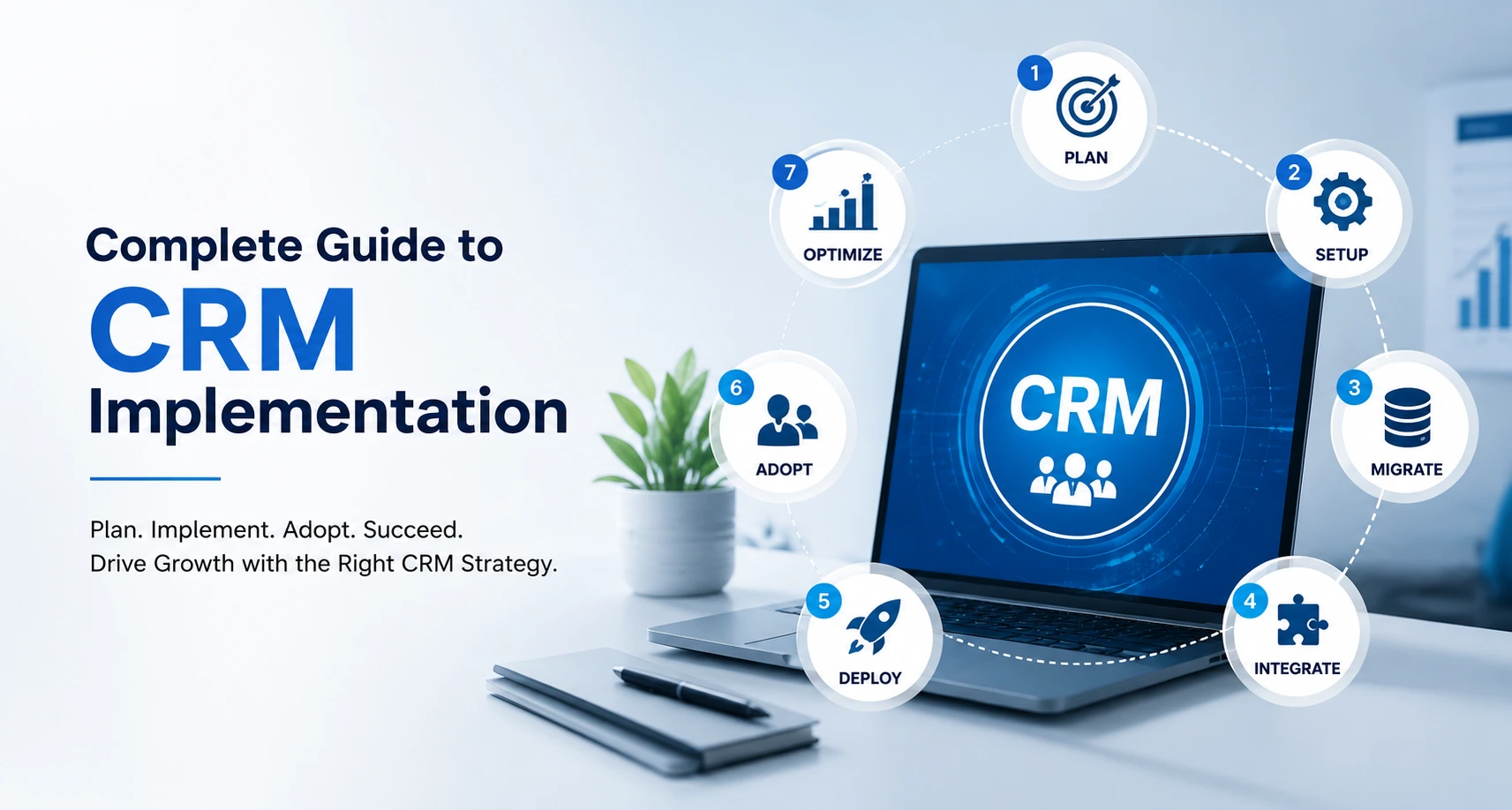
The primary stages include planning, CRM setup, CRM migration, CRM integration, CRM deployment, CRM rollout, and ongoing CRM adoption and optimization.
How long does CRM implementation take?
Implementation timelines vary depending on business complexity, customization requirements, integration needs, and organizational readiness. Enterprise projects typically require several months.
What causes CRM implementations to fail?
Common causes include poor data quality, inadequate training, unclear business objectives, weak executive sponsorship, and low user adoption.
What is CRM migration?
CRM migration involves transferring customer, sales, service, and historical business data from legacy systems into a new CRM platform while maintaining data quality and integrity.
Why is CRM integration important?
CRM integration creates a unified source of truth by connecting customer data across ERP, marketing, finance, analytics, and service systems.
How does AI improve CRM performance?
AI enhances lead prioritization, forecasting, customer insights, predictive analytics, workflow automation, and customer engagement capabilities.
Which industries benefit most from CRM implementation?
Life sciences, healthcare, pharmaceuticals, biotechnology, financial services, manufacturing, retail, telecommunications, and technology organizations all benefit significantly from CRM implementation.
How can organizations improve CRM adoption?
Organizations can improve adoption through executive sponsorship, role-based training, simplified workflows, ongoing support, and measurable performance tracking.
Conclusion
The CRM landscape is evolving faster than ever. Organizations are no longer implementing CRM systems simply to manage contacts or track opportunities. They are building intelligent customer engagement platforms that support commercial excellence, revenue growth, customer retention, predictive analytics, and enterprise-wide digital transformation. For a broader perspective on how CRM supports enterprise growth and operational excellence, organizations can explore the complete guide to CRM commercial excellence.
The organizations that succeed in 2026 will recognize that CRM implementation is not a software deployment project. It is a strategic business initiative that connects people, processes, data, and technology around a shared vision of customer value creation.
As AI, automation, analytics, and Customer 360 strategies become increasingly central to enterprise growth, the gap between organizations with successful CRM adoption and those without it will continue to widen.
Learn how BSS Universal helps organizations accelerate CRM transformation, commercial excellence, analytics, and AI-driven growth through strategic implementation, integration, adoption, and optimization services, or Contact Our CRM Experts to get started.