Pharmaceutical Digital Transformation in the GCC
The pharmaceutical industry across the Gulf Cooperation Council (GCC) is facing a growing technology challenge: companies need better visibility across commercial operations, enterprise data, distribution networks and business systems while managing increasingly complex digital environments.
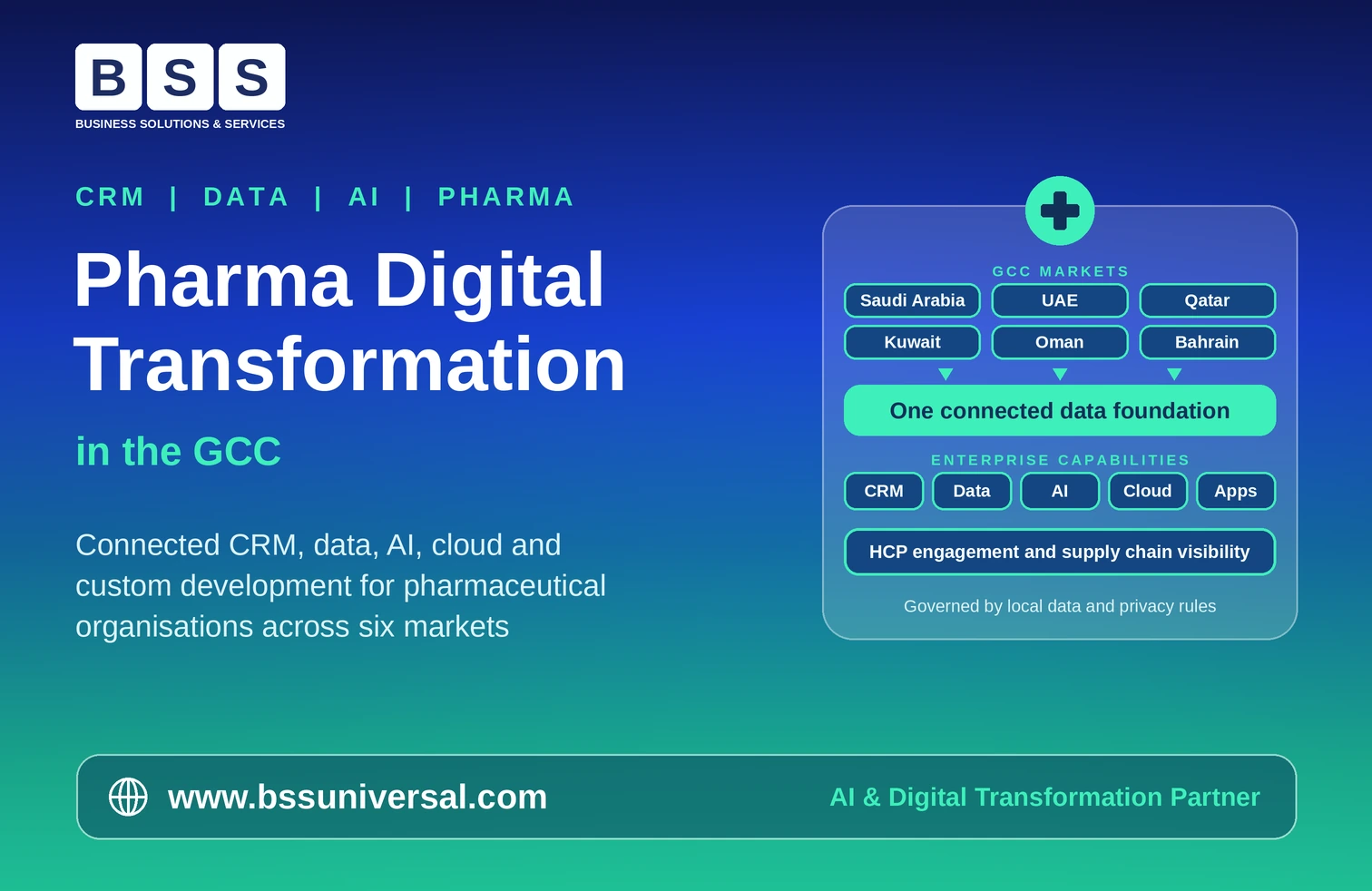
For pharmaceutical organisations operating across Saudi Arabia, the United Arab Emirates (UAE), Qatar, Kuwait, Oman and Bahrain, digital transformation is no longer simply about introducing new software. It requires connecting existing systems, improving data quality, strengthening operational visibility and building technology foundations that support informed business decisions.
The challenge is particularly important for pharmaceutical companies managing multiple markets, distributors, healthcare professional (HCP) relationships, product portfolios and supply chain partners.
Pharmaceutical digital transformation in the GCC requires a connected enterprise approach. Customer relationship management (CRM), data engineering, artificial intelligence (AI), cloud architecture and custom development must work together rather than operate as separate technology investments.
Understanding where these systems create value is the first step towards a practical transformation strategy.
Why Pharmaceutical Companies in the GCC Need Digital Transformation
The six GCC markets share regional economic and healthcare priorities, but pharmaceutical companies cannot assume that their business processes, regulatory environments and technology requirements are identical.
Saudi Arabia's healthcare transformation priorities include national health IT infrastructure, information exchange standards, digital technologies and improved coordination between healthcare providers. The UAE has also established dedicated digital health frameworks and pharmaceutical traceability infrastructure.
These developments create a more demanding technology environment for pharmaceutical manufacturers, distributors and regional commercial organisations.
Several business pressures make digital transformation particularly relevant.
Expanding commercial operations: Pharmaceutical companies need consistent information about healthcare professionals, customer interactions, field activities and commercial performance across different markets.
Fragmented enterprise systems: CRM platforms, ERP applications, reporting systems and distribution databases frequently operate independently, limiting enterprise-wide visibility.
Increasing data requirements: Business leaders need reliable information to evaluate sales performance, product availability, market opportunities and operational risks.
Digital supply chain expectations: Pharmaceutical distribution requires accurate product information, traceability and timely communication between supply chain participants.
Technology modernisation: Legacy applications and disconnected infrastructure can make integration, analytics and enterprise automation more difficult.
The opportunity is not to replace every existing application. It is to create a connected technology environment in which business-critical systems exchange reliable information.
7 Major Pharmaceutical Digital Transformation Challenges in the GCC
Understanding the underlying problems helps organisations prioritise investments instead of purchasing technology without a clear business objective.
1. Fragmented Pharmaceutical Data Across Enterprise Systems
Pharmaceutical businesses generate information through multiple operational systems.
For example, commercial teams may use Salesforce CRM, finance departments may rely on ERP platforms, and management teams may receive reports from separate business intelligence applications.
When these systems do not communicate effectively, organisations experience:
- Duplicate customer and business records.
- Inconsistent product and account information.
- Manual reporting and reconciliation.
- Delayed management insights.
- Limited visibility across departments.
The problem becomes more complicated when regional business units use different applications and data structures.
What businesses should consider
Establish a unified enterprise data architecture that connects important systems through appropriate integration methods.
This includes data engineering, master data management, data quality controls and consistent reporting structures.
The objective is to provide business teams with reliable information without unnecessarily replacing working enterprise applications.
2. Inefficient CRM and Pharmaceutical Commercial Operations
Pharmaceutical commercial teams need more than a database of healthcare professionals.
They require structured visibility into HCP profiles, field activities, engagement history, campaign performance and customer interactions.
Without a properly configured CRM environment, organisations may struggle with:
- Inconsistent HCP records.
- Limited visibility into field force activities.
- Inefficient territory and account planning.
- Disconnected digital and field engagement.
- Difficulties measuring campaign effectiveness.
- Incomplete commercial performance reporting.
These problems affect commercial decision-making and make it harder for leadership to understand how effectively teams engage their target audiences.
What businesses should consider
A modern pharmaceutical CRM strategy should connect customer information, sales workflows, digital engagement and analytics.
Platforms such as Salesforce can help establish consolidated HCP profiles, structured field workflows, account segmentation and more consistent commercial reporting.
CRM should function as part of the wider enterprise technology ecosystem rather than as an isolated sales application.
3. Limited Pharmaceutical Supply Chain Visibility
Pharmaceutical supply chains involve manufacturers, importers, distributors, warehouses, pharmacies and healthcare providers.
Each participant generates information about products, movements, inventory and transactions.
When information remains distributed across different systems, companies may find it difficult to understand product availability, identify operational exceptions or respond quickly to supply chain disruptions.
The GCC also has country-specific pharmaceutical traceability requirements.
For example, Saudi Arabia's Food and Drug Authority operates the Drug Track and Trace System (RSD), which tracks human pharmaceutical products from manufacturing or import through distribution and consumption.
The UAE uses Tatmeen, a national pharmaceutical tracking platform based on GS1 serialization standards.
These initiatives demonstrate why accurate product identification and system integration matter.
What businesses should consider
Evaluate how existing enterprise applications exchange product, inventory and transaction information.
Where applicable, integration architecture should support reliable data exchange with relevant traceability platforms and authorised supply chain systems.
Data dashboards can also improve management visibility into stock information, distribution performance and operational exceptions.
Technology integration does not replace regulatory responsibilities or physical supply chain controls.
4. Limited Use of AI and Business Intelligence
Many pharmaceutical organisations collect substantial amounts of commercial and operational data but still depend on manual processes to interpret it.
For example, management teams may spend considerable time preparing sales reports, identifying performance variations and consolidating information from different departments.
AI and advanced analytics can help address these limitations.
Relevant enterprise applications include:
- Commercial performance analysis.
- Sales forecasting support.
- Customer engagement insights.
- Automated business reporting.
- Identification of unusual data patterns.
- Internal knowledge retrieval.
- Workflow automation.
However, introducing AI without reliable data creates additional problems.
Incorrect information can produce misleading recommendations, while uncontrolled AI automation can introduce security and accountability risks.
What businesses should consider
Start with clearly defined business use cases, reliable data sources and measurable outcomes.
AI systems should operate within approved permissions, defined workflows and human oversight, particularly where decisions carry commercial, legal or regulatory consequences.
5. Legacy Technology and Enterprise Integration Problems
Many pharmaceutical organisations operate technology environments developed over several years.
These may include older CRM applications, customised databases, disconnected reporting tools and infrastructure that cannot easily support modern integrations.
Replacing everything at once can introduce unnecessary cost, disruption and implementation risk.
The more practical approach is to identify which systems should be modernised, which should remain and where integration can solve existing problems.
API-based integration, application modernisation and custom development can connect business-critical applications while protecting essential existing workflows.
What businesses should consider
Review the current application landscape before selecting new technology.
Prioritise systems that create operational bottlenecks, duplicate information or prevent departments from accessing reliable business data.
6. Data Security, Privacy and Governance
Pharmaceutical organisations may process sensitive commercial information, employee records, HCP information and, depending on their operations, personal or health-related data.
These information categories require appropriate access controls and governance.
The UAE has Federal Law No. 2 of 2019 concerning ICT in health fields, which addresses the security and use of health information.
Saudi Arabia also maintains a Personal Data Protection Law and associated requirements governing personal data processing and transfers outside the Kingdom.
Companies operating across multiple GCC countries should not assume that one data protection model automatically satisfies every local requirement.
What businesses should consider
A strong enterprise data governance framework should address:
- Data ownership and classification.
- Role-based access controls.
- Data encryption and security.
- Audit trails and monitoring.
- Data quality and retention.
- Secure system integration.
- Cross-border data transfer requirements.
- Responsible AI governance.
Cloud and data architecture decisions should be reviewed against the organisation's applicable legal, contractual and security obligations.
7. Poor Coordination Between Commercial and Technology Teams
Digital transformation can struggle when business departments and IT teams work towards different priorities.
For example, commercial teams may request better customer insights, while IT focuses on infrastructure maintenance and existing system requirements.
Without a shared business roadmap, technology projects can become disconnected investments.
What businesses should consider
CIOs and commercial leaders should jointly identify business problems, agree on measurable outcomes and establish implementation priorities.
Every technology initiative should have a clear relationship with operational efficiency, commercial performance, data quality or enterprise scalability.
Technologies Driving Pharmaceutical Digital Transformation
An effective pharmaceutical digital transformation strategy combines several connected technology capabilities.
TechnologyPharmaceutical Business ApplicationBusiness ValueEnterprise CRMHCP profiles, field force workflows and commercial engagementBetter commercial visibilityData EngineeringIntegration of CRM, ERP and business dataTrusted enterprise informationAI and AgenticsBusiness insights, intelligent assistance and workflow automationFaster decision-makingCloud ComputingModern application infrastructure and scalable platformsFlexibility and operational controlCustom DevelopmentEnterprise application extensions and API integrationReduced system fragmentationBusiness IntelligenceDashboards, performance tracking and analyticsImproved management visibility
These technologies should be selected according to business requirements rather than implemented simply because they are emerging trends.
How AI Is Changing Pharmaceutical Business Operations
AI is increasingly relevant to the way pharmaceutical businesses organise information and execute commercial workflows.
However, its strongest starting point for many enterprise technology programmes is not complex autonomous decision-making. It is improving existing business processes.
Consider a pharmaceutical organisation operating across several GCC markets.
Its commercial leadership may need to review sales performance, identify engagement gaps, compare regional activity and prepare management reports.
Traditionally, this may require teams to collect information from several platforms and consolidate it manually.
An integrated AI environment can help retrieve approved business information, summarise performance, identify patterns and recommend follow-up actions.
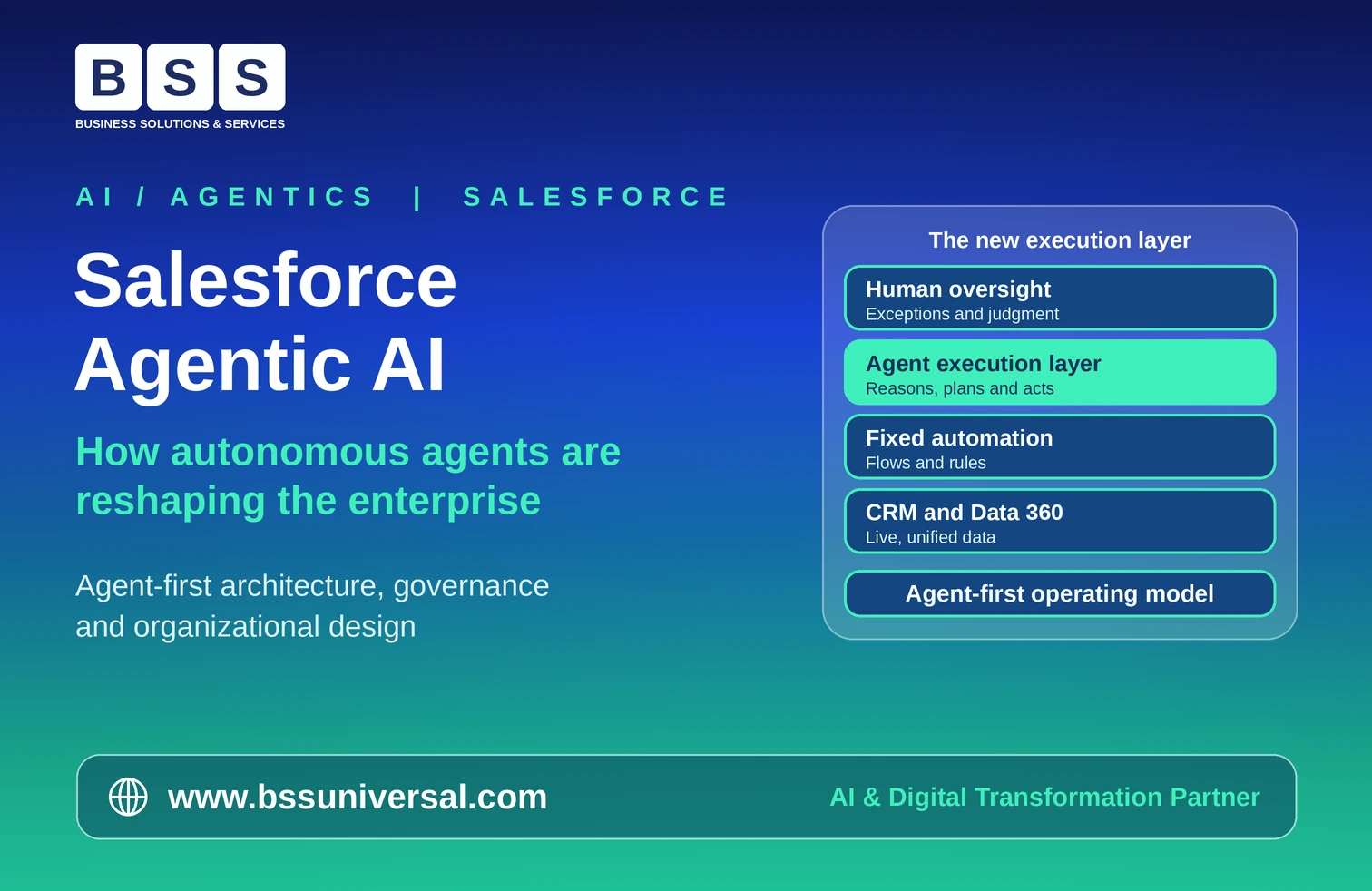
Agentic AI can also support defined multi-step workflows, provided that permissions, approval requirements and human oversight are established.
Three practical areas deserve attention:
Commercial intelligence: Use trusted CRM and sales data to support account analysis, segmentation and commercial planning.
Operational automation: Reduce repetitive work through controlled workflow automation, information processing and reporting.
Enterprise knowledge access: Connect AI assistants to approved business information so employees can retrieve relevant internal knowledge more efficiently.
The foundation remains the same: reliable data, appropriate security and clearly defined accountability.
Building a Pharmaceutical Digital Transformation Roadmap
Digital transformation should be implemented as a structured enterprise programme rather than a collection of unrelated technology projects.
A practical roadmap can follow five stages.
Stage 1: Assess Existing Systems and Business Requirements
Begin by reviewing existing CRM, ERP, data platforms, cloud infrastructure and reporting applications.
Identify duplicated systems, disconnected workflows, data quality problems and important integration requirements.
Interview commercial, IT, data and operational leaders to understand their priorities.
Stage 2: Prioritise High-Value Transformation Opportunities
Not every technology problem deserves immediate investment.
Prioritise opportunities based on:
- Business impact.
- Operational complexity.
- Technical feasibility.
- Implementation cost.
- Data availability.
- Security and governance requirements.
For example, improving HCP data visibility may provide a clearer initial business case than attempting enterprise-wide AI automation.
Stage 3: Establish the Data and Integration Foundation
Connect relevant applications through a structured data architecture.
Define data ownership, integration standards, access permissions and data quality requirements.
This stage is essential because analytics and AI depend on information that can be trusted.
Stage 4: Implement and Integrate Enterprise Technologies
Modernise the selected CRM, data, cloud and application environments.
Introduce analytics and AI capabilities where the supporting infrastructure and business processes are ready.
Test integrations, validate information flows and involve end users throughout implementation.
Stage 5: Measure Performance and Optimise Continuously
Monitor whether transformation investments are producing meaningful results.
Relevant KPIs include:
- CRM adoption and data completeness.
- HCP engagement effectiveness.
- Reporting preparation time.
- Data integration reliability.
- Workflow processing time.
- Cloud operational performance.
- AI adoption and productivity improvements.
Continuous optimisation helps technology investments remain aligned with changing business priorities.
How BSS Supports Pharmaceutical Digital Transformation in the GCC
Pharmaceutical organisations need technology partners capable of connecting business requirements with enterprise technology implementation.
BSS works with Life Sciences, Pharma and Healthcare organisations to modernise digital operations through connected CRM, data, AI, cloud and custom development capabilities.
Rather than treating these services as separate projects, BSS connects them around enterprise business priorities.
CRM and Commercial Excellence Solutions
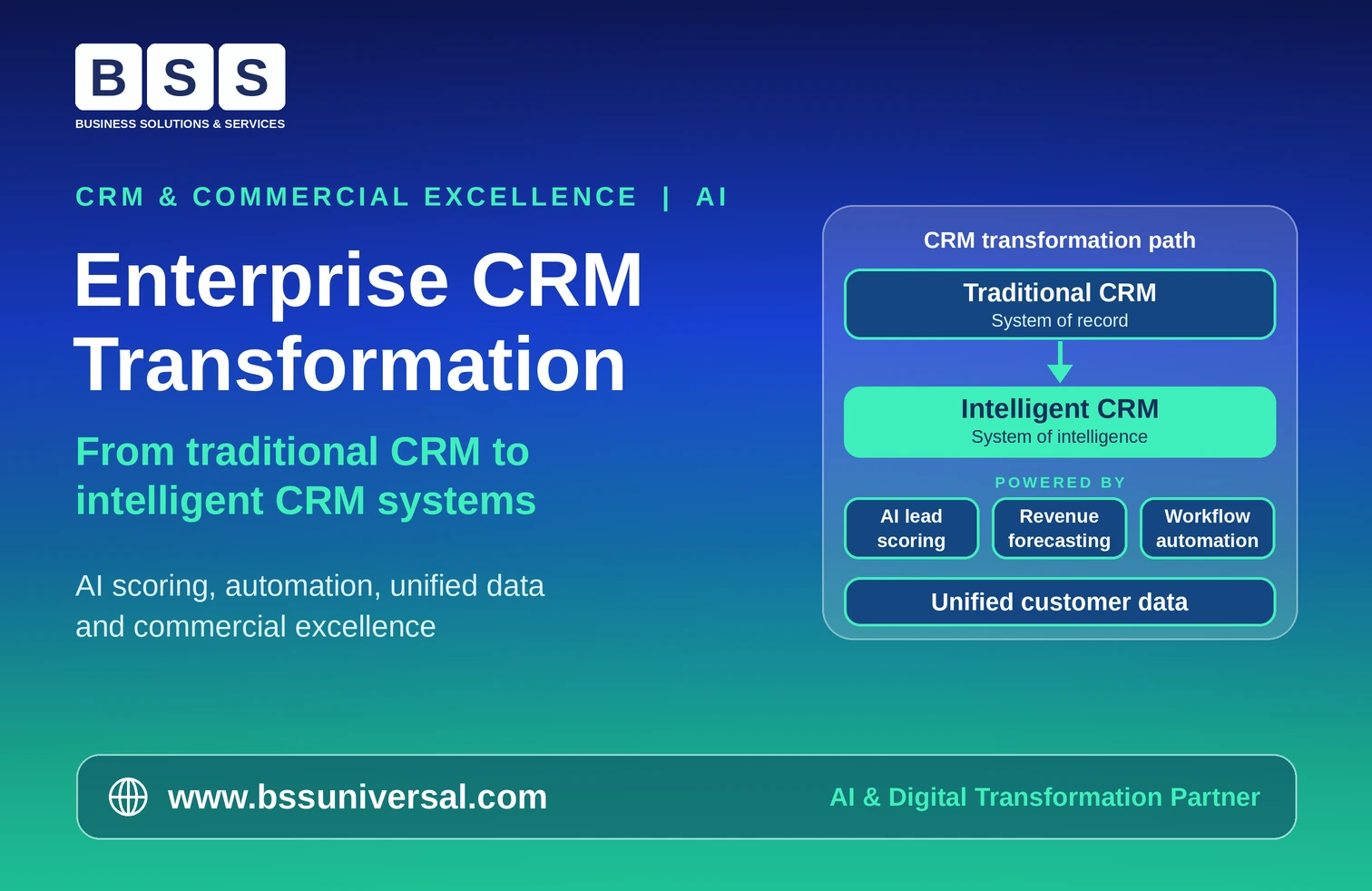
BSS supports enterprise CRM transformation through customer engagement, commercial workflows, sales automation, analytics and system integration.
For pharmaceutical organisations, these capabilities can help improve HCP visibility, field execution and commercial performance management.
Data Engineering and Analytics
Disconnected enterprise information makes reliable decision-making difficult.
BSS provides data engineering, integration, modern data platforms, business intelligence and data governance capabilities to help organisations establish more reliable information foundations.
AI and Agentics
BSS supports enterprise AI adoption through AI strategy, GenAI, copilots, agentic AI and intelligent workflow automation.
These capabilities can help pharmaceutical business teams improve information access, automate appropriate workflows and embed intelligence into existing enterprise applications.
Cloud Architecture and Modernisation
Modern enterprise applications need infrastructure that can support scalability, security and operational control.
BSS provides cloud architecture, application modernisation, cloud-native engineering and cloud governance capabilities.
Custom Development and Enterprise Integration
Not every business requirement can be addressed through standard platform configuration.
BSS provides custom application development, platform extensions and integration-first architecture to connect legacy and modern enterprise systems.
Relevant Pharmaceutical Experience
BSS has published a pharmaceutical commercial transformation case study titled Enhanced Primary Care Effectiveness.
The organisation in the case study experienced fragmented HCP engagement information, limited channel visibility and inefficient field prioritisation.
The implemented solution connected Salesforce Sales Cloud, Salesforce Data Cloud and Agentforce capabilities.
BSS reports the following outcomes:
- 15% improvement in primary care HCP engagement effectiveness.
- 12% increase in prescription volume across targeted segments.
- 20% improvement in call quality and coverage consistency.
These results demonstrate the potential business value of connecting CRM, data and AI capabilities within pharmaceutical commercial operations. They should be viewed as outcomes from this particular published case, not as guaranteed results for every implementation.
Building a Connected Digital Future for GCC Pharmaceuticals
Pharmaceutical digital transformation across the GCC requires more than individual technology upgrades.
Organisations need connected systems, trusted data, modern enterprise infrastructure and intelligent business workflows that support their regional operations.
For CIOs, CTOs and digital transformation leaders, the priority should be to understand existing technology limitations, identify high-value opportunities and establish a roadmap that connects business objectives with practical implementation.
The most successful transformation programmes will be those that combine technology, governance and business execution rather than treating them as independent initiatives.
BSS brings together CRM and Commercial Excellence, Data Engineering and Analytics, AI and Agentics, Cloud and Custom Development to support enterprise technology transformation.
Discuss your pharmaceutical digital transformation requirements with BSS and explore an enterprise roadmap aligned with your business objectives.
Frequently Asked Questions
1. What is pharmaceutical digital transformation in the GCC?
It refers to integrating technologies such as CRM, AI, cloud computing, data analytics and enterprise applications into pharmaceutical business operations across Saudi Arabia, the UAE, Qatar, Kuwait, Oman and Bahrain. The objective is to improve data visibility, commercial execution, operational efficiency and enterprise decision-making.
2. What are the biggest pharmaceutical digital transformation challenges in the GCC?
Major challenges include fragmented enterprise data, legacy applications, disconnected CRM and ERP systems, limited supply chain visibility, data security requirements, inefficient commercial workflows and difficulties integrating technology across multiple countries.
3. How is AI used in the pharmaceutical industry?
AI can support commercial analytics, sales forecasting, business reporting, information retrieval and workflow automation. Enterprise AI systems can also assist employees with routine tasks and provide recommendations based on approved business information.
4. Why is data integration important for pharmaceutical companies?
Data integration connects information from different enterprise applications, including CRM, ERP and reporting systems. It helps reduce duplicate information, improve data consistency and provide management teams with a more reliable view of business performance.
5. What is the role of CRM in pharmaceutical digital transformation?
CRM platforms help pharmaceutical organisations manage HCP information, commercial interactions, field force workflows, customer engagement and sales performance. Integrated CRM environments also provide better visibility into commercial activities across different teams and markets.
6. How do Saudi Arabia and the UAE support pharmaceutical digitalisation?
Saudi Arabia operates the SFDA Drug Track and Trace System (RSD), while the UAE uses the Tatmeen pharmaceutical traceability platform. Both initiatives demonstrate the importance of digital product identification, supply chain visibility and connected information systems.
7. How can pharmaceutical companies improve digital transformation across multiple GCC countries?
They should establish a common enterprise technology architecture while accounting for country-specific business processes, regulatory requirements, data governance and integration needs. A phased approach helps organisations maintain consistency without overlooking local requirements.
8. How can BSS support pharmaceutical digital transformation?
BSS supports enterprise transformation through CRM and Commercial Excellence, Data Engineering and Analytics, AI and Agentics, Cloud Architecture and Custom Development. These capabilities help organisations connect business systems, improve data foundations and modernise enterprise workflows.
Ready to assess your pharmaceutical technology environment? Discuss your transformation priorities with BSS.