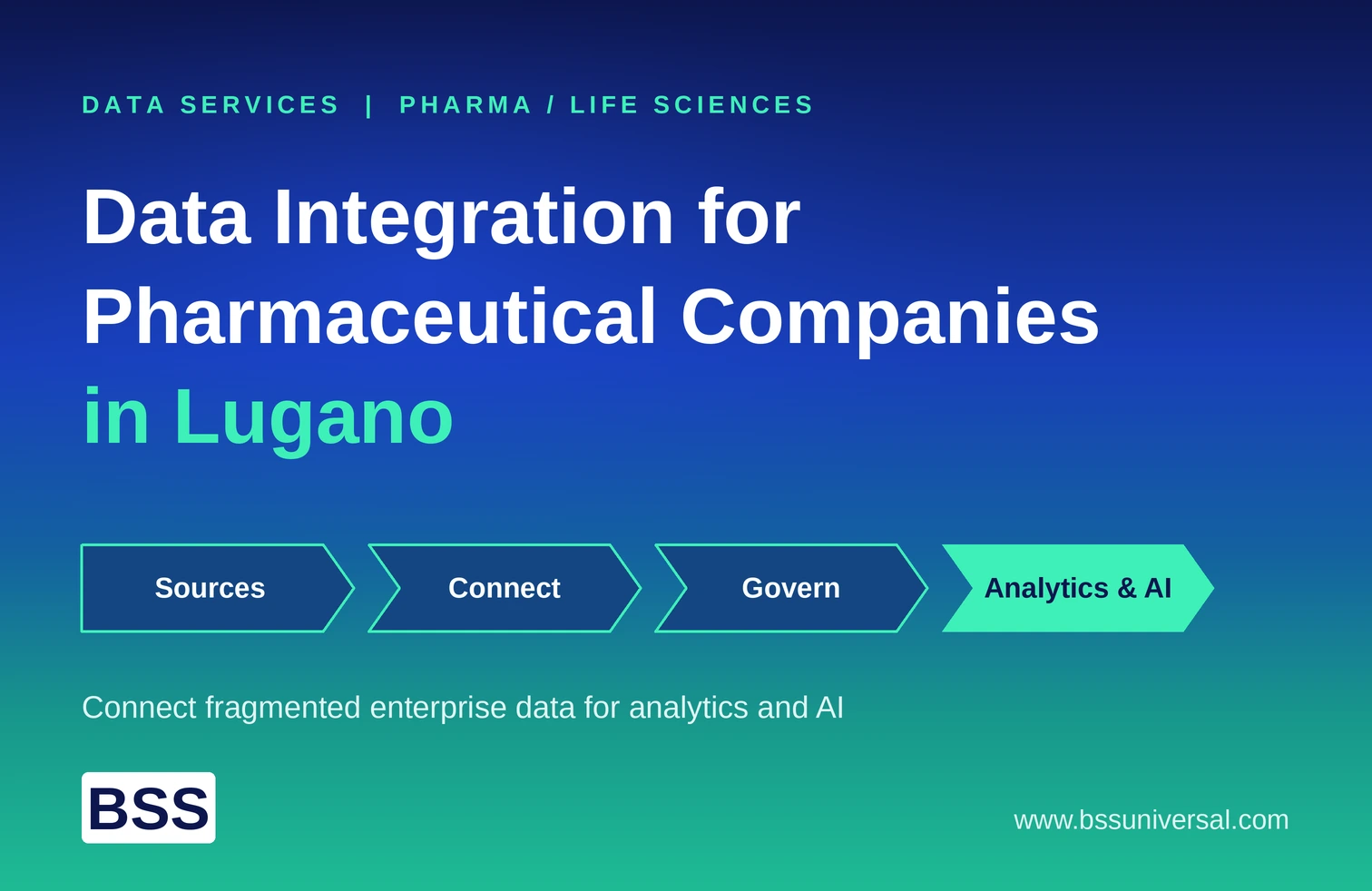
Data Integration for Pharmaceutical Companies in Lugano
Data integration for pharmaceutical companies means connecting the systems that hold quality, manufacturing, clinical, regulatory, supply, and commercial data, so teams work from one governed view. For pharma and life sciences teams in Lugano and Ticino, the hard part is rarely a lack of data. It is that the data sits in ERP, MES, LIMS, quality, and research tools that do not agree with each other. BSS Universal's Data Services practice helps pharma organizations [connect fragmented enterprise data for analytics and AI](INTERNAL LINK: Connect fragmented enterprise data for analytics and AI) by designing the integration layer, the governance, and the access rules together, not only moving data from A to B.
This guide focuses on the integration challenges pharma teams face, how Denodo's logical data management approach addresses them, and how to run a phased, validation-aware program.
What Data Integration Means for Pharma Companies
Pharma data integration is the practice of making data from many source systems available, consistent, and traceable for operations, compliance, analytics, and AI. It can work by copying data into a central store, by connecting to data where it lives, or by combining both. The right mix depends on the use case, so teams should treat it as an architecture choice, not a product choice.
Common integration targets in pharma:
- Manufacturing and quality: ERP, MES, LIMS, quality management, and batch records
- Research and development: Electronic lab notebooks, omics datasets, and clinical systems
- Regulatory and safety: Submission, pharmacovigilance, and document systems
- Supply chain: Planning, warehouse, and cold-chain monitoring tools
- Commercial: CRM, sales, and market data
Why Lugano Pharma Teams Are Rethinking Data Integration
Lugano pharma teams are rethinking data integration because their data estate has grown across sites, partners, and tools, while inspection and AI expectations keep rising. Lugano sits in Italian-speaking Ticino and hosts manufacturers, biotech start-ups, and specialist technology firms. Many teams work across Italian, German, French, and English, and across Swiss and EU rules.
Three pressures stand out:
- Data silos: Each system answers its own question, but no one view links a batch, a deviation, a supplier, and a customer order.
- Inspection readiness: Inspectors expect traceable, complete records, and manual reconciliation between systems creates gaps.
- AI readiness: AI models and agents give poor answers when they reason over inconsistent or ungoverned data.
The Main Integration Challenges in Pharma and How to Solve Them
The main integration challenges in pharma are siloed systems, data integrity, inconsistent master data, timing, security, and AI readiness. Each has a known design response. The sections below name the challenge first, then the fix.
Siloed Systems and Point-to-Point Connections
Point-to-point links between systems multiply fast, and each one needs its own testing and maintenance. A shared integration layer replaces many custom links with one governed access point. Data consumers then query a common model instead of learning each source.
Data Integrity and ALCOA+ Expectations
Data integrity rules expect records to be attributable, legible, contemporaneous, original, and accurate, with additional principles that extend to complete, consistent, enduring, and available (ALCOA+). Every extra copy of a record is another place where it can drift. Reading data from the system of record, instead of copying it repeatedly, helps keep one authoritative version.
Inconsistent Master Data and Definitions
Different systems name the same material, site, supplier, or product in different ways. Integration fails quietly when these identifiers do not match. Fix this with agreed definitions, named data owners, and mapping rules before building any pipeline.
Timing: Real-Time Access Versus Batch Loads
Some questions need current data, such as batch status or stock position. Others need history, such as trend analysis over years. Use live access for the first group and scheduled loads for the second.
Security, Privacy, and Access Control
Pharma data includes confidential formulas, quality records, and personal data. Access should follow roles, and sensitive fields should be masked for users who do not need them. A single integration layer gives one place to apply and audit these rules.
AI Readiness
AI assistants and agents need current, governed, and well-described data. Denodo has described AI features such as retrieval-augmented generation support and an open-source AI SDK for building agents on governed data. Teams should confirm current features and licensing with Denodo before planning around them.
Logical Versus Physical Integration: Choosing the Right Approach
Logical integration connects to data in place and presents it through a virtual layer, while physical integration copies data into a central store such as a warehouse or lakehouse. Denodo describes data virtualization as combining data from disparate sources and formats without replicating it. Most pharma architectures need both.
Choose logical integration when:
- Teams need a current view across several systems
- Data must stay in its source for ownership or sovereignty reasons
- New use cases need to launch without a long build
Choose physical integration when:
- Workloads need heavy transformation or very large historical scans
- Source systems cannot take extra query load
- A stable, curated dataset serves many repeated reports
A mixed design lets each pattern do what it does best. Analysts at TDWI have said that organizations will use both logical and physical architectures, and Denodo positions its platform to support both.
A Reference Architecture for Pharma Data Integration
A pharma integration architecture built on Denodo has five layers, each with one clear job. This keeps the design easy to explain to quality, IT, and business leaders.
- Sources: ERP, MES, LIMS, quality, clinical, regulatory, and commercial systems stay as systems of record
- Connection layer: Denodo connects to each source and exposes its data as views
- Semantic layer: Business-friendly models define terms such as batch, material, and site once
- Security and governance: Role-based access, masking, lineage, and audit logs apply in one place
- Consumers: Reports, analytics tools, applications, and AI agents read from the governed layer
How BSS Universal's Team Handles This
BSS Universal's Data Engineering and Integration team begins by mapping the systems that hold regulated data and who owns each one. The team agrees on shared definitions with business owners, then builds a small first set of governed data views for one high-value use case. Access rules and lineage are designed with the data model, not added later. Test evidence is kept for each release, and progress is reported in plain language, so quality, IT, and business leaders can agree on the next step.
Compliance, Validation, and Privacy in Switzerland
Compliance for a pharma integration program means showing that data stays accurate, controlled, and traceable across systems. An integration layer does not remove the duties of the system owner. The pharma company remains responsible for how its own solution is configured, validated, and used, and should confirm requirements with its quality, compliance, and legal teams.
Key areas to cover:
- GxP and computerized system validation: Risk-based testing, change control, and documented evidence, using approaches such as GAMP 5
- Electronic records rules: EU GMP Annex 11 and 21 CFR Part 11 affect audit trails and access
- Data integrity: ALCOA+ expectations apply to integrated data as much as to source records
- Data protection: The revised Swiss Federal Act on Data Protection (FADP) governs personal data. Teams working with EU data may also need to meet GDPR duties.
- Data location: Decide where data may sit and what may cross borders
- Security: ISO 27001 is a recognized standard for information security management. BSS Universal's delivery is ISO 27001 certified.
- AI oversight: Define human review points before AI agents use integrated data
This article is general information and not legal advice.
A Phased Approach to Pharma Data Integration
A phased program lowers risk, because each step produces a result that business owners can review. BSS Universal approaches pharma data integration in these steps:
- Governance and sponsorship: Name an executive sponsor and data owners, and agree on goals and a small first release
- Source and challenge audit: List systems, interfaces, data quality issues, and the manual work that integration should remove
- Architecture and security design: Choose logical, physical, or mixed patterns for each use case, and design access and audit rules
- Semantic model and first views: Build shared definitions and connect the first sources
- Testing and validation: Test with real users and produce evidence where regulated data is involved
- Phased rollout: Add sources and consumers by use case or site
- Operations and improvement: Monitor performance, review access, and keep an enhancement backlog
What a Pharma Data Integration Program Costs
The cost of a pharma data integration program depends on the number of source systems, data quality, security needs, validation scope, and the platform licensing model. A single-use-case release costs far less than an enterprise rollout. Budget should cover more than software.
Main cost drivers:
- Platform licences and infrastructure: Confirm current licensing with Denodo
- Source connections and interfaces
- Data cleansing and mapping: Often a large share of effort
- Security and governance design
- Validation and documentation
- Training and support: Including Italian, German, and English materials
Fund discovery first, then a focused release, and expand once users adopt it.
How to Choose a Data Integration Partner in Lugano
The right partner combines pharma knowledge, integration skills, and a clear delivery method. Buyers should test how a partner handles validation, data quality, and adoption, not only how it demos tools.
Evaluate partners on these points:
- Pharma experience: Does the team understand GxP, data integrity, and audit evidence?
- Platform credentials: Can the partner show current Denodo skills and project examples?
- Architecture judgment: Will the partner recommend logical, physical, or mixed designs honestly?
- Governance method: Are access control, lineage, and AI oversight part of the standard approach?
- Security credentials: Does the partner hold certifications such as ISO 27001?
- Language and local support: How will Italian, German, and English needs and working hours be handled?
- Support after go-live: Is there a managed service or a clear handover model?
BSS Universal serves clients across the US, MENA, and GCC regions from offices in Arlington Heights, Riyadh, and Dubai, with a delivery center in Lahore. Lugano buyers should ask any partner, including BSS Universal, how local engagement and language support will work for their program.
Common Risks and How to Avoid Them
The most common risks are unclear ownership, weak data, and tool-first thinking. Each is avoidable with early planning.
- Tool before problem: Name the integration challenge first, then pick the pattern.
- No data owners: Unowned data creates disputes. Assign an owner to every domain.
- Skipping master data: Mismatched identifiers break joins. Agree on definitions early.
- Load on source systems: Live queries can strain production systems. Test performance and use caching or copies where needed.
- Governance added late: Retrofitting access rules is costly. Design them with the model.
- AI before foundations: Agents on ungoverned data give poor advice. Fix data first.
Getting Started
The best way to start is a short discovery phase that maps your integration challenges, data owners, and candidate use cases. This produces a clear plan before major spending.
A practical first set of actions:
- Name an executive sponsor and a data owner for each domain
- List the five reports or decisions that most need joined-up data
- Inventory source systems, interfaces, and manual reconciliations
- Decide which data must stay in place and which can be copied
- Agree on validation, language, and security needs early
- Select a first use case that users can adopt and you can measure
To plan your integration roadmap with a team that focuses on integration challenges, [INTERNAL LINK: talk to a BSS Universal Data Services consultant] and share your goals.
Frequently Asked Questions
What is data integration in pharma?
Data integration in pharma connects data from quality, manufacturing, clinical, regulatory, supply, and commercial systems so teams can use one governed view. It can copy data into a central store, connect to data in place, or combine both.
What is Denodo used for?
Denodo provides a logical data management platform that connects to many data sources and presents them through a virtual layer. Pharma teams use this approach to give analytics tools, applications, and AI agents governed access to data without copying all of it.
What is the difference between data virtualization and ETL?
Data virtualization connects to data where it lives and serves it on demand. ETL extracts, transforms, and loads data into a separate store. Many pharma programs use both, depending on performance, history, and ownership needs.
Is data virtualization suitable for GxP environments?
It can be, but the pharma company must still validate its own configuration and keep audit evidence. Because data stays in its source system, it can help limit extra copies. Confirm the approach with your quality and compliance teams.
How does data integration support AI in pharma?
AI works better on current, consistent, governed data. An integration layer with shared definitions and access rules gives AI assistants and agents trusted inputs, and keeps their access within policy.
How long does a pharma data integration project take?
Timelines depend on the number of sources, data quality, security needs, and validation scope. A focused first use case shows results sooner than an enterprise rollout. A phased plan with checkpoints gives the best view of progress.
How should Swiss pharma teams handle privacy and data location?
Assess the FADP, and GDPR where EU data is involved, and decide which data may sit where. Apply role-based access and masking in one governed layer, and confirm hosting options with your vendors.