Pharma Data Integration Across Enterprise Systems
A pharmaceutical company may have accurate information in its ERP, CRM, manufacturing and finance systems, yet still struggle to produce a reliable picture of its overall business performance.
For example, the commercial team may report strong product sales while the supply chain team works with different inventory figures. Finance may use separate product and customer identifiers, while management receives operational reports assembled manually from multiple applications.
The problem is not necessarily a lack of data. It is that important business information remains distributed across systems that were designed to perform different functions.
For pharmaceutical groups operating across Saudi Arabia, the UAE and other GCC markets, this fragmentation becomes more difficult to manage as business units, distributors, manufacturing operations and reporting requirements expand.
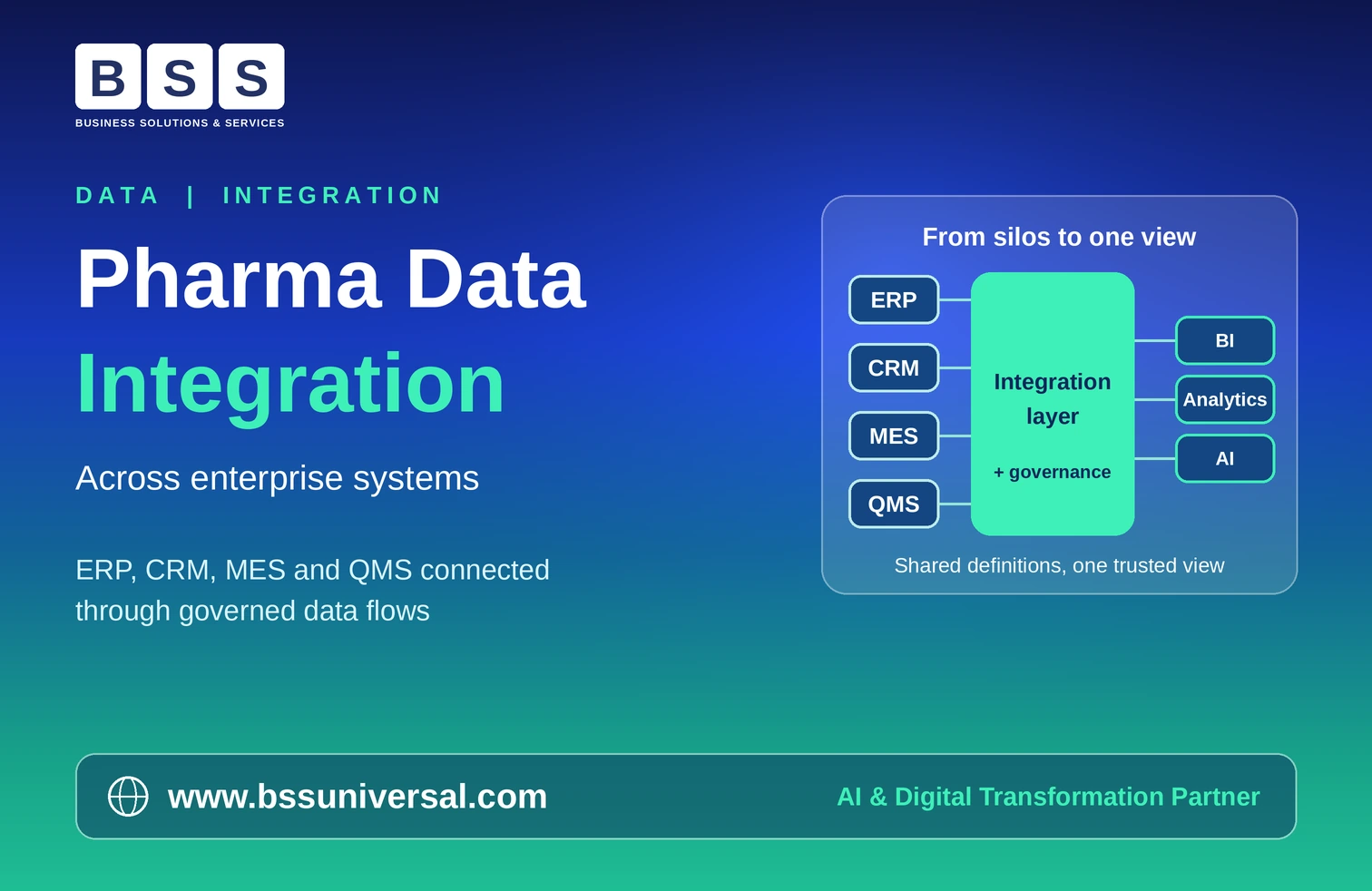
Pharmaceutical data integration connects these enterprise systems through structured data flows, shared definitions and appropriate governance. It helps organisations make information more consistent, improve reporting and establish a reliable foundation for analytics and AI.
However, connecting applications is only one part of the process. Businesses must also address data quality, ownership, integration architecture, security and the timing of information exchange.
Why Pharmaceutical Companies Struggle With Enterprise Data Silos
Pharmaceutical organisations depend on several interconnected business functions, each supported by different applications.
A typical enterprise environment may include:
- ERP systems for procurement, finance, inventory and business operations.
- CRM platforms for HCP relationships and commercial activities.
- Manufacturing Execution Systems (MES) for production operations.
- Warehouse Management Systems (WMS) for inventory and distribution.
- Quality Management Systems (QMS) for quality-related workflows.
- Laboratory Information Management Systems (LIMS) for laboratory information.
- Business Intelligence (BI) platforms for reporting and analysis.
These systems often have different data structures, identifiers, integration capabilities and update schedules.
The problem develops when departments exchange information through spreadsheets, manual uploads or individually developed connections.
For example, a product might have one identifier in the ERP, another in a warehouse application and a different reference in a reporting database.
Unless these identifiers are mapped correctly, the same product may appear as separate records in management reports.
This creates several business challenges:
Inconsistent reporting: Different departments calculate performance using different information and definitions.
Manual reconciliation: Employees spend time checking spreadsheets and resolving differences between systems.
Delayed decisions: Management waits for information to be collected and consolidated.
Limited operational visibility: Leaders cannot easily connect sales, inventory, procurement and distribution information.
Growing integration complexity: Every new application or business unit creates additional data exchange requirements.
A well-designed integration architecture addresses these problems by establishing reliable connections and consistent business definitions.
6 Major Pharmaceutical Enterprise Data Integration Challenges
1. Disconnected ERP, CRM and Financial Data
ERP, CRM and financial platforms contain information that frequently needs to be analysed together.
For example, management may want to compare customer sales, product revenue, outstanding payments and commercial activity.
When each application maintains separate customer identifiers and reporting structures, creating a consistent analysis becomes difficult.
The solution requires more than transferring records between applications.
Organisations should establish common customer, product and account definitions, identify authoritative source systems and map the relationships between them.
This allows reporting platforms to use consistent business information without assuming that every application must store identical records.
2. Fragmented Manufacturing and Quality Information
Manufacturing organisations use multiple applications to manage production, materials, equipment, quality and laboratory activities.
MES, ERP, QMS and LIMS may maintain separate information about materials, production orders, samples and quality-related activities.
When these systems are disconnected, operational teams may struggle to obtain a consolidated view of relevant production information.
Integration can connect approved information flows between operational and enterprise applications.
For example, production order information from an ERP can be associated with relevant manufacturing and quality records for operational reporting.
However, this does not mean that an analytics integration layer should replace validated manufacturing or quality systems.
Systems that manage regulated records require appropriate controls for data integrity, auditability, intended use and validation.
3. Inconsistent Product, Customer and Supplier Data
Master data management is one of the most important foundations of pharmaceutical data integration.
The same business entity may appear differently across systems.
Examples include:
- Different product codes for the same commercial product.
- Multiple customer records for the same distributor.
- Inconsistent supplier identifiers.
- Different names for manufacturing sites.
- Duplicate inventory and material references.
These inconsistencies affect reporting accuracy and integration reliability.
A master data management approach establishes agreed identifiers, ownership responsibilities, matching rules and validation processes.
For example, a pharmaceutical group should define how a product is identified across procurement, manufacturing, warehouse and sales applications.
The objective is to create consistent references while allowing individual systems to retain their operational responsibilities.
4. Limited Distributor and Supply Chain Data Visibility
Pharmaceutical distribution involves multiple organisations, including manufacturers, importers, wholesalers and distributors.
Each participant may use different applications and data exchange methods.
Without structured integration, information about inventory, orders, shipment status and product availability can become delayed or inconsistent.
Businesses should evaluate how distributor systems exchange relevant information with internal ERP and reporting environments.
APIs, EDI interfaces, scheduled data pipelines and agreed data formats can support these connections.
Integration requirements should also account for product identifiers, transaction references, update frequency and error handling.
5. Manual Business Intelligence and Reporting
When enterprise applications operate independently, BI teams often depend on manual exports and spreadsheet consolidation.
This makes management reporting slower and increases the risk of inconsistent calculations.
For example, a regional dashboard may need to combine:
- Product revenue from finance.
- Customer activity from CRM.
- Inventory information from ERP.
- Shipment information from distribution applications.
- Production information from manufacturing systems.
A structured data pipeline can bring these datasets into an analytics environment, where they can be validated, transformed and modelled for reporting.
This provides management with more consistent information for operational and commercial decisions.
6. Weak Data Governance Across Multiple Countries
Multi-country pharmaceutical groups must manage different business units, data owners, applications and access requirements.
Without defined governance, integration projects can create new data inconsistencies rather than solving existing ones.
Common problems include unclear ownership, undocumented transformations, uncontrolled data access and inconsistent definitions of business metrics.
A governance framework should establish who owns each data domain, who can access information and how changes are approved.
For GCC organisations, data protection and international transfer requirements must also be assessed where personal data is involved.
Pharmaceutical Data Integration Methods and Technologies
Different integration methods solve different problems. Choosing the right method depends on the type of information, required update frequency, source system capabilities and intended business use.
API-Based Integration
Application Programming Interfaces (APIs) allow different applications to exchange information through defined interfaces.
For example, a CRM application may retrieve approved customer or product information from an ERP through an API.
APIs are useful when applications need structured, controlled communication rather than manual file exchanges.
Important considerations include authentication, permissions, API limits, error handling and version management.
ETL and ELT Data Pipelines
ETL stands for Extract, Transform and Load.
It extracts information from source systems, transforms it into an agreed structure and loads it into a destination such as a data warehouse.
ELT follows a different sequence: data is extracted and loaded first, then transformed within the destination environment.
Both approaches support the consolidation of enterprise information for analytics.
For example, a pharmaceutical company can combine CRM sales records, ERP financial data and warehouse inventory information into a curated reporting dataset.
Change Data Capture
Change Data Capture (CDC) identifies changes made to source data and transfers relevant updates to downstream systems.
Instead of repeatedly extracting entire databases, CDC can capture inserts, updates and deletions where the source technology supports them.
This can improve the freshness of information used in operational dashboards and analytical applications.
The implementation must address transaction ordering, duplicate events, failed transfers and recovery procedures.
Event-Driven Integration
Event-driven integration allows applications to communicate when important business events occur.
For example, when a relevant inventory transaction is completed, an application can publish an event that other authorised systems consume.
This can support workflows that depend on timely updates without requiring every system to constantly request information.
Electronic Data Interchange
Electronic Data Interchange (EDI) enables structured business documents to be exchanged between organisations using agreed formats.
It is relevant when pharmaceutical companies exchange purchase orders, invoices, shipment information and other business documents with distributors or commercial partners.
EDI may be particularly useful when external partners do not offer suitable APIs.
Choosing the Appropriate Integration Method
Integration MethodBest ApplicationMain ConsiderationAPIsApplication-to-application communicationSecurity and interface managementETLCentralised analytical datasetsTransformation and schedulingELTCloud data platforms and analyticsDestination processing and governanceCDCIncremental data updatesSource compatibility and reliabilityEvent-driven integrationEvent-based operational workflowsDelivery and event managementEDIExternal business document exchangePartner formats and standards
Most large pharmaceutical environments require a combination of these methods rather than a single integration technology.
A Practical Architecture for Pharmaceutical Enterprise Data Integration
A scalable integration architecture should organise information flows into clear layers.
The following model illustrates how enterprise data can move from source applications to business reporting.
Enterprise integration architecture
SOURCE SYSTEMS
ERP | CRM | MES | QMS | LIMS | Finance | WMS
                    |
                    v
INTEGRATION LAYER
APIs | ETL/ELT | CDC | EDI | Event Messaging
                    |
                    v
DATA PROCESSING
Validation | Mapping | Transformation | Quality Checks
                    |
                    v
GOVERNED DATA ENVIRONMENT
Warehouse | Lakehouse | Curated Data Models
                    |
                    v
DATA CONSUMPTION
BI Dashboards | Analytics | Applications | AI
Governance, security, metadata and monitoring should apply across these layers rather than being treated as a final implementation step.
Source Systems
Identify the applications that generate and maintain important enterprise information.
For each system, establish the data owner, business purpose, available interfaces and authoritative records.
Integration and Processing Layer
Connect the applications using suitable integration methods.
Data should be transformed and validated according to agreed business rules before it is made available for downstream use.
Governed Data Environment
Store and organise information where there is a business need for consolidated datasets, historical analysis and reusable reporting models.
Depending on the architecture, this may involve data warehouses, lakehouses or other approved enterprise data platforms.
Analytics and Business Consumption
Provide authorised users with consistent datasets for dashboards, financial reporting, supply chain analysis and operational decision-making.
This architecture should be designed around specific business use cases, not the assumption that all enterprise information must be copied into one central database.
Data Governance: The Foundation of Trusted Pharmaceutical Reporting
Integration can connect different systems, but it cannot automatically guarantee that the information is correct.
A reliable pharmaceutical data management strategy needs defined governance responsibilities.
Establish Data Ownership
Every important data domain should have an accountable owner.
For example, finance may own specific financial definitions, while supply chain leadership may own inventory-related business definitions.
IT and data engineering teams support the implementation, but business ownership is necessary to resolve questions about meaning and usage.
Implement Master Data Management
Establish consistent identifiers for important entities such as:
- Products and materials.
- Customers and distributors.
- Suppliers.
- Manufacturing sites.
- Warehouses.
- Business units.
Define how records are matched, updated and reconciled across applications.
Apply Data Quality Controls
Data validation should check for missing fields, invalid values, duplicates and inconsistent relationships.
For example, a product sales report should not silently combine unrelated product identifiers because their descriptions appear similar.
Maintain Data Lineage and Metadata
Data lineage explains where information originated, which transformations were applied and where the resulting dataset is used.
Metadata helps users understand definitions, business meaning, ownership and update frequency.
Together, these controls make it easier to investigate reporting differences and manage changes to integration processes.
Protect Data Through Appropriate Access Controls
Access policies should reflect data sensitivity and the user's responsibilities.
Where personal data is processed, organisations must also consider relevant privacy, retention and transfer requirements.
Data Integrity and Compliance Considerations for Pharmaceutical Companies
Not all pharmaceutical enterprise data has the same regulatory significance.
A management dashboard combining sales and inventory information does not automatically have the same validation requirements as a system maintaining GMP-regulated electronic records.
This distinction is important when designing integrations.
The US Food and Drug Administration's guidance on Data Integrity and Compliance With Drug CGMP explains that CGMP data should be reliable and accurate and that its integrity must be maintained throughout the data lifecycle.
The ALCOA principles include:
- Attributable.
- Legible.
- Contemporaneous.
- Original.
- Accurate.
For systems supporting regulated processes, integration teams should consider how relevant metadata, timestamps, audit trails, record completeness and source-system controls are preserved.
ICH Q9(R1) also provides a risk-based approach to pharmaceutical quality management, including the assessment of risks associated with advanced technologies and computerised systems.
For GCC organisations, privacy requirements require additional attention.
Saudi Arabia's Personal Data Protection Law and its international transfer regulations should be assessed where personal data is transferred outside the Kingdom. The UAE's Federal Decree-Law No. 45 of 2021 provides a separate framework for personal data protection.
Organisations should therefore establish appropriate governance for data classification, processing, storage, access and cross-border transfers.
How Pharmaceutical Companies Should Implement Data Integration
A structured implementation programme helps avoid unnecessary complexity and reduces the risk of integrating unreliable information.
Stage 1: Assess the Existing Enterprise Data Environment
Identify all important business applications and understand how data moves between them.
Document manual exports, duplicate records, disconnected reporting processes and integration limitations.
Stage 2: Prioritise Business Use Cases
Start with decisions that require information from several systems.
For example, a regional management dashboard may need data from finance, CRM, ERP and distributor applications.
Define the required information, reporting frequency and expected business outcome.
Stage 3: Establish Data Ownership and Standards
Agree on customer, product, supplier and operational definitions.
Assign data owners and identify authoritative source systems before implementing large integration pipelines.
Stage 4: Design and Implement Integration Architecture
Choose appropriate API, ETL/ELT, CDC or EDI patterns.
Define data flows, transformations, security controls, monitoring and recovery processes.
Use a focused pilot to validate the architecture with real source data.
Stage 5: Validate and Monitor Data Quality
Test integration accuracy, completeness, performance and reliability.
Where regulated records or processes are affected, involve quality and compliance teams to determine the appropriate validation and documentation requirements.
Stage 6: Expand Across Systems and Business Units
After validating the initial use case, extend the integration environment to additional systems, sites and business units.
Maintain common definitions and governance while accommodating genuine country-specific business requirements.
Measuring Enterprise Data Integration Performance
Pharmaceutical CIOs and Chief Data Officers should evaluate integration using business and technical indicators.
KPIWhat It MeasuresData pipeline success rateReliability of scheduled data transfersData freshnessTime between source updates and data availabilityData quality scoreCompleteness, accuracy and consistencyDuplicate record rateData duplication across systemsIntegration error rateFailed or rejected data transactionsReporting preparation timeEffort required to prepare management reportsData reconciliation effortTime spent resolving inconsistenciesData lineage coverageVisibility into data origin and transformationSystem availabilityAvailability of required data services
The organisation should establish baseline performance before implementation and define realistic improvement targets.
A technically successful integration is not enough if business teams still cannot trust or use the resulting information.
How BSS Supports Pharmaceutical Enterprise Data Integration
Pharmaceutical organisations need a data technology partner that understands enterprise integration, analytics, platform architecture and governance.
BSS provides Enterprise Data Engineering and Analytics services to connect fragmented business systems and establish more reliable enterprise data environments.
Its relevant capabilities include:
Enterprise Data Strategy and Architecture
BSS supports enterprise data strategy and architecture to align data initiatives with business priorities.
This includes identifying data fragmentation, defining architecture requirements and planning scalable enterprise data environments.
Data Engineering and Integration
BSS supports the integration of applications, databases and enterprise data sources through structured data flows.
These capabilities can help organisations connect CRM, ERP and other business applications to support consistent reporting and operational information exchange.
Business Intelligence and Analytics
Connected enterprise information can support dashboards, business reporting and analytical use cases.
BSS provides analytics capabilities to help organisations improve operational visibility and decision-making.
Data Governance and Enterprise Data Management
Data integration needs consistent business definitions, access controls and data management practices.
BSS's enterprise data positioning includes governance and architecture capabilities that support trusted data environments.
Denodo-Powered Enterprise Data Access
For organisations managing information across multiple databases, cloud environments and business applications, Denodo can provide a governed logical data access layer.
It can complement physical data pipelines by making distributed information available through consistent data views.
However, this is not a replacement for every ETL/ELT or application integration requirement. The appropriate architecture depends on the workload, data freshness, performance and governance requirements.
Building a More Reliable Data Foundation for GCC Pharmaceutical Businesses
Pharmaceutical organisations cannot make consistent enterprise decisions when their most important business information remains fragmented across disconnected systems.
ERP, CRM, manufacturing, finance and distribution applications need reliable data exchange, consistent definitions and clear ownership.
For pharmaceutical groups operating across the GCC, these requirements become especially important when reporting spans multiple countries, business units and external partners.
A practical integration strategy starts with high-value business use cases, establishes trusted data foundations and expands through governed, measurable implementation stages.
BSS brings together Enterprise Data Engineering and Analytics, data integration, Denodo expertise and enterprise technology capabilities to support these transformation requirements.
Talk to BSS about connecting your pharmaceutical enterprise systems and building a more reliable foundation for business intelligence, analytics and AI.
Frequently Asked Questions
1. What is pharmaceutical data integration?
Pharmaceutical data integration connects information from different business and operational applications, including ERP, CRM, manufacturing, finance and supply chain systems. It enables organisations to exchange, harmonise and use information for operational reporting and decision-making.
2. Why is data integration important for pharmaceutical companies?
It helps reduce disconnected information, improve reporting consistency, minimise manual reconciliation and connect information across business departments. It also establishes a stronger data foundation for analytics and AI.
3. What systems should pharmaceutical companies integrate?
Common integration requirements include ERP, CRM, MES, QMS, LIMS, finance, warehouse management and distributor systems. The appropriate scope depends on the organisation's business requirements and data architecture.
4. What is the difference between ETL and ELT?
ETL extracts information, transforms it and then loads it into a destination. ELT loads extracted information first and performs transformations within the destination platform. Both approaches support enterprise data consolidation and analytics.
5. How does Denodo support pharmaceutical data integration?
Denodo provides logical data management capabilities that allow organisations to access and combine information across distributed systems through governed data views. It can complement physical integration pipelines and support analytics and enterprise applications without requiring every source dataset to be copied.
6. How can pharmaceutical companies improve enterprise data quality?
They should establish master data management, common identifiers, data ownership, validation rules, duplicate detection and data lineage. Quality controls should be implemented at appropriate points throughout the data lifecycle.
7. What should GCC pharmaceutical companies consider when integrating enterprise data?
They should evaluate multi-country data architecture, system compatibility, business ownership, security, data quality and applicable national privacy and cross-border data transfer requirements. Regulated records also need appropriate quality and validation oversight.
8. How can BSS help with pharmaceutical data integration?
BSS provides Enterprise Data Engineering and Analytics capabilities, including data strategy, integration, architecture, BI and Denodo expertise. The implementation approach depends on the customer's existing systems, integration requirements and business objectives.