Pharma CRM for Commercial Excellence in the GCC
Pharmaceutical companies can have experienced sales representatives, established healthcare professional relationships and sophisticated commercial strategies, yet still struggle to understand their actual field performance.
The problem often lies in the systems supporting commercial operations. Healthcare professional (HCP) records may be distributed across multiple databases, field representatives may use disconnected applications, and sales managers may depend on manually consolidated reports to evaluate territory performance.
For pharmaceutical businesses operating across Saudi Arabia, the UAE, Qatar, Kuwait, Oman and Bahrain, these challenges become more complex as commercial operations expand across different markets, teams and distribution networks.
Pharmaceutical CRM solutions help address this fragmentation by connecting HCP information, field-force activities, commercial workflows and performance reporting within a structured enterprise environment.
However, implementing a CRM platform is not enough. Organisations must select the right technology, establish reliable customer data, configure business processes and ensure that commercial teams actually use the system.
Understanding these requirements is essential for pharmaceutical companies seeking stronger commercial execution across the GCC.
Why Pharmaceutical Companies Need a Dedicated CRM Strategy
Traditional CRM systems are often designed around general customer and sales management. Pharmaceutical commercial operations have additional requirements that must be considered during implementation.
Sales representatives engage with HCPs, including doctors, specialists and healthcare institutions. Commercial leaders manage territories, account relationships and product portfolios, while management teams need reliable information about field activities and sales performance.
When these activities operate independently, organisations experience several problems:
- Duplicate or incomplete HCP records.
- Inconsistent field-force activity reporting.
- Poor territory and account visibility.
- Limited coordination between sales and marketing.
- Manual commercial reporting.
- Difficulties tracking sales execution across markets.
A structured life sciences CRM environment connects these activities and establishes consistent processes for commercial teams.
For pharmaceutical businesses, the purpose is not simply to record customer interactions. It is to improve how commercial information supports daily execution and management decisions.
6 Core Capabilities of Pharmaceutical CRM Solutions
An effective pharmaceutical CRM implementation should address the operational requirements of both field representatives and commercial leadership.
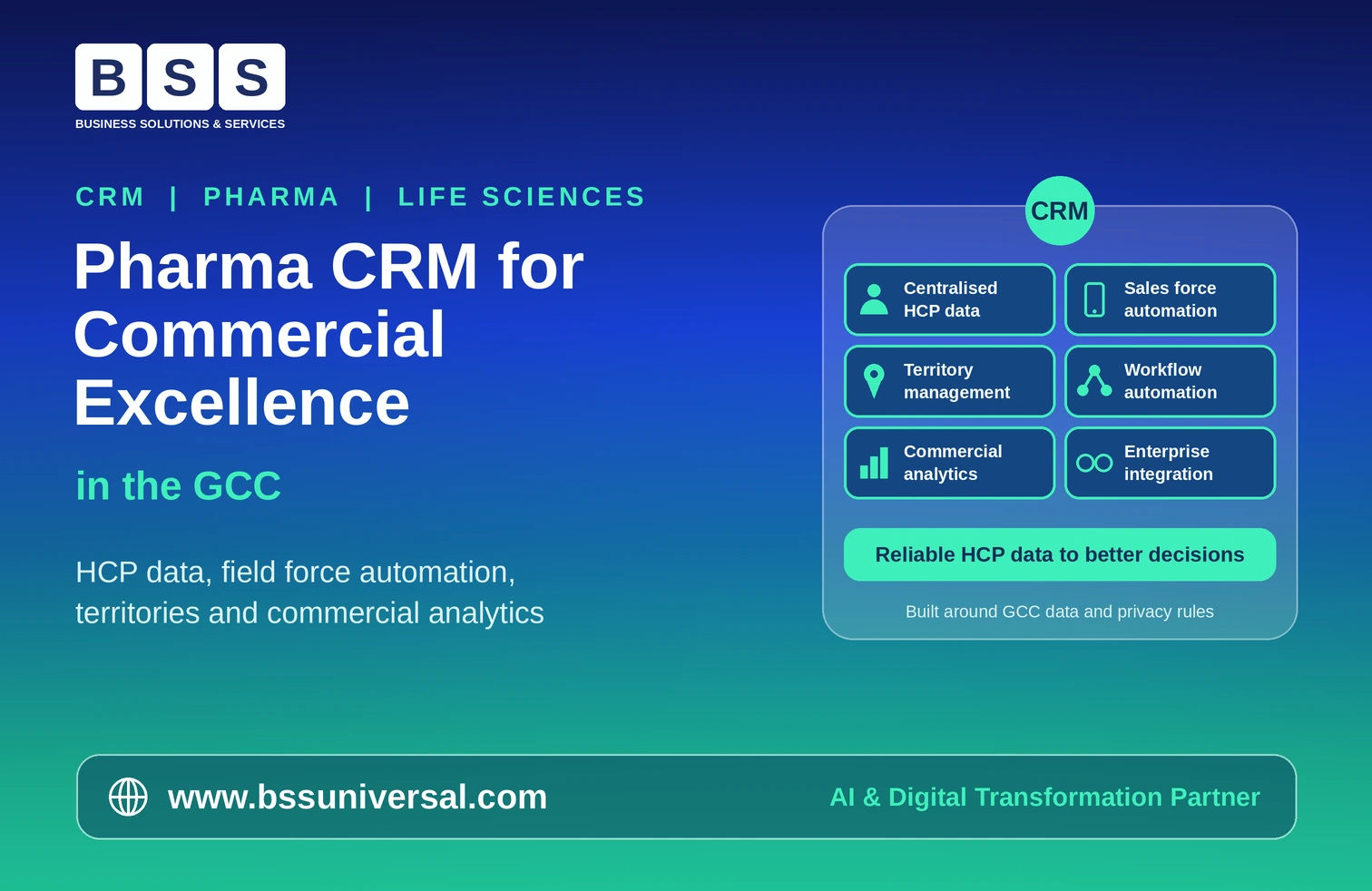
1. Centralised HCP and Healthcare Organisation Data
HCP information is one of the most important foundations of pharmaceutical commercial operations.
Companies may maintain customer information across spreadsheets, legacy CRM platforms, external data providers and regional databases.
This creates inconsistencies in customer identification, professional details and account relationships.
A structured HCP and healthcare organisation (HCO) data model can establish a more consistent view of each customer.
Important information may include:
- HCP name and professional identification.
- Medical specialty and relevant professional details.
- Healthcare organisation and institutional affiliation.
- Assigned territory and account ownership.
- Relevant interaction history.
- Appropriate communication preferences and permissions.
Organisations should also establish duplicate detection, record validation and data ownership rules.
For example, when a doctor works across multiple hospitals, the CRM should distinguish the individual HCP record from the different institutional relationships.
This makes customer information more useful for commercial planning and field execution.
2. Pharmaceutical Sales Force Automation
Field representatives need access to relevant customer information and structured daily workflows.
Without appropriate automation, representatives may spend excessive time preparing visit reports, updating spreadsheets and coordinating information with sales managers.
Pharmaceutical sales force automation connects field activities with the central CRM environment.
Common capabilities include:
- Mobile access to HCP profiles.
- Daily call planning and scheduling.
- Territory-based customer assignments.
- Visit and call reporting.
- Activity capture and follow-up tasks.
- Manager visibility into field execution.
Offline functionality should also be evaluated where representatives work in locations with unreliable internet access or restricted connectivity.
The objective is to reduce administrative friction while improving the completeness and timeliness of field activity information.
3. Territory Management and Sales Operations
Territory management becomes increasingly important when pharmaceutical organisations operate through multiple regional teams.
Without structured territory information, sales leaders may struggle to understand customer coverage, account ownership and workload distribution.
A CRM environment can connect HCP records, healthcare institutions, representative assignments and business territories.
For example, a pharmaceutical company operating across Riyadh, Jeddah and Dammam may need different account structures and field responsibilities for each location.
Commercial managers should be able to evaluate:
- HCP coverage by territory.
- Assigned versus unassigned accounts.
- Planned and completed visits.
- Account activity distribution.
- Territory-level performance.
- Resource allocation.
These insights help leadership identify operational gaps and review whether territories are organised around actual business requirements.
4. CRM Workflow Automation
Manual commercial processes can create unnecessary delays and inconsistent records.
Examples include approval requests, customer account updates, field activity submissions and administrative follow-ups.
CRM workflow automation can standardise these processes.
Organisations may configure automated notifications, approval workflows, task assignments and data validation rules.
For example, when a representative submits a field activity report, the CRM can validate required information, update the relevant customer record and make the activity available for management reporting.
Automation should be designed around approved business procedures rather than simply automating every existing manual task.
5. Commercial Performance Analytics
Collecting CRM information has limited value when commercial leaders cannot interpret it.
CRM analytics can connect field activities, customer records, territory information and sales-related business data to provide a clearer picture of commercial performance.
Useful reporting areas include:
- Field-force activity and coverage.
- HCP data completeness.
- Territory performance.
- Account engagement history.
- Sales performance by region.
- Commercial workflow efficiency.
- Adoption of CRM applications.
For example, a regional sales manager may compare territory coverage with available commercial performance information to identify areas requiring further investigation.
It is important to distinguish activity metrics from business outcomes. A higher number of recorded visits does not automatically mean better commercial performance.
6. Integration With Enterprise Business Systems
Pharmaceutical CRM should not operate as an isolated application.
Organisations frequently need to exchange relevant information with ERP platforms, enterprise data warehouses, analytics tools and other internal systems.
API-based integrations can support structured information exchange between these applications.
For example:
Connected SystemPotential CRM IntegrationERPRelevant product, account and business informationData WarehouseConsolidated commercial reportingBusiness IntelligenceTerritory and sales dashboardsIdentity ManagementUser authentication and permissionsApproved Content SystemsAccess to relevant commercial materialsExternal HCP Data ProvidersLicensed and validated customer information
The integration approach should define system ownership, data synchronisation frequency, error handling and security requirements.
This is particularly important when pharmaceutical businesses use different applications across their regional operations.
Choosing the Right Pharmaceutical CRM Platform
Selecting a CRM platform requires more than comparing software features.
Pharmaceutical organisations should evaluate the technology against their commercial operating model, existing infrastructure, integration requirements and long-term objectives.
Several established enterprise platforms operate in the life sciences CRM market.
Salesforce Life Sciences Cloud and related CRM capabilities
Salesforce provides life sciences capabilities supporting customer and organisation management, commercial operations and connected enterprise workflows.
Its broader platform ecosystem can also support integrations, automation, analytics and custom business applications.
Veeva Vault CRM
Veeva offers a CRM platform specifically designed for life sciences. Its capabilities include customer profiling, territory and account planning, field engagement and connections between commercial, medical and marketing teams.
IQVIA Orchestrated Customer Engagement (OCE)
IQVIA OCE provides a life sciences commercial engagement platform designed to connect customer-facing functions and support coordinated commercial operations.
These products have different architectures, capabilities, licensing arrangements and implementation considerations. They should not be treated as interchangeable solutions.
Before selecting a platform, pharmaceutical companies should evaluate:
Evaluation AreaWhat to CheckIndustry requirementsSupport for pharmaceutical commercial workflowsHCP dataCustomer data model and integration optionsField mobilityMobile experience and offline capabilitiesIntegrationCompatibility with existing enterprise applicationsAnalyticsReporting and commercial performance visibilitySecurityAccess controls, auditability and data protectionScalabilityAbility to support additional teams and marketsTotal ownership costLicensing, implementation, integration and supportFlexibilityConfiguration, customisation and future expansion
The best CRM choice depends on the organisation's existing technology environment and business requirements, not simply the popularity of a particular platform.
Pharmaceutical CRM Implementation Considerations in the GCC
A pharmaceutical CRM implementation across the GCC needs to account for regional operating requirements.
The six markets share commercial similarities, but companies should not assume that the same customer data, workflows or governance rules will automatically work across every country.
Saudi Arabia
Pharmaceutical organisations operating in Saudi Arabia should consider the Kingdom's Personal Data Protection Law (PDPL) when collecting and processing personal information.
CRM implementation teams should review data classification, processing purposes, user permissions, data transfers and applicable retention requirements.
The platform should also accommodate relevant local commercial processes and the company's existing enterprise architecture.
United Arab Emirates
The UAE's Federal Decree-Law No. 45 of 2021 on the Protection of Personal Data provides a national framework governing personal data processing.
Pharmaceutical organisations should assess how their HCP records, employee information and other personal information are collected, stored, accessed and shared.
Qatar, Kuwait, Oman and Bahrain
Businesses operating in these markets should separately evaluate applicable national data protection requirements, organisational policies and contractual obligations.
A regional CRM architecture may provide shared reporting and consistent commercial workflows, but local governance requirements must be addressed during implementation.
Other Important GCC Requirements
Pharmaceutical CRM projects should also consider:
Bilingual usability: Evaluate Arabic and English interface requirements, customer data handling and reporting preferences.
Field connectivity: Confirm whether representatives can access necessary CRM information in areas with limited connectivity.
Market-specific account structures: Healthcare institutions, distributor relationships and sales territories may differ between countries.
Data ownership: Establish who maintains HCP information, approves updates and resolves duplicate records.
Scalable configuration: Support new commercial teams, brands, territories and business units without unnecessary system redesign.
One important distinction: CRM is not a pharmaceutical product traceability system. Saudi Arabia's SFDA RSD and the UAE's Tatmeen are separate drug tracking platforms. CRM integration with other systems should be considered only where there is a defined operational requirement.
A Practical Roadmap for Pharmaceutical CRM Implementation
Successful CRM implementation begins with understanding commercial operations rather than immediately configuring software.
Step 1: Assess Existing CRM and Commercial Processes
Review current customer databases, field-force workflows, territory structures, reporting applications and integration requirements.
Identify the problems affecting sales representatives and commercial management.
Step 2: Clean and Structure HCP Data
Identify duplicate records, missing information, inconsistent customer identifiers and unclear ownership.
Establish master data management rules before transferring information into the new environment.
Step 3: Define Platform Architecture
Select a CRM platform based on business requirements.
Define application configuration, integration architecture, permissions, data flows and reporting responsibilities.
Step 4: Configure Commercial Workflows
Develop the required customer records, territory structures, mobile workflows, activity reporting and approval processes.
Involve field representatives and commercial managers to ensure the system reflects actual working practices.
Step 5: Run a Controlled Pilot
Test the implementation with a selected business unit or territory.
Review data accuracy, mobile usability, workflow performance, integration reliability and user feedback before expanding the rollout.
Step 6: Roll Out and Continuously Optimise
Introduce structured user training, adoption monitoring and technical support.
Review CRM performance regularly and improve configuration as commercial requirements evolve.
A phased implementation helps organisations identify practical problems before they affect the entire commercial operation.
Measuring Pharmaceutical CRM Performance
CRM implementation should be evaluated using operational and commercial measures rather than software deployment alone.
KPIWhat It MeasuresHCP record completenessQuality of customer informationDuplicate record rateConsistency of HCP dataCRM adoptionActive platform usageActivity reporting timelinessSpeed of field information captureTerritory coverageVisibility into customer coverageWorkflow completion timeEfficiency of commercial processesDashboard availabilityAccessibility of management informationIntegration reliabilityConsistency of information exchange
Organisations should establish baseline measurements before implementation and agree on realistic improvement targets.
This makes it easier to distinguish actual business improvements from simple increases in system activity.
How BSS Supports Pharmaceutical CRM and Commercial Excellence
Pharmaceutical CRM transformation requires a combination of platform implementation, data management, workflow automation and commercial analytics.
BSS provides CRM and Commercial Excellence Solutions designed to connect customer data, sales operations and enterprise business processes.
Its relevant capabilities include:
Enterprise CRM Implementation
BSS supports CRM configuration and implementation to help organisations establish structured customer records, commercial workflows and connected sales operations.
Sales Force Automation
CRM-enabled field-force workflows can support mobile access, activity reporting, customer information and management visibility.
CRM Integration and Data Management
BSS supports enterprise integrations and data-related capabilities to connect CRM environments with relevant business applications and reporting systems.
CRM Analytics and Commercial Insights
Connected CRM information and business intelligence capabilities help management teams review customer activity, territory performance and commercial operations.
Workflow Automation and AI-Powered CRM
Where appropriate to the business scope, automation and AI capabilities can support prioritisation, information processing and operational efficiency.
Pharmaceutical Field Force Automation: BSS Case Study
BSS has published a pharmaceutical field-force transformation case study involving a leading Life Sciences organisation with more than 5,000 sales representatives.
The organisation faced fragmented tools for HCP information, call planning, marketing content and activity reporting.
BSS implemented a mobile-first Field Force Automation solution using Salesforce Sales Cloud and Service Cloud.
The implementation included:
- Unified mobile access to HCP profiles and call-planning tools.
- Integrated Closed Loop Marketing (CLM) content.
- Structured call reporting and real-time data capture.
- Automated synchronisation with central systems.
- QlikView dashboards for territory and performance reporting.
- Integration with AWS and SQL environments.
The solution was designed to support more than 15,000 application users across business functions.
The published case study reports improved field engagement visibility, shorter reporting cycles, reduced administrative work and better commercial decision-making.
Read the BSS Pharmaceutical Field Force Automation Case Study.
This example demonstrates how CRM and field-force automation can work together to support large-scale pharmaceutical commercial operations.
Build a More Connected Pharmaceutical Commercial Environment
Pharmaceutical CRM should be treated as an enterprise commercial capability, not simply another software deployment.
For GCC pharmaceutical organisations, the priorities are clear: establish reliable HCP data, strengthen field-force execution, organise territories, connect enterprise systems and make commercial performance easier to understand.
A well-planned implementation connects technology with the actual requirements of sales representatives, commercial managers and enterprise leadership.
BSS combines CRM and Commercial Excellence expertise with data integration, analytics and enterprise technology capabilities to support these transformation requirements.
Discuss your pharmaceutical CRM implementation and commercial excellence requirements with BSS.
Frequently Asked Questions
1. What are pharmaceutical CRM solutions?
Pharmaceutical CRM solutions are enterprise applications designed to help pharmaceutical companies manage HCP and HCO information, field-force activities, commercial workflows, territory assignments and sales performance reporting.
2. Which CRM platforms are used in the pharmaceutical industry?
Established platforms include Salesforce Life Sciences Cloud, Veeva Vault CRM and IQVIA OCE. The appropriate choice depends on business requirements, existing systems, implementation scope and commercial operating models.
3. How does CRM improve pharmaceutical sales force automation?
CRM connects customer records, daily call planning, mobile workflows and activity reporting. It gives representatives better access to relevant information and helps managers monitor field execution.
4. Why is HCP data management important in pharmaceutical CRM?
HCP data management improves customer record accuracy, reduces duplication and helps commercial teams maintain consistent information about healthcare professionals and their institutional relationships.
5. How long does pharmaceutical CRM implementation take?
Implementation timelines depend on data quality, platform selection, customisation, integration complexity, user numbers and rollout requirements. A phased implementation with a controlled pilot can help manage operational risk.
6. What should pharmaceutical companies consider before selecting a CRM?
Companies should evaluate pharmaceutical workflow requirements, HCP data management, mobile capabilities, integration, analytics, security, scalability, licensing and ongoing support.
7. Can Salesforce be used for pharmaceutical commercial operations?
Yes. Salesforce provides life sciences CRM capabilities that support customer and healthcare organisation management, commercial workflows and enterprise integrations. The exact functionality depends on the Salesforce products, configuration and licensing selected.
8. How can BSS support pharmaceutical CRM implementation in the GCC?
BSS provides CRM implementation, commercial workflow automation, Salesforce-based field-force solutions, enterprise integration and analytics capabilities. The implementation scope depends on each organisation's requirements and existing technology environment.