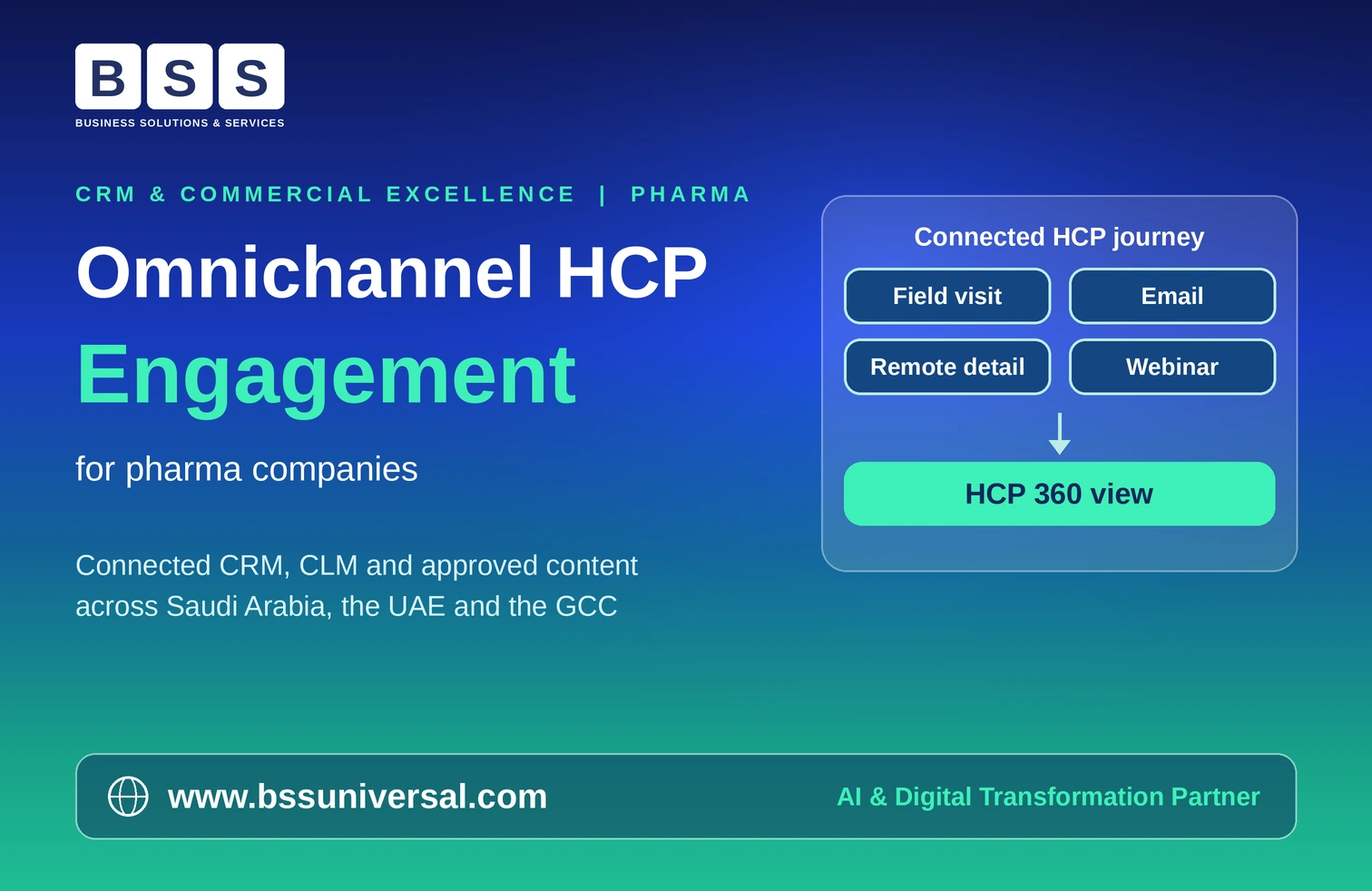
Omnichannel HCP Engagement for Pharma Companies
A pharmaceutical company may have hundreds of field representatives, active email campaigns, remote detailing sessions and digital content platforms, yet still struggle to deliver a consistent experience to healthcare professionals (HCPs).
The problem is often not a lack of communication channels. It is the absence of coordination between them.
A representative may visit a physician without knowing which digital materials the physician has recently viewed. Marketing teams may send promotional emails without knowing about recent field interactions. Medical teams may manage separate communications without sufficient visibility into other relevant touchpoints.
For pharmaceutical companies operating across Saudi Arabia, the UAE and other GCC markets, these disconnected interactions can create duplicated communication, inconsistent messaging and limited understanding of HCP engagement preferences.
Pharmaceutical omnichannel engagement connects these interactions into a coordinated, data-informed experience. Instead of managing each channel independently, companies use shared customer information, approved content and engagement analytics to make interactions more relevant.
The objective is not to communicate more frequently. It is to make every appropriate interaction more useful.
What Is Omnichannel HCP Engagement in Pharma?
Pharmaceutical omnichannel engagement is an approach that connects different communication channels, customer information and engagement activities around the needs and preferences of healthcare professionals.
These channels may include:
- Face-to-face pharmaceutical representative visits.
- Remote detailing and virtual meetings.
- Email communications.
- Approved digital educational content.
- Scientific webinars and virtual events.
- HCP portals and professional websites.
- Customer relationship management (CRM) platforms.
The important distinction is how these channels work together.
A connected engagement environment allows authorised commercial teams to understand relevant previous interactions, coordinate appropriate follow-ups and assess how different touchpoints contribute to engagement.
For example, a physician may attend a scientific webinar, access an approved digital resource and subsequently discuss a related topic with a pharmaceutical representative.
When these activities are appropriately connected, the representative can understand the previous interaction and avoid unnecessarily repeating information.
This creates a more consistent engagement journey.
Multichannel vs. Omnichannel Pharmaceutical Engagement
Although these terms are frequently used interchangeably, they describe different approaches to customer communication.
AreaMultichannel EngagementOmnichannel EngagementChannel managementChannels operate separatelyChannels are coordinatedCustomer informationDistributed across platformsConnected customer informationInteraction historyLimited shared visibilityRelevant cross-channel historyContent deliverySeparate channel campaignsCoordinated content journeysMarketing and salesIndependent activitiesConnected workflowsPerformance measurementIndividual channel metricsCross-channel performance analysisPersonalisationOften campaign-basedInformed by preferences and interactions
A pharmaceutical organisation can offer several communication channels without having a true omnichannel strategy.
For example, sending emails, conducting representative visits and hosting webinars does not automatically create coordinated engagement.
The difference comes from shared information, appropriate sequencing, consistent content and feedback between channels.
Why Pharmaceutical Companies Need Connected HCP Journeys
HCPs have different professional responsibilities, schedules, medical specialties and information requirements.
A hospital specialist may prefer a scheduled scientific discussion, while another healthcare professional may find an approved educational resource more convenient to access independently.
A single communication approach cannot be assumed to work equally well for every audience.
Deloitte's research on omnichannel HCP engagement highlights the importance of relevant, scientifically supported content and engagement strategies that reflect differences in specialty, information needs and communication preferences.
Several operational challenges make connected engagement particularly valuable.
1. Repeated Communication Across Different Channels
When commercial and marketing teams manage separate engagement platforms, the same HCP may receive overlapping messages.
For example, a representative may schedule a visit while a separate marketing campaign sends several emails about the same subject.
Without shared interaction information, teams may not recognise the duplication.
A connected engagement environment helps teams review relevant previous interactions and coordinate appropriate communication.
2. Limited Visibility Into HCP Preferences
Pharmaceutical organisations may collect information about email responses, webinar attendance, remote meetings and field interactions.
However, when these records remain separated, understanding channel preferences becomes difficult.
Connecting relevant engagement information can help identify which formats an HCP chooses to access and which communication methods receive meaningful responses.
These insights should inform decisions rather than create assumptions about individual clinical preferences.
3. Disconnected Sales and Marketing Activities
Marketing teams may plan campaigns independently of field representatives.
As a result, representatives may not know which approved materials an HCP has already received, while marketers may lack visibility into discussions taking place during field visits.
Connected workflows help align campaign planning, field engagement and appropriate follow-up activities.
4. Inconsistent Content Across Engagement Channels
Different teams may use outdated presentations, duplicated documents or inconsistent versions of promotional content.
This creates additional risks when pharmaceutical information needs to remain accurate and aligned with approved product information.
A centralised content management approach helps teams control access to approved materials and maintain consistency across channels.
5. Limited Understanding of Engagement Performance
Traditional reporting may measure email opens, representative visits and webinar registrations separately.
However, individual channel results do not necessarily show how the overall engagement journey is performing.
Cross-channel analytics provide a broader view of interaction patterns and content performance.
The Main Channels in Pharmaceutical Omnichannel Engagement
A connected HCP engagement strategy combines personal interactions with digital communication and professional education.
Face-to-Face Field Engagement
Pharmaceutical representatives remain an important communication channel for professional discussions and approved product information.
CRM-connected field applications can provide representatives with relevant HCP profiles, previous interaction records and approved content.
This helps representatives prepare for conversations and record relevant follow-up information.
The value comes from making field interactions part of a coordinated customer journey rather than treating every visit as an isolated activity.
Remote Detailing and Virtual Meetings
Remote detailing allows pharmaceutical teams to conduct appropriate product-related or educational discussions through digital meeting platforms.
These interactions can be useful when physical meetings are difficult to arrange or when an HCP prefers a remote communication format.
Integration with CRM enables relevant meeting records and follow-up activities to become part of the wider engagement history.
Email and Digital Communications
Email provides an asynchronous communication option for distributing approved information to appropriate professional audiences.
Pharmaceutical teams can use it for authorised educational resources, event information and relevant follow-up communications.
Email engagement reporting may also help organisations understand delivery, interaction and content performance.
However, email activity should not be treated as proof that an HCP has read, understood or agreed with a particular product message.
Webinars and Scientific Events
Scientific webinars and professional events provide opportunities to share educational information and engage relevant healthcare audiences.
Connecting registration, attendance and approved follow-up information with the wider engagement environment helps commercial and medical teams understand previous touchpoints.
Communications must remain appropriate to the event's purpose and target audience.
HCP Portals and Digital Content Platforms
Professional portals can give authorised users access to approved information, educational materials and relevant digital resources.
When integrated appropriately with enterprise data systems, organisations can understand content access and improve the organisation of future engagement.
The focus should remain on professional relevance, appropriate access and data protection rather than collecting unnecessary user information.
How CRM and CLM Create Connected HCP Engagement
An omnichannel strategy needs more than a collection of communication tools. It requires an information and workflow foundation that connects the different activities.
Two important components are CRM and Closed Loop Marketing (CLM).
CRM as the Central Engagement Record
CRM provides a structured environment for managing HCP information, customer relationships and commercial activities.
When integrated with relevant digital engagement systems, it can provide authorised teams with a more complete view of previous interactions.
For example, a pharmaceutical representative may review whether an HCP recently attended a webinar or accessed a particular approved resource before planning a follow-up discussion.
This reduces the risk of unnecessary repetition and improves coordination between customer-facing teams.
CLM for Connected Content and Feedback
Closed Loop Marketing connects content delivery with information about how that content is used and received.
For pharmaceutical teams, CLM can help manage approved digital materials, present relevant content during field interactions and capture engagement information.
A connected CLM environment can support:
- Centralised approved content.
- Consistent material across sales channels.
- Digital presentation during field visits.
- Content usage tracking.
- Relevant engagement feedback.
- Performance analysis.
The integration between CRM and CLM allows customer interaction records and content engagement information to contribute to a more connected commercial environment.
Importantly, CLM does not automatically make promotional content compliant. Content approval, version control and appropriate distribution permissions remain essential.
Building an HCP 360 View Through Integrated Data
An HCP 360 view brings relevant customer information and engagement history together into a structured profile.
It can connect information from different platforms, including CRM, digital engagement applications, webinar systems and content management environments.
Consider a pharmaceutical organisation interacting with the same healthcare professional through three channels.
InteractionInformation CapturedHow It Supports CoordinationField visitRelevant visit information and follow-upProvides context for future interactionsEmailDelivery and available engagement informationHelps evaluate digital communicationWebinarRegistration and attendanceIdentifies previous educational touchpoints
When these records are appropriately integrated, authorised teams can understand relevant engagement history without searching multiple applications.
However, an HCP 360 view should not become unrestricted collection of professional or personal information.
Organisations should define what data is necessary, who can access it, why it is processed and how long it should be retained.
How AI Improves Pharmaceutical Omnichannel Engagement
Artificial intelligence can help pharmaceutical organisations analyse interaction information and improve engagement planning.
However, AI is most useful when it operates on reliable data and within defined business and compliance controls.
Channel Preference Analysis
AI-assisted analytics can identify patterns in available interaction information, helping teams understand which communication channels are being used and which receive meaningful engagement.
Organisations can combine these insights with documented HCP preferences and feedback.
Next Best Engagement Recommendations
Next Best Engagement (NBE) refers to the process of identifying an appropriate potential interaction based on available information.
For example, an integrated system may indicate that a particular approved educational resource could be relevant for a planned interaction.
Recommendations should consider available permissions, previous interactions, channel preferences and communication frequency.
A recommendation is not automatic authorisation to send promotional content.
Content Personalisation
AI can help identify relevant approved content for different professional audiences and interaction contexts.
For example, it may support the retrieval of an existing approved resource based on a representative's workflow or a defined HCP segment.
All pharmaceutical content must continue to follow the organisation's medical, legal and regulatory approval processes.
Engagement Analytics
AI-powered analytics can help identify patterns across field visits, email engagement, webinar participation and content usage.
These insights can support better campaign evaluation and help commercial teams identify areas requiring further investigation.
Compliance and Data Governance Across GCC Markets
Omnichannel engagement involves customer information, communication preferences, digital interactions and pharmaceutical promotional content.
Therefore, technology architecture must account for applicable privacy, pharmaceutical promotion and professional communication requirements.
Saudi Arabia
The Saudi Food and Drug Authority (SFDA) has established a Code of Conduct for Promotional Practices of Pharmaceutical and Herbal Products.
Its requirements apply to relevant pharmaceutical promotional activities conducted through electronic media, including websites and applications.
Companies should ensure that digital pharmaceutical communications follow the same applicable promotional requirements as other formats.
Saudi data protection requirements should also be considered when processing personal information for marketing or related activities, including applicable consent and withdrawal requirements.
United Arab Emirates
The Emirates Drug Establishment (EDE) provides an advertisement licensing process for medical products.
Its published requirements address valid marketing authorisation, licensed applicants, truthful and evidence-supported promotional material, and disclosure of relevant product risks.
Companies distributing medical product advertisements through digital channels should assess the relevant approval and audience requirements before launching campaigns.
Other GCC Markets
Qatar, Kuwait, Oman and Bahrain have their own legal and regulatory environments.
Pharmaceutical companies should review applicable national requirements for medical promotion, HCP communications, personal data processing and digital marketing before implementing regional engagement programmes.
A shared enterprise platform does not remove the need for country-specific compliance controls.
What a Compliant Engagement Environment Should Include
A suitable operating model should account for:
- Approved promotional and educational content.
- Medical, legal and regulatory review workflows.
- Appropriate HCP communication permissions.
- Documented preferences and applicable consent.
- Channel-specific communication controls.
- Frequency management and suppression rules.
- Secure access to customer information.
- Audit trails and record retention.
- Country-specific content and distribution requirements.
Technology can support these controls, but the pharmaceutical organisation remains responsible for its applicable promotional and regulatory obligations.
Measuring Omnichannel HCP Engagement Performance
An effective omnichannel strategy needs measurement beyond basic channel activity.
The following KPIs can help organisations evaluate how well different touchpoints work together.
KPIWhat It MeasuresHCP engagement coverageReach across relevant professional segmentsChannel preference alignmentWhether communication reflects recorded preferencesContent engagement rateInteraction with approved digital materialsCross-channel engagementActivity across connected communication channelsDuplicate communication rateOverlapping or repeated outreachFollow-up completionCompletion of appropriate follow-up activitiesEngagement frequencyCommunication volume and potential over-contactCampaign effectivenessPerformance against defined campaign objectivesCRM interaction completenessAvailability of relevant interaction records
Metrics should be interpreted carefully.
For example, an increase in email opens does not necessarily indicate stronger professional engagement. Similarly, higher activity volume does not automatically demonstrate improved business outcomes.
Organisations should evaluate engagement quality, operational efficiency and commercial effectiveness together.
How to Implement an Omnichannel HCP Engagement Strategy
Implementing connected engagement requires coordination between commercial, marketing, medical, IT and data teams.
A practical approach involves five stages.
Stage 1: Audit Existing Engagement Channels
Identify the platforms used for field visits, email, remote detailing, webinars and digital content.
Determine which systems maintain interaction records and where information remains disconnected.
Stage 2: Map the HCP Engagement Journey
Understand how different professional audiences currently interact with the organisation.
Identify repeated communications, unnecessary handovers and missing follow-up information.
Stage 3: Establish the Connected Data Foundation
Integrate the relevant CRM, digital engagement and content platforms.
Define HCP identity resolution, data ownership, permissions and information-sharing requirements.
Stage 4: Coordinate Content and Campaign Workflows
Connect approved content with the relevant engagement channels.
Define how field visits, remote interactions and digital follow-ups should work together.
Establish review, approval, version control and communication-frequency processes.
Stage 5: Measure and Optimise Engagement
Monitor cross-channel performance, content usage, HCP preferences and campaign effectiveness.
Use the results to improve future engagement journeys while maintaining appropriate oversight.
A controlled pilot can help organisations validate integration, user adoption and governance before a wider rollout.
How BSS Supports Connected Pharmaceutical HCP Engagement
Building a connected engagement environment requires CRM capabilities, integration, reliable data and analytics.
BSS supports enterprise CRM and Commercial Excellence transformation through its capabilities in Salesforce, customer engagement, data integration, analytics and workflow automation.
Relevant areas include:
CRM and Customer Engagement
BSS supports connected CRM environments that bring customer, sales and service activities together.
For pharmaceutical organisations, this can help establish more consistent access to relevant HCP interaction records and commercial workflows.
Omnichannel Campaign Integration
CRM-powered omnichannel capabilities can connect marketing and sales activities, helping organisations coordinate campaigns and understand engagement performance.
CLM and Field Engagement Integration
Integration of approved content with field-force applications can help representatives access relevant digital materials and capture interaction information.
Data Integration and Analytics
BSS supports enterprise data integration and analytics capabilities that help organisations connect information from multiple applications and improve cross-channel reporting.
AI-Enabled Engagement Workflows
Where appropriate to the implementation scope, AI capabilities can help operationalise engagement insights, retrieve relevant information and support defined commercial workflows.
BSS Case Study: Multi-Channel Engagement Transformation
BSS published a pharmaceutical multi-channel engagement transformation case study that directly demonstrates how disconnected HCP interactions can be connected through an integrated enterprise environment.
The pharmaceutical organisation was managing field visits, email campaigns, remote detailing and digital content through separate systems.
Field representatives had limited visibility into digital interactions, while marketing teams could not easily access information about field-level conversations.
This resulted in duplicated outreach, inconsistent messaging and limited cross-channel performance visibility.
BSS supported the implementation of a connected engagement model using:
- Salesforce Data Cloud as a central data foundation.
- Salesforce Sales Cloud for commercial engagement.
- Integration of field and digital interaction information.
- Agentforce capabilities for operationalising engagement insights.
- Analytics dashboards for cross-channel performance monitoring.
The solution connected field activities, email engagement, remote sessions and content consumption into structured HCP profiles.
Published business outcomes included:
- 30% increase in content engagement rate.
- Improved message consistency across brands and therapies.
- Better visibility into engagement performance.
- More contextual field interactions through access to previous digital engagement information.
The case demonstrates how integrating CRM, digital channels and enterprise data can help pharmaceutical organisations move beyond isolated communication activities.
Read the BSS Multi-Channel Engagement Transformation Case Study.
Creating More Relevant HCP Engagement Across the GCC
Pharmaceutical omnichannel engagement is not about adding more communication channels or increasing the number of promotional messages.
It is about connecting relevant interactions, understanding professional preferences, coordinating approved content and giving commercial teams a more complete view of their engagement activities.
For pharmaceutical organisations across Saudi Arabia, the UAE and the wider GCC, this requires a combination of enterprise CRM, CLM integration, data management, analytics and appropriate governance.
BSS brings together CRM and Commercial Excellence, data integration, analytics and AI-enabled capabilities to support connected enterprise engagement environments.
Explore connected HCP engagement with BSS and discuss how your organisation can coordinate field and digital interactions across its pharmaceutical operations.
Frequently Asked Questions
1. What is omnichannel engagement in the pharmaceutical industry?
It is an approach that coordinates pharmaceutical interactions across channels such as field visits, email, remote detailing, webinars and digital content platforms using connected customer information and engagement workflows.
2. What is the difference between multichannel and omnichannel HCP engagement?
Multichannel engagement uses several communication channels that may operate independently. Omnichannel engagement connects those channels through shared data, coordinated content and consistent interaction information.
3. What is an HCP 360 view?
An HCP 360 view is a consolidated representation of relevant healthcare professional information and interaction history. It can include authorised records from CRM, field visits, digital communications and content engagement systems.
4. What is the role of CRM in pharmaceutical omnichannel engagement?
CRM helps manage HCP records, coordinate commercial activities and connect relevant interaction information. When integrated with digital engagement platforms, it provides authorised teams with a more consistent view of the customer journey.
5. What is Closed Loop Marketing in pharma?
Closed Loop Marketing (CLM) connects pharmaceutical content delivery with engagement information and performance feedback. It helps commercial teams manage approved digital content, understand its usage and improve coordination across relevant channels.
6. How does AI support HCP engagement?
AI can analyse available engagement information, identify interaction patterns, support relevant content retrieval and assist with engagement planning. Its use should follow appropriate data permissions, human oversight and pharmaceutical promotional requirements.
7. How can pharmaceutical companies personalise HCP engagement?
Companies can use documented communication preferences, professional information, approved segmentation and previous interaction history to coordinate appropriate communications. Personalisation should remain relevant, proportionate and compliant with applicable requirements.
8. What are the main KPIs for omnichannel pharmaceutical engagement?
Relevant measures include channel preference alignment, content engagement rate, HCP engagement coverage, cross-channel performance, duplicate communication rate and campaign effectiveness.
9. How can pharmaceutical companies ensure compliant digital HCP engagement in the GCC?
They should apply relevant country-specific pharmaceutical promotional requirements, data protection obligations, content approvals, communication permissions, audit trails and channel-specific controls. Requirements must be reviewed separately for each market.