Managed CRM Support for Gulf Pharmaceutical Teams
Pharmaceutical sales teams rely on customer relationship management (CRM) systems to coordinate customer interactions, manage field activities, maintain account information and understand commercial performance. However, implementing a CRM platform is only the beginning. Organizations also need reliable administration, issue resolution, data-quality controls, user training and continuous improvement to keep daily operations running smoothly.
For pharmaceutical companies operating across Saudi Arabia and the United Arab Emirates, CRM support can become more challenging when sales teams work across multiple cities, markets, territories and business functions. Unclear ownership, inconsistent data, recurring technical issues and manual reporting can reduce confidence in the system and make routine activities harder to manage.
Managed CRM support provides a structured approach to these operational challenges. Instead of treating every issue as an isolated technical problem, organizations can combine platform administration, incident management, data governance, user enablement and performance reporting under one support model.
BSS Universal's CRM & Commercial Excellence Solutions can be aligned with these requirements to help organizations assess existing workflows, identify operational gaps and establish a practical support framework suited to their business needs.
The Operational Problems Managed CRM Support Should Solve
CRM problems are not always caused by software defects. Many originate from unclear processes, inconsistent configuration, poor data ownership or insufficient user training.
Unresolved tickets and recurring technical issues
A user who cannot access an account, submit a call report or complete an assigned workflow needs a clear route to resolution. Without defined ticket categories, priorities and escalation responsibilities, the same issue may be reported repeatedly without addressing its underlying cause.
A structured support process records the symptoms, business impact, affected workflow, investigation steps and final resolution. Recurring incidents should also be reviewed to determine whether a configuration change, training improvement or permanent technical fix is required.
Inconsistent permissions and configuration changes
Pharmaceutical organizations may have different roles for sales representatives, managers, administrators and other business users. When permissions are incorrectly assigned or configuration changes lack proper review, employees may experience unnecessary access restrictions or receive access they should not have.
Support teams should follow approved access procedures, document changes, test their impact and maintain a clear record of authorizations. Changes affecting critical business workflows should be reviewed before production release.
Inaccurate customer and account data
Incomplete account profiles, duplicate records, outdated contact information and inconsistent customer classifications can undermine segmentation and reporting. In life sciences environments, healthcare professional (HCP) and healthcare organization (HCO) records may also require careful management of professional details, affiliations and relevant communication preferences.
Managed support should distinguish between correcting individual records and addressing the underlying data-quality problem. Validation rules, ownership assignments and recurring quality checks help prevent the same errors from returning.
Manual reporting and inconsistent KPIs
When teams rely on separate spreadsheets or inconsistent definitions, regional and local reports may not agree. Commercial leaders may spend time reconciling figures instead of reviewing performance and identifying operational issues.
A consistent reporting framework should document metric definitions, data sources, refresh schedules and ownership. Automated reporting can then reduce repetitive work and make exceptions easier to identify.
Low user adoption
Even a technically functional CRM can provide limited business value when users maintain incomplete records, delay activity reporting or bypass approved workflows.
Support therefore needs to include accessible documentation, role-based training, user feedback and adoption monitoring. The objective is to make the system easier to use correctly, not simply to increase the number of login sessions.
What Managed CRM Support Should Include
An effective support model combines several complementary services rather than focusing exclusively on ticket resolution.
1. CRM administration and platform maintenance
Routine administration includes managing approved user access, investigating configuration issues, documenting requested changes and maintaining operational procedures. The precise responsibilities depend on the CRM platform, licensing, existing internal team and support agreement.
A clear responsibility matrix should distinguish routine administration from activities that require the client's platform owner, internal IT department or software vendor.
2. Incident, problem and change management
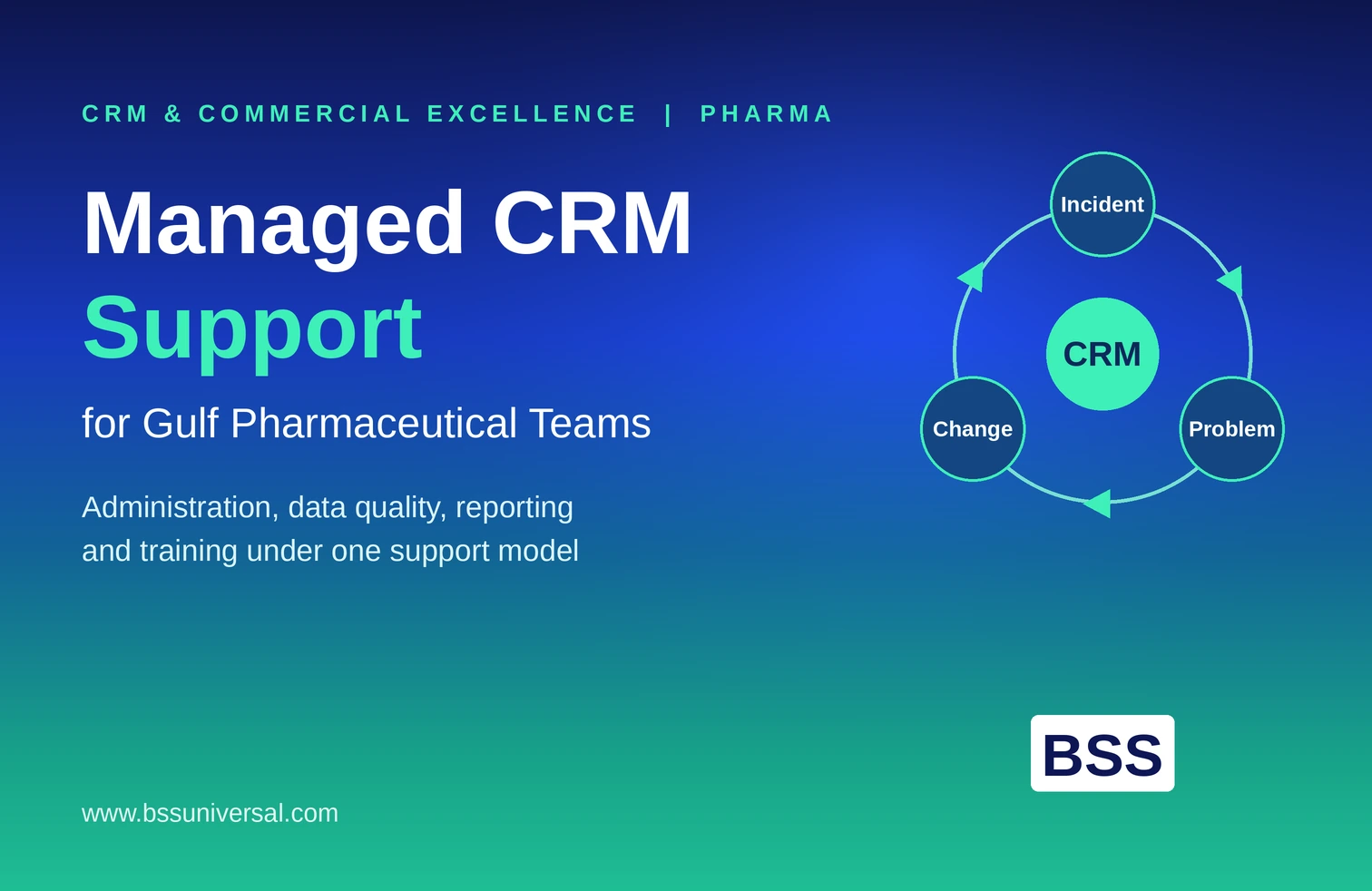
Incident management aims to restore an affected service as quickly as appropriate. Problem management investigates recurring incidents and their underlying causes. Change management ensures that system modifications are assessed, authorized, tested and documented.
These activities should work together.
For example, if several employees experience the same call-reporting error, the support team should resolve the immediate disruption, investigate the cause and verify the proposed fix before deployment. Closing each ticket individually without addressing the common cause can allow the problem to continue.
3. Customer data-quality management
Data-quality support should establish measurable rules for completeness, consistency, uniqueness and validity. For relevant HCP and HCO records, the rules should also address professional affiliations, approved data sources and record ownership.
A useful process includes identifying exceptions, assigning responsibility, reviewing corrections and measuring whether quality improves over time. Automated checks can flag suspicious records, while authorized users remain responsible for approving consequential changes.
4. Reporting and dashboard support
Support teams can standardize recurring reports for ticket volumes, resolution times, data-quality exceptions, system adoption and agreed commercial activity metrics.
Where appropriate, Power BI can consolidate CRM data with approved supporting data sources. Before building dashboards, organizations should agree on KPI definitions, data access rules, refresh frequency and reconciliation procedures.
The goal is to make reports dependable enough for operational reviews without introducing another layer of manual reconciliation.
5. User training and knowledge management
Training should reflect the user's responsibilities. Sales representatives may need help with account updates and activity reporting, while managers may require guidance on reviewing performance dashboards and resolving data exceptions.
Administrators need separate documentation for permissions, configuration changes and escalation procedures.
Short task-based instructions, recorded demonstrations, refresher sessions and a searchable knowledge base can reduce avoidable support requests. Training effectiveness should be measured through practical task completion and improvements in recurring error patterns.
6. Continuous optimization
Managed support should also identify opportunities to simplify workflows. These might include reducing duplicate data entry, improving validation rules, standardizing reports or automating repetitive administrative tasks.
Every proposed improvement should have a defined business objective, an accountable owner and a test plan. Automation should be introduced only after the underlying process has been reviewed and appropriate controls are established.
How to Establish a Managed CRM Support Model
A practical implementation can begin with an assessment and progress through the following stages.
Step 1: Assess the existing environment
Document the current CRM platform, user groups, business workflows, integrations, recurring incidents and reporting arrangements. Review available support tickets and identify the most disruptive or frequent issues.
Confirm the client's existing contracts and internal responsibilities before assigning work to an external support provider.
Step 2: Define the scope and ownership
Separate routine administration, technical troubleshooting, data-quality tasks, reporting support and enhancement requests. Assign an owner to each activity and define which decisions require approval from the client.
The scope should identify included services, excluded work, support hours, escalation routes and responsibilities for vendor-managed components.
Step 3: Establish ticket priorities and service targets
Create ticket categories for access issues, configuration errors, data problems, integration failures, reporting defects and user questions.
Severity should reflect business impact, affected users and the availability of a suitable workaround. The support agreement should define response and resolution targets separately, since a response does not necessarily mean that an issue has been resolved.
Step 4: Introduce change control and testing
Classify changes according to risk. Document the requested outcome, approval, test evidence, release plan and rollback approach where appropriate.
Changes affecting customer data, permissions, integrations or widely used workflows require particular attention. Testing should reflect the real business process rather than checking only whether the software technically opens.
Step 5: Launch reporting and governance reviews
Provide recurring reports showing ticket trends, aging incidents, recurring problems, data-quality exceptions and performance against agreed service targets.
Schedule regular reviews with the relevant business and IT stakeholders. Use these reviews to decide which problems require permanent fixes, additional training or workflow redesign.
Step 6: Improve the service continuously
Compare performance against the initial baseline. Prioritize changes according to business impact, risk, effort and the availability of reliable evidence.
The support model should evolve as the organization introduces new workflows, changes business priorities or expands into additional markets.
Technical and Governance Considerations for Pharmaceutical CRM
Pharmaceutical CRM environments may support customer engagement planning, call reporting, segmentation, consent preferences and approved content workflows. The exact capabilities depend on the selected platform and its configuration.
Data governance should clarify who can create, modify, approve and access records. Support teams should follow applicable privacy obligations, company policies and approved procedures for customer information. Saudi and UAE operations may have different local requirements, so a regional support model should not assume that one country's process automatically satisfies every market's obligations.
Integrations also require defined ownership. When CRM data feeds reporting platforms or connects to other enterprise applications, support procedures should monitor failed transfers, delayed updates and inconsistent records. Reconciliation reports and exception logs can help identify problems before they affect business decisions.
Where AI is introduced for ticket classification, suggested responses or workflow assistance, it should operate within approved access boundaries. Important changes and decisions involving sensitive data should have appropriate human review, auditability and fallback procedures.
The objective is to improve operational reliability without weakening data protection, accountability or business controls.
How Managed CRM Support Applies Across Gulf Markets
Saudi Arabia: Riyadh and Jeddah
Organizations operating across Riyadh and Jeddah may need a consistent support model for users, reporting and business processes while allowing for approved local differences.
A shared ticket taxonomy, standardized KPI definitions and documented escalation procedures can make it easier to compare service performance across teams. Pharmaceutical manufacturers and distribution businesses can also benefit from clearly assigned ownership of customer records and field-activity data.
United Arab Emirates: Dubai and Abu Dhabi
Companies with teams or business functions across Dubai and Abu Dhabi may need coordinated administration, data access and reporting. A regional support model can help standardize routine operations while preserving appropriate market-specific processes.
City targeting should reflect actual company operations, service coverage or relevant market requirements rather than simply inserting city names into otherwise identical content.
For both countries, the support scope should be based on a verified understanding of the client's current systems, operating model and priorities.
Which KPIs Show Whether CRM Support Is Working?
A managed support service should be measured through a balanced set of operational and quality indicators.
KPIWhat it measuresFirst-response timeHow quickly support acknowledges a reported issueMean time to resolutionHow long incidents take to resolve, interpreted by severity and complexitySLA attainmentPerformance against agreed service targetsRepeat incident rateWhether the same problems continue to occurTicket backlog and agingThe volume and age of unresolved requestsData-quality exception rateThe prevalence of records that fail agreed validation rulesChange success rateThe proportion of changes completed without a defined failure or rollbackUser adoptionUsage of relevant workflows, interpreted alongside completion qualityReporting reliabilityWhether reports are delivered on time and reconcile to agreed sourcesTraining effectivenessWhether users can complete the tasks covered by training
Targets should be established after a baseline assessment rather than selecting arbitrary percentages. Improvement should be evaluated against the original position, service scope and complexity of the work.
How BSS Universal Can Support CRM Operations
BSS Universal's CRM & Commercial Excellence Solutions can be positioned around the operational work required to keep CRM workflows dependable and useful.
Depending on the client's current environment, a proposed engagement may include a CRM support assessment, ticket and escalation design, administration procedures, data-quality controls, reporting improvements, user training and a prioritized optimization roadmap.
The engagement should begin by confirming the CRM platform, internal ownership, current support gaps and required outcomes. BSS Universal can then define a suitable scope with clear deliverables, responsibilities, service targets and review processes.
For organizations requiring broader capabilities, related data engineering and analytics, cloud architecture or custom development work may be considered where the assessment identifies a justified need. These services should be scoped separately rather than assumed to be part of every CRM support engagement.
Learn more about BSS Universal's CRM & Commercial Excellence Solutions.
Frequently Asked Questions
What is managed CRM support?
Managed CRM support is an ongoing service for administering, troubleshooting, monitoring and improving a CRM environment. Depending on the agreement, it may also include data-quality checks, reporting, training and change management.
Do pharmaceutical companies need managed CRM support after implementation?
Implementation does not remove the need for ongoing administration, issue resolution, user enablement and data governance. The appropriate support model depends on the organization's internal capabilities, platform complexity and business requirements.
Can managed CRM support include Salesforce or Veeva?
The scope depends on the client's actual platform, licensing, access arrangements and the support provider's verified capabilities. The existing system should be confirmed before agreeing to platform-specific implementation or administration work.
How should CRM support SLAs be defined?
SLAs should specify service coverage, ticket priorities, response targets, resolution or workaround expectations, escalation routes and reporting responsibilities. They should reflect business impact and the complexity of each issue.
How can CRM support improve data quality?
Support can introduce validation rules, exception reporting, duplicate detection, clear record ownership and controlled correction processes. Recurring quality reviews help establish whether the causes of data problems are being addressed.
How can a company evaluate a CRM support provider?
Evaluate the proposed scope, relevant technical capabilities, security practices, escalation arrangements, documentation, reporting methods and measurable service commitments. Confirm platform experience and certifications independently instead of relying on unsupported claims.
Improve CRM Reliability with a Structured Support Model
Reliable CRM operations require more than fixing individual technical issues. Pharmaceutical organizations need clear ownership, effective support processes, dependable data, useful reporting and training that helps people follow approved workflows.
BSS Universal can help organizations assess these requirements and develop a structured CRM support approach aligned with their technology environment and commercial objectives.
Contact BSS Universal to discuss your CRM support requirements, identify operational gaps and define a practical improvement roadmap.