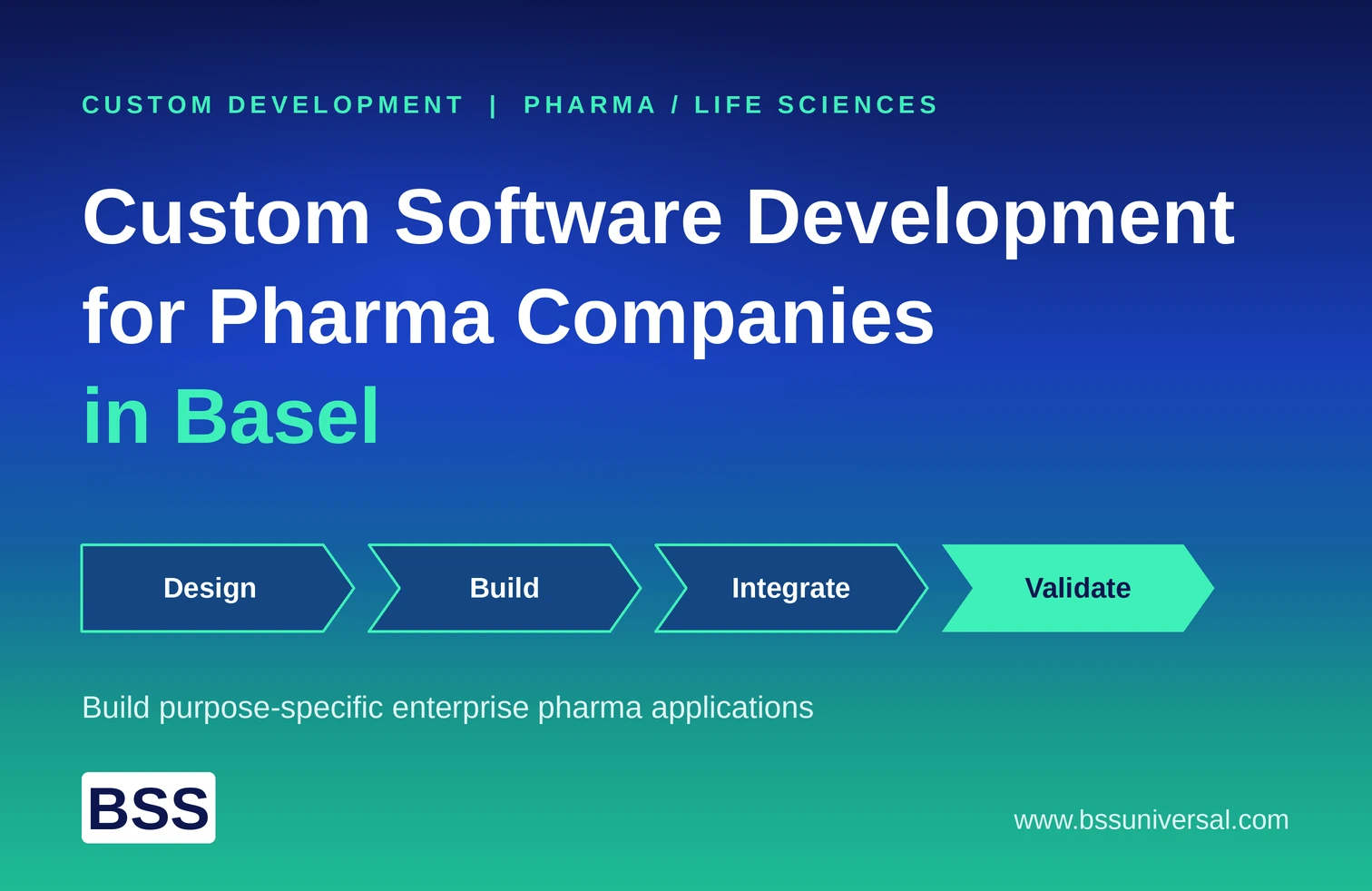
Custom Software Development for Pharma Companies in Basel
Custom software development for pharma companies means designing and building applications around a specific business or regulated process that standard products do not cover well. For pharma teams in Basel, the strongest cases are bespoke tools that connect to ERP, LIMS, MES, quality, and identity systems and that can be validated and supported for years. BSS Universal's Custom Development team helps life sciences organizations [build purpose-specific enterprise pharma applications] by combining product design, engineering, integration, and validation-ready delivery.
This guide explains when to build instead of buy, which applications suit custom development, how to integrate with enterprise systems, and how to run a validation-aware program.
What Custom Software Development Means for Pharma Companies
Custom pharma software is an application or integration built for one organization's process, data, and compliance needs. It differs from configuring a standard product, because the team designs the logic, data model, screens, and interfaces itself. It can be a small workflow tool, a portal, a middleware service, or a larger enterprise application.
Typical building blocks:
- Application layer: Web or desktop applications for a defined user group
- Integration layer: APIs, middleware, and event flows that connect enterprise systems
- Data layer: Databases and data models with audit trails
- Identity and access: Single sign-on, roles, and approval rules
- AI features: Optional assistants or document tools, with human review
- Operations: Monitoring, backup, release management, and support
Why Basel Pharma Teams Invest in Bespoke Applications
Basel pharma teams invest in bespoke applications because large, regulated organizations have processes that standard software only partly fits. Basel is a major life sciences hub, home to global pharma companies, specialist suppliers, and research groups, and teams often work across German, English, and French-speaking neighbors in the tri-border region.
Three pressures stand out:
- Process gaps: A standard product covers most of a workflow, and spreadsheets or email cover the rest.
- Integration load: Staff move data between ERP, laboratory, quality, and document systems by hand.
- Compliance pressure: Manual steps create weak audit trails, which raises inspection risk.
Custom software can close these gaps when the process is stable, specific, and valuable enough to justify the build.
Build or Buy: How to Decide
You should build custom software when the process is unique, no product fits well, and the application will live long enough to repay the investment. You should buy or configure a product when a mature option covers most of the need. The decision is about total cost and risk, not preference.
Choose to build when:
- The workflow is specific to your organization and gives you an operational edge
- Existing products need heavy workarounds
- You need tight integration with several internal systems
- You want to own the logic and roadmap
Choose to buy or configure when:
- A proven product already covers the main need
- The process is common across the industry
- Your team lacks capacity to maintain software long term
- Vendor validation packages reduce your effort
A hybrid is common. Teams buy a core platform and build small extensions and integrations around it.
Application Types That Suit Custom Development in Pharma
The best custom applications are narrow, high-value tools tied to a specific process. Each of the following types appears often in pharma environments.
Quality and Compliance Workflow Tools
These tools manage deviations, change requests, document review, and approvals where a standard quality system does not fit a local process. Key design points include audit trails, electronic signatures, role-based approvals, and clear links to the system of record.
Laboratory and Manufacturing Support Applications
These applications help laboratory and plant teams with tasks such as sample tracking, instrument data capture, batch review support, and equipment logs. They often sit between instruments, LIMS, MES, and ERP, so interface quality matters more than screen design.
Integration Services and Middleware
Middleware connects enterprise systems through APIs and message flows, so data moves without manual re-entry. It should log every transaction, handle failures safely, and be monitored. This is often the highest-value custom work, because it removes silent errors between systems.
Portals for Partners, Sites, and Internal Users
Portals give suppliers, contract partners, or internal teams one controlled entry point for requests, documents, and status. They reduce email chains and give owners clear visibility.
Data and Reporting Applications
These applications combine data from several sources into governed views for operations, supply, or quality. They work best on a clean data foundation, with shared definitions and access rules.
AI-Assisted Applications
Custom apps can include AI features such as document extraction, summarization, or search. In regulated settings, these features need human review, logging, and clear limits. Teams should keep AI for operational and administrative uses unless a regulatory review confirms a wider scope.
Integrating Custom Software with Enterprise Systems
Integration is where most custom pharma projects succeed or fail, so it deserves its own design phase. Custom software should connect to enterprise systems through supported interfaces, not through fragile shortcuts.
Key design points:
- API-first design: Use documented APIs and avoid direct database access to other systems
- Systems of record: Decide which system owns each data element, and never create a second source of truth
- Error handling: Plan retries, alerts, and manual recovery paths
- Identity: Use single sign-on and central access management
- Change control: Version interfaces, and agree on release windows with system owners
- Performance: Test load on source systems before go-live
- Monitoring: Track transactions end to end, so support teams can trace a failed record
GxP, Validation, and Quality Practices
Validated custom software needs a documented, risk-based lifecycle from requirements to retirement. The pharma company remains responsible for validation, and should confirm requirements with its quality and compliance teams.
Key practices:
- Risk-based approach: Use computerized system validation methods such as GAMP 5, and scale testing to patient, product, and data integrity risk. Custom applications usually sit in the highest software category, so they need strong development controls.
- Requirements and traceability: Link each requirement to design and tests
- Version control and release management: Keep a controlled record of every change
- Automated testing: Run repeatable tests on every release
- Audit trails and electronic signatures: Design for rules such as EU GMP Annex 11 and 21 CFR Part 11 where they apply
- Supplier assessment: Assess the development partner's quality system
- Documentation: Write once, at a depth that matches the risk
Security, Privacy, and Data Location
Security for pharma software means protecting intellectual property, quality records, and personal data throughout the lifecycle. Teams should design access, logging, and hosting early.
Key areas to cover:
- Access control: Least privilege, role-based access, and regular reviews
- Data protection: The revised Swiss Federal Act on Data Protection (FADP) governs personal data, and GDPR may also apply to EU data
- Hosting location: Decide where code, data, and backups may sit
- Secure development: Code review, dependency checks, and secret management
- Certification: ISO 27001 is a recognized standard for information security management. BSS Universal's delivery is ISO 27001 certified.
This article is general information and not legal advice.
How BSS Universal Approaches Custom Software for Pharma
BSS Universal approaches custom pharma software as a phased program that delivers a working piece early and grows from there. A dedicated client point of contact works with the business owner and quality representative from day one.
A typical program follows these steps:
- Discovery and business case: Define the process, users, and success measures, and test the build-or-buy choice
- Requirements and risk assessment: Write clear requirements, and assess risk to set the validation depth
- Architecture and integration design: Design the data model, interfaces, access, and hosting
- Iterative build: Build in short cycles with real users reviewing working software
- Testing and validation: Run automated and manual tests, and produce evidence at the agreed depth
- Release and training: Release in stages, with role-based training
- Support and evolution: Monitor, fix, and improve under a clear support model
How BSS Universal's Team Handles This
BSS Universal's Platform Engineering and Extensibility team starts every build with a short process workshop that includes the business owner, the end users, and quality. The team defines the first working slice and the interfaces it needs, then builds it with automated tests and controlled releases. Where AI is part of the application, the Human-in-the-Loop and Escalation Design function sets what the AI may do alone and when a person must review. The Responsible AI and Governance function defines logging and monitoring before launch. Progress is reported in plain language, so business and quality leaders can agree on each step.
What Custom Pharma Software Costs
The cost of custom pharma software depends on scope, number of integrations, validation depth, security needs, and the support model. A small workflow tool costs far less than an enterprise application. Budget should cover the full lifecycle, not only the build.
Main cost drivers:
- Discovery and design
- Development and integration
- Validation and documentation: Often a large share for regulated uses
- Infrastructure and hosting
- Security review and testing
- Training and change management
- Long-term support: Fixes, upgrades, and dependency updates
Fund discovery and a first release before committing to the full scope.
How to Choose a Custom Development Partner in Basel
The right partner combines engineering quality, pharma process knowledge, and a long-term support model. Buyers should test how a partner handles validation, integration, and ownership, not only how it presents past projects.
Evaluate partners on these points:
- Pharma and GxP experience: Does the team understand validation, data integrity, and audit evidence?
- Integration skill: Can the team connect ERP, LIMS, MES, and identity systems safely?
- Quality system: Does the partner have documented development controls and testing practices?
- Security credentials: Does the partner hold certifications such as ISO 27001?
- Ownership terms: Who owns the code, documentation, and test evidence?
- Team access: Will you work directly with the engineers?
- Language and local support: How will German and English needs and working hours be handled?
- Long-term support: Who maintains the software after release?
BSS Universal serves clients across the US, MENA, and GCC regions from offices in Arlington Heights, Riyadh, and Dubai, with a delivery center in Lahore. Basel buyers should ask any partner, including BSS Universal, how local engagement and language support will work for their program.
Common Risks and How to Avoid Them
The most common risks are unclear requirements, weak integration design, and missing long-term support. Each is avoidable with early planning.
- Vague requirements: Write testable requirements with the business owner.
- Building what exists: Check the market before committing to a build.
- Fragile integrations: Use supported APIs and plan for failures.
- Late validation: Plan evidence from the start, not at the end.
- Single-person dependency: Keep documentation and a second engineer on every system.
- Unplanned maintenance: Budget for upgrades and security patches.
- Scope creep: Release a small first version, then expand.
Getting Started
The best way to start is a short discovery phase that tests the build-or-buy decision and defines a small first release. This produces a clear plan before major spending.
A practical first set of actions:
- Name a business owner and a quality representative
- List the processes where standard tools fall short
- Test the build-or-buy choice for each candidate
- Map the systems the application must connect to
- Agree on validation depth, hosting, and security needs
- Pick a first release that users can adopt and you can measure
To plan your build with a team that focuses on bespoke applications and enterprise integration, and share your goals.
Frequently Asked Questions
What is custom software development for pharma?
Custom software development for pharma means building applications and integrations for a specific pharma process. It suits needs that standard products do not cover, such as local quality workflows, laboratory support tools, and system integrations.
When should a pharma company build instead of buy software?
Build when the process is unique, no product fits well, and the application will live long enough to repay the cost. Buy or configure when a mature product covers most of the need. Many teams combine both.
Does custom software need GxP validation?
Custom software that supports regulated processes usually needs validation. A risk-based approach, such as GAMP 5, sets the depth of testing and documentation. Confirm the scope with your quality and compliance teams.
How do custom applications integrate with ERP, LIMS, and MES?
They connect through documented APIs, middleware, and event flows. Good designs name a system of record for each data element, log every transaction, and plan for failures.
Can custom pharma software include AI features?
Yes, for operational and administrative uses such as document extraction and search. Keep human review, logging, and clear limits, and check any borderline case with regulatory experts.
How long does custom software development take?
Timelines depend on scope, integrations, and validation depth. A small first release can ship in months, while larger applications take longer. A phased plan with checkpoints gives the best view of progress.
Who owns the code in a custom development project?
Ownership depends on the contract, so agree on it early. Ask for clear terms on source code, documentation, and test evidence, and on what happens if the partnership ends.