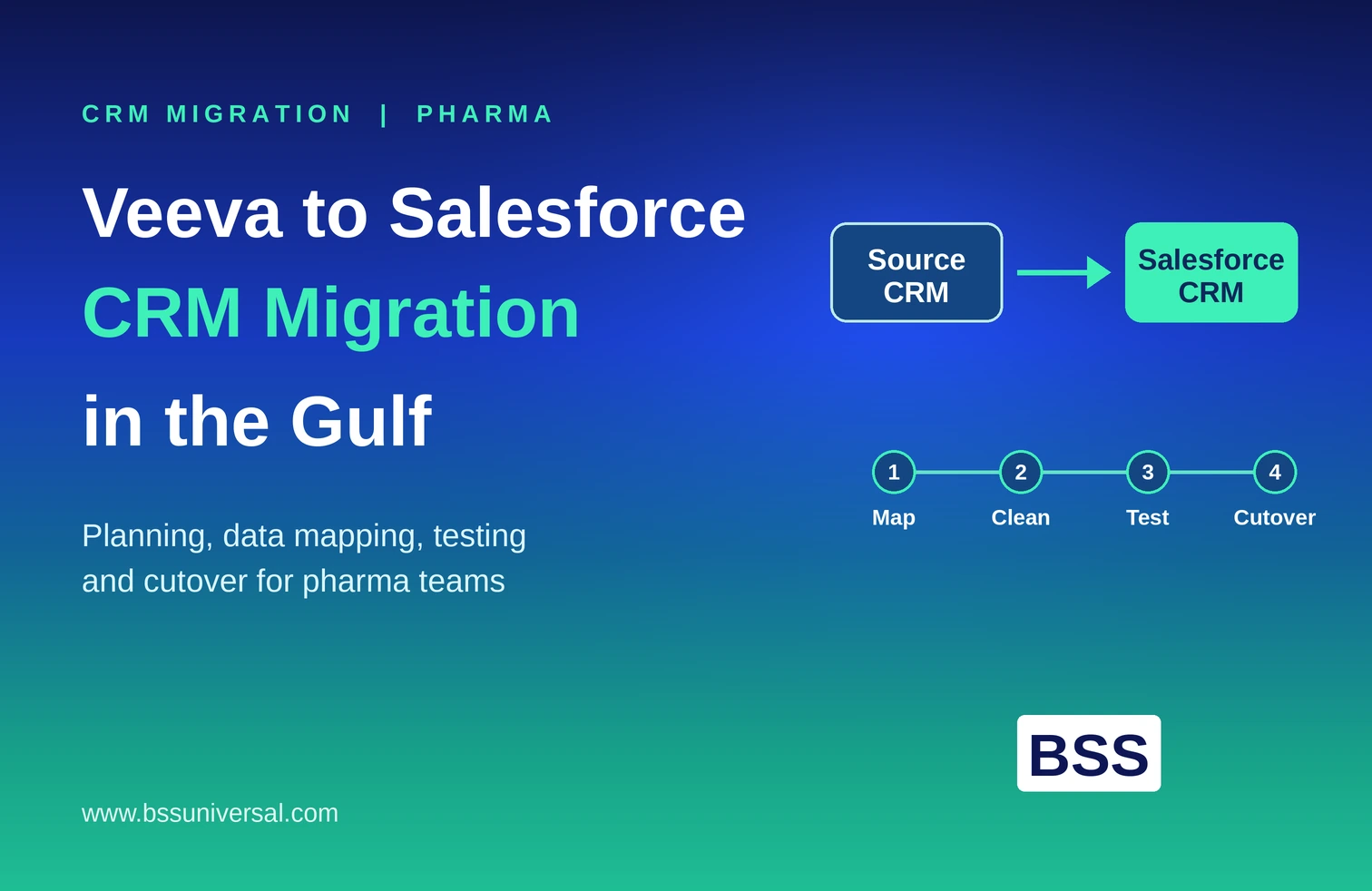
Planning a Veeva-to-Salesforce CRM Migration in the Gulf
A customer relationship management (CRM) migration can affect customer records, sales processes, reporting, integrations and daily work across an organization. For pharmaceutical companies, the challenge is not simply moving data from one system to another. The new environment must support field operations, customer engagement, accurate reporting and appropriate data governance without unnecessary disruption.
For businesses operating across Saudi Arabia and the United Arab Emirates, migration planning may also involve regional stakeholders, different market requirements, multiple user groups and shared global technology standards. A migration that overlooks these dependencies can create incomplete records, inconsistent reports, delayed workflows and avoidable support requests after launch.
A successful Veeva-to-Salesforce CRM migration begins with a clear understanding of the existing environment, the intended destination and the business outcomes the project must deliver. Careful planning, controlled data movement, realistic testing and structured user adoption help reduce risk throughout the transition.
BSS Universal's CRM & Commercial Excellence Solutions, Data Engineering & Analytics, and Custom Development capabilities can support organizations in assessing these requirements and defining a practical migration approach based on their confirmed technology environment.
The Operational Problems a CRM Migration Must Address
Unclear Data Mapping and Legacy Fields
Source systems often contain fields, record types, classifications and custom configurations that do not have direct equivalents in the target system. Some fields may be obsolete, while others may contain values that have different meanings across business units.
Moving these fields without reviewing their purpose can preserve old inconsistencies or create new ones. Before migration begins, business and technical teams should agree which information must be retained, transformed, redesigned or retired.
A source-to-target mapping document should specify each field, its destination, transformation rules, validation requirements, ownership and treatment of exceptions.
Inconsistent HCP and HCO Records
Pharmaceutical CRM environments may contain healthcare professional (HCP) and healthcare organization (HCO) records, professional affiliations, account hierarchies and customer interaction histories.
Duplicates, missing identifiers and inconsistent affiliations can affect targeting, account coverage and reporting. These problems become more difficult to resolve when records are copied into the new platform without a defined data-quality process.
A migration team should profile the source data, identify duplicates, agree on record-matching rules and document how uncertain matches will be reviewed. Records should not be merged or deleted automatically when the identity or relationship is unclear.
Disrupted Integrations and Reporting
CRM platforms may exchange information with data warehouses, analytics systems, identity services, content platforms and other enterprise applications. Changing the CRM environment can affect these connections even when the main customer records appear to have migrated successfully.
Reports may also depend on formulas, historical definitions or undocumented transformation rules. If these dependencies are not identified early, the new system may produce results that differ from established reports without a clear explanation.
The migration inventory should include interfaces, scheduled data flows, dashboards, reports, permissions and downstream dependencies.
Different Regional Workflows
A regional CRM program may need to support common global processes alongside approved local variations. Sales planning, customer engagement, data access and reporting requirements should be documented before the target configuration is finalized.
For teams serving Riyadh, Jeddah, Dubai and Abu Dhabi, the objective is not to create a separate CRM design for every city. It is to establish a consistent regional foundation while accommodating genuine differences in business operations and applicable requirements.
A Practical Framework for Veeva-to-Salesforce CRM Migration
Step 1: Confirm the Source and Target Platforms
Begin by identifying the precise source application, version, architecture, customizations, integrations and licensing arrangements.
The term Veeva CRM should not automatically be treated as interchangeable with Veeva Vault CRM. The technical approach depends on the actual source environment and whether the destination is Salesforce Life Sciences Cloud or another approved Salesforce configuration.
Document the target architecture, required functionality, business ownership, vendor responsibilities and migration boundaries. Confirm these details with the relevant platform providers before committing to a design or timeline.
Step 2: Assess Business Processes and Technical Dependencies
Inventory the data objects, custom fields, workflows, reports, integrations, user roles and business rules that support current operations.
Interview the relevant stakeholders to identify which processes must remain unchanged, which require improvement and which are no longer needed. Include sales operations, commercial excellence, data owners, IT, compliance and reporting teams as appropriate.
The outcome should be a documented baseline, a dependency register and a prioritized set of migration requirements.
Step 3: Profile and Clean the Data
Analyze the source data before extraction. Review completeness, duplicate records, inconsistent formats, missing identifiers and relationships that cannot be validated automatically.
Define data-quality rules and assign ownership for corrections. Separate routine data cleaning from decisions requiring business approval, particularly where HCP/HCO identity or customer relationships are uncertain.
Cleaning data before migration helps prevent avoidable errors from being carried into the new environment.
Step 4: Build and Validate the Mapping
Map every in-scope source object and field to the agreed target structure. Document transformation logic, default values, reference data, relationship rules and exception handling.
A mapping specification should also explain how historical information will be treated. Not every legacy record or field needs to be migrated into an operational system; retention, accessibility and reporting requirements should guide the decision.
Use representative test data to validate the mappings and obtain approval from the responsible business owners before production migration.
Step 5: Run Controlled Trial Migrations
Perform trial loads in a suitable non-production environment before the final cutover.
Compare source and destination records, verify relationships, investigate failed records and review transformed values. Test real business scenarios, including customer lookup, account updates, activity reporting and relevant integrations.
Each trial should produce a reconciliation report, an exception log, assigned corrective actions and a decision on whether the next migration stage can proceed.
Step 6: Complete User Acceptance Testing
User acceptance testing (UAT) confirms whether the solution supports the agreed business requirements.
Representatives from the relevant user groups should test normal workflows, exceptions, permissions, reporting outputs and integrations. Test scenarios should reflect the work users actually perform rather than focusing only on technical functionality.
Record the results, prioritize defects according to business impact and define explicit approval criteria. Critical defects should be resolved or formally addressed before go-live.
Step 7: Plan Cutover and Post-Launch Support
The cutover plan should define the migration sequence, data freeze arrangements, final extraction, validation, decision owners and go/no-go criteria.
Include communication plans, fallback options and rollback conditions where technically feasible. Confirm how business operations will continue if a critical migration step fails or the destination system is not ready.
After launch, hypercare provides structured support for users, data issues, integration failures and unexpected workflow problems. Assign named owners for unresolved items and agree when responsibility will transition into routine operations.
Technical and Governance Considerations
Data Security and Regulatory Requirements
Pharmaceutical CRM data may include personal information, professional contact details and records of customer interactions. Migration teams should establish appropriate access controls, approved transfer methods, retention rules and data-handling responsibilities.
Saudi Arabia's Personal Data Protection Law and applicable UAE data-protection requirements should be assessed in the context of the organization's activities, data flows and legal obligations. The applicable rules may vary according to the entity and operating environment.
Security and privacy reviews should take place during design, not as a final checklist immediately before launch. Where required, involve the client's legal, privacy and information-security teams.
Integrations and Custom Development
Legacy workflows may depend on custom components, APIs, reporting pipelines or scheduled transfers that need to be redesigned for the destination environment.
Document each dependency and decide whether it should be retained, replaced or retired. Integration testing should verify not only successful data transfer but also error handling, retries, reconciliation, access controls and monitoring.
Custom development should address a clearly defined requirement that cannot be met adequately through an approved standard configuration. This helps limit unnecessary complexity and reduces the burden of future maintenance.
Data Ownership and Change Control
Migration success depends on decisions being made by the correct people. Technical teams can identify mapping options, but business owners should approve consequential decisions about record meaning, reporting definitions and workflow changes.
Maintain version-controlled mapping documents, requirements, test evidence, approvals and issue logs. This creates a reliable record of why decisions were made and helps teams investigate problems after launch.
KPIs for Measuring Migration Success
Migration progress should be measured through predefined indicators rather than a single completion percentage.
KPIWhat it measuresMapping coverageThe proportion of in-scope fields with approved mappingsData completenessWhether required destination fields contain valid informationDuplicate rateThe prevalence of duplicate records under agreed matching rulesReconciliation varianceDifferences between expected and migrated records or valuesUAT pass rateThe proportion of executed test cases that meet acceptance criteriaCritical defectsUnresolved high-impact issues at key project milestonesCutover durationThe elapsed time required to complete the approved cutover processIntegration successWhether required data transfers complete and reconcile correctlyUser adoptionWhether users adopt the new workflows and complete required activitiesReporting consistencyWhether approved KPIs reconcile to their agreed source data
Define each metric, its calculation, its source and its owner before testing begins. Establish a baseline where appropriate and set targets according to the project's complexity and risk profile. Do not treat a high UAT pass rate or completed data load as proof that every business requirement has been satisfied.
Applying the Migration Approach in Saudi Arabia and the UAE
Riyadh and Jeddah, Saudi Arabia
For teams operating in Riyadh and Jeddah, migration planning can include field-force workflows, customer master data, regional reporting requirements and alignment with global business processes.
The project should verify which activities and systems are actually used by the relevant teams. Saudi-specific data governance and privacy requirements should be assessed by the appropriate internal specialists.
Dubai and Abu Dhabi, United Arab Emirates
For regional teams operating in Dubai and Abu Dhabi, the design should clarify shared services, local responsibilities, integration ownership and reporting requirements.
Testing should include the workflows used by the relevant business units and any approved differences in operating processes. Market localization should reflect verified needs rather than assuming every team requires an identical configuration.
These cities are the workbook's target markets for this article; their inclusion does not establish that a particular company is running a migration project in each location.
How BSS Universal Can Support CRM Migration
BSS Universal can help organizations define a structured migration approach through three relevant service areas.
CRM & Commercial Excellence Solutions can support business-process assessment, requirement mapping, customer engagement workflows, adoption planning and commercial reporting considerations.
Data Engineering & Analytics can support data profiling, source-to-target mapping, validation, reconciliation, integration pipelines and migration-quality dashboards.
Custom Development can address approved integration requirements, specialized workflows and extensions where standard platform functionality does not meet the documented business need.
The appropriate scope depends on the actual source platform, destination environment, licensing, technical access and internal responsibilities. A discovery assessment should establish those facts before any delivery commitment is made.
Explore BSS Universal's CRM & Commercial Excellence Solutions, Data Engineering & Analytics and Custom Development.
Frequently Asked Questions
How long does a Veeva-to-Salesforce CRM migration take?
The duration depends on the source application, data volume, customization, integration complexity, validation needs and regional scope. A reliable timeline should be established after discovery, dependency assessment and migration planning.
What is the biggest risk in CRM migration?
There is rarely one universal risk. Poor data mapping, unvalidated records, missed integrations, incomplete testing and weak user adoption can each threaten the outcome. A structured assessment helps identify the most significant risks for the specific environment.
Should all legacy CRM data be migrated?
Not necessarily. Data should be assessed against operational, reporting, retention and business requirements. Some information may need transformation, archival or separate access rather than migration into the new operational system.
What is the difference between UAT and data reconciliation?
Data reconciliation compares expected source and destination records or values. UAT checks whether the configured solution supports the agreed business processes. Both are necessary because accurate data alone does not prove that workflows operate correctly.
Can BSS Universal support migration across multiple Gulf markets?
BSS Universal can assess the requirements and propose a suitable scope for regional migration support. The proposed approach should account for the actual platforms, available technical access, local operating requirements and approved project responsibilities.
Plan Your CRM Migration with Confidence
A successful CRM migration requires more than moving records. It requires clear business ownership, validated data, tested integrations, realistic cutover planning and support that helps users adopt the new environment.
BSS Universal can help your organization assess its migration requirements, document technical dependencies and develop a practical roadmap for CRM, data and integration work.
Contact BSS Universal to discuss your CRM migration objectives and establish a clear, evidence-based plan for your next steps.