Why Pharmaceutical Analytics Needs a Better Approach to Distributed Data
Pharmaceutical companies generate valuable data across research laboratories, clinical operations, manufacturing facilities, quality management systems, supply chains and commercial platforms. However, having access to large amounts of data does not necessarily mean that teams can use it effectively.
Information is often distributed across enterprise resource planning (ERP) systems, laboratory information management systems (LIMS), manufacturing execution systems (MES), customer relationship management (CRM) platforms, clinical applications and cloud data warehouses. Connecting these systems through separate integration pipelines can introduce delays, duplicated information and inconsistent business definitions.
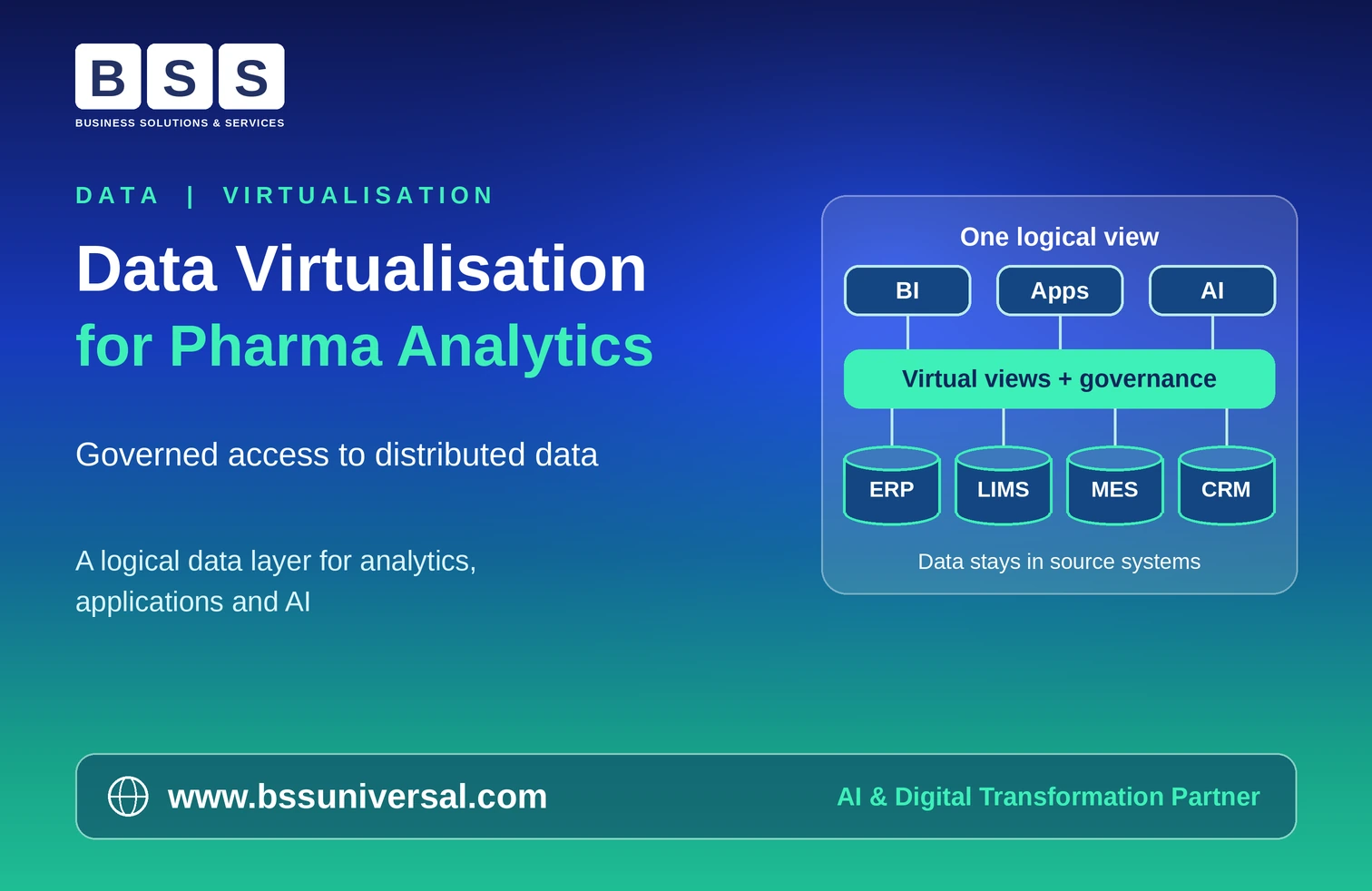
Pharmaceutical data virtualisation offers another approach. It creates a logical data access layer that allows authorised users and applications to retrieve and combine information from distributed sources without requiring every dataset to be physically consolidated first.
For pharmaceutical organisations operating across multiple facilities, business units and GCC markets, this approach can improve how enterprise data is accessed for analytics and operational decision-making.
However, virtualisation is not a replacement for every integration or storage requirement. Its effectiveness depends on source-system readiness, query performance, governance and the suitability of individual workloads.
What Is Data Virtualisation in Pharmaceutical Analytics?
Data virtualisation is a data management approach that provides a unified logical view of information distributed across different systems.
Instead of first copying every dataset into a central repository, a virtualisation platform connects to existing sources and presents their information through reusable data views.
For example, a pharmaceutical company may maintain:
- Product and inventory information in an ERP system.
- Laboratory results in LIMS.
- Production information in MES.
- Clinical trial information in clinical data platforms.
- Customer and sales information in CRM.
- Historical analytics datasets in a cloud data warehouse.
A data virtualisation layer can connect relevant information from these systems and make it available through consistent interfaces.
Users can then access combined information through their existing business intelligence (BI) tools, analytical applications and authorised data services.
The important distinction is that the logical layer provides a consistent way to access information without requiring all underlying systems to be replaced or consolidated.
How a Logical Data Layer Works
A typical architecture includes four main components:
1. Distributed data sources
Information remains within its existing systems, including operational databases, warehouses, data lakes, SaaS platforms and enterprise applications.
2. Virtual data integration
The virtualisation platform establishes connections with these sources, maps their structures and creates reusable logical views.
3. Business and governance layer
Data architects define relationships, business definitions, access permissions and reusable data models. This helps different departments work with consistent information.
4. Data consumption
Approved consumers access the resulting views through BI platforms, applications, reporting tools and suitable AI or machine learning workflows.
Depending on the use case, queries can be executed against underlying sources, optimised through query pushdown, or supported by caching and materialisation.
This flexibility makes enterprise data virtualisation useful in environments where different teams need information at different levels of freshness and performance.
Why Pharmaceutical Companies Struggle With Distributed Data Access
The challenge is not simply that pharmaceutical companies have multiple databases. The larger problem is that information must be combined across systems that were designed for different operational purposes.
Fragmented Data Across Research and Clinical Operations
Research teams work with laboratory systems, scientific applications, experimental results and other specialised datasets.
Clinical teams maintain trial-related information, study records, site performance data and patient-related information within their respective systems.
When these environments remain disconnected, analysts may need separate extracts and integration processes to develop cross-functional views.
This can make it difficult to access consistent information across research programmes and clinical operations.
Data virtualisation can provide a logical access layer for authorised information from these environments, subject to source-system capabilities and appropriate controls.
Disconnected Manufacturing and Quality Information
Manufacturing facilities generate information through MES, equipment systems, historians, ERP and quality management applications.
For example, an operations team may need to compare production volumes, material availability, equipment performance and quality indicators across multiple facilities.
When these datasets are accessed through independent pipelines, maintaining consistent reporting can require substantial integration and reconciliation work.
A shared logical data layer can help expose relevant information through reusable views while allowing the original operational systems to remain in place.
Importantly, this does not replace the validated systems responsible for manufacturing execution or quality records.
Delayed Enterprise and Supply Chain Reporting
Pharmaceutical supply chains involve suppliers, manufacturing locations, warehouses, distributors and regional operations.
Inventory information, shipment status, demand forecasts and order data may be maintained across different platforms.
A central reporting process that depends on frequent extraction and consolidation may not always provide the information freshness required by operational teams.
Virtualised access can help combine selected information from these systems, provided that the sources can support the required query workload.
Inconsistent Business Definitions
Different departments may calculate the same business metric differently.
For example, regional teams might use different definitions for inventory availability, product demand, sales performance or manufacturing output.
This creates confusion when leadership compares performance across facilities or markets.
A governed logical layer can establish reusable business views and definitions, reducing the need to recreate integration logic in every reporting environment.
Where Data Virtualisation Can Improve Pharmaceutical Analytics
The most valuable applications depend on the information available, the analytical requirements and the readiness of underlying systems.
Pharmaceutical areaInformation to connectPotential analytical valueResearch and developmentLaboratory, research and scientific datasetsCross-system research analysisClinical operationsTrial, site and study informationConsolidated clinical oversightManufacturingMES, ERP and equipment informationProduction and operational visibilityQuality managementQuality, laboratory and manufacturing informationBetter access to quality-related reportingSupply chainInventory, logistics and distributor dataSupply chain visibilityCommercial operationsCRM, sales and regional business informationConsistent commercial reporting
Connecting Research and Laboratory Information
Researchers and data teams may need to combine selected information from multiple laboratory and scientific systems.
A logical data layer can provide reusable access to compatible datasets without creating a separate physical copy for every analytical request.
This can support cross-system research analysis, although specialised scientific processing and large-scale historical workloads may still require dedicated data pipelines and analytical storage.
Improving Clinical Operations Visibility
Clinical operations teams may benefit from combining authorised trial information with site performance and operational datasets.
A virtualised architecture can expose selected data through consistent analytical views, helping reporting teams investigate operational patterns across studies and locations.
Patient information requires particular care. Access must follow applicable privacy requirements, permissions and approved purposes. A virtual view does not remove the need for privacy controls.
Supporting Manufacturing and Supply Chain Analytics
Manufacturing and supply chain teams often require information from operational and enterprise applications.
For example, a dashboard could combine approved inventory information, production schedules, shipment records and demand data.
This can reduce dependence on manually assembling information from several departmental systems.
The freshness of the resulting dashboard will depend on source availability, query execution and any caching or refresh arrangements.
Data Virtualisation vs Traditional Data Integration
Data virtualisation and traditional ETL or ELT processes address different requirements. Pharmaceutical organisations may need both.
Evaluation areaData virtualisationETL/ELT and warehousingData approachProvides logical access to existing sourcesCopies and processes data into target platformsData freshnessCan support live or cached accessDepends on pipeline and refresh frequencyHistorical analysisDepends on source and architectureWell suited to curated historical datasetsData transformationSupports logical transformations and viewsSupports extensive physical transformationsSource dependencyOften depends on source availability and performanceCan operate on previously ingested datasetsBest applicationDistributed data accessLarge-scale processing and historical analytics
The most effective architecture is frequently a hybrid model.
For example, a pharmaceutical company could use its existing data warehouse for historical sales analysis, a data lake for large-scale research datasets and Denodo for governed access across selected distributed systems.
This avoids forcing every workload into one integration model.
Designing a Governed Pharma Data Virtualisation Architecture
An enterprise implementation needs more than connecting databases and exposing queries.
Pharmaceutical organisations should consider several architectural requirements before deploying a logical data layer.
Establish Data Ownership and Source Readiness
Start by identifying the systems that contain relevant information.
Document their owners, data structures, update frequencies, access methods and operational importance.
Data architects should also establish which system is the authoritative source for each business entity.
For example, inventory quantities, product identifiers and manufacturing records may have different authoritative systems.
Without clear ownership, a logical layer can expose inconsistent information rather than resolve it.
Define Reusable Business Views
Data architects should create views that represent meaningful business information rather than simply reproducing individual database tables.
A reusable pharmaceutical inventory view, for example, might combine approved product, location and inventory attributes from selected systems.
Business definitions should be agreed upon by the relevant data owners before these views are published.
Apply Security and Data Governance
Governance must cover who can access data, what information they can retrieve and how access is monitored.
Important considerations include:
- Role-based and attribute-based access where appropriate.
- Sensitive and patient-related data restrictions.
- Data classification and ownership.
- Lineage and metadata management.
- Access logging and monitoring.
- Regional data residency and transfer requirements.
For GCC organisations, requirements should be assessed separately for each relevant country, data category and cross-border data flow.
Define Performance and Caching Policies
Not every analytical request needs live access.
Frequently accessed dashboards may benefit from caching, while selected operational applications may require fresher information.
The architecture should establish acceptable data freshness, refresh policies, query limits and source-system protection.
Performance testing should include complex joins, concurrent users and the expected workload across different source types.
Regulatory and Data Integrity Considerations
Pharmaceutical organisations must treat data integrity as an architectural requirement rather than an additional platform feature.
Where systems support regulated GxP processes, the intended use of the data, applicable regulations and validation requirements must be assessed.
Relevant considerations may include:
- Preservation and availability of original records.
- Appropriate access permissions.
- Data accuracy and completeness.
- Audit trails and change visibility.
- Data transfer integrity.
- System validation and documented controls.
FDA guidance on pharmaceutical CGMP data integrity and relevant electronic-record requirements, as well as applicable international GMP guidance, provide important reference points.
A data virtualisation platform should not be assumed to replace the controls within source systems or independently establish regulatory compliance.
The design must preserve access to the original records and their required metadata, particularly where analytical outputs support regulated decisions.
Common Data Virtualisation Challenges to Evaluate
Although virtualisation can simplify distributed data access, it introduces architectural considerations that should be evaluated early.
Query performance: Complex queries across multiple systems can introduce latency. Source capabilities, network conditions, query optimisation and workload design all matter.
Source-system load: Frequent analytical queries can affect operational databases. Workload limits, query scheduling and caching may be necessary.
Data freshness: Cached information is not automatically current. Refresh frequency and acceptable latency must be defined for each use case.
Data quality: A unified view cannot automatically correct inaccurate, incomplete or inconsistent source information.
Governance complexity: Access policies must be aligned across the virtualisation layer and underlying systems.
Workload suitability: Large historical aggregations, complex transformations and machine learning training datasets may be better served by physical data integration and storage.
These limitations do not make virtualisation unsuitable. They reinforce the importance of designing it around specific business and technical requirements.
How Pharmaceutical Enterprises Should Evaluate Denodo
Denodo provides data virtualisation capabilities for connecting distributed enterprise information through a logical data layer.
For pharmaceutical organisations, an evaluation should focus on whether its architecture can address actual data access challenges without creating unnecessary complexity.
Before selecting an implementation approach, consider:
- Source connectivity: Can the platform connect to the required ERP, LIMS, MES, CRM, warehouse and cloud data sources?
- Query optimisation: Can appropriate operations be executed at source to reduce unnecessary data transfer?
- Caching requirements: Which datasets need live access, and which can use managed caching?
- Security and governance: Can the architecture apply the required access policies and monitoring controls?
- Analytics compatibility: Can existing BI tools and analytical applications consume the logical data views?
- Scalability: Can the proposed architecture support multiple facilities, regions and concurrent users?
- Operational impact: Will the implementation protect critical source systems from excessive analytical workloads?
A proof of concept should use representative data sources, realistic queries and measurable performance criteria.
This helps decision-makers determine where data virtualisation provides genuine value and where other integration methods remain more appropriate.
How BSS Supports Enterprise Data Virtualisation
Pharmaceutical companies operating complex data environments need an integration strategy that considers existing platforms, business requirements, security and long-term scalability.
BSS provides enterprise data and analytics capabilities, with Denodo expertise positioned around logical data access, governed data delivery and integration across distributed enterprise sources.
Through its Denodo offering, BSS focuses on helping organisations connect existing data environments and make information accessible to analytics, applications and AI initiatives without requiring wholesale replacement of existing data platforms.
The approach considers the relationship between virtualised access, enterprise data integration, analytics architecture and governance.
For pharmaceutical organisations, the first step is to identify where fragmented data access affects reporting, operational visibility and analytical initiatives.
BSS can discuss these requirements and help evaluate an appropriate enterprise data virtualisation architecture.
Explore BSS Denodo and Data Virtualisation Services.
Building a More Connected Foundation for Pharmaceutical Analytics
Pharmaceutical analytics depends on more than collecting information from different systems. Organisations need reliable access, consistent business definitions and appropriate governance across their data environments.
Data virtualisation provides a way to establish a logical access layer while allowing existing warehouses, data lakes and operational applications to continue serving their intended purposes.
Its value depends on selecting suitable workloads, protecting source-system performance and maintaining control over sensitive and regulated information.
For pharmaceutical enterprises across the GCC, evaluating Denodo as part of a broader enterprise data strategy can help identify practical opportunities to improve distributed data access.
Discuss your pharmaceutical data integration and analytics requirements with BSS to evaluate a governed data virtualisation architecture.
Frequently Asked Questions
1. What is data virtualisation in the pharmaceutical industry?
Data virtualisation connects information from distributed pharmaceutical systems through a logical data layer. It allows authorised users and applications to access combined information without requiring every dataset to be physically moved into one central repository.
2. How does data virtualisation support pharmaceutical analytics?
It can provide analytical teams with governed access to information across research, clinical, manufacturing, quality, supply chain and commercial systems. This helps create consistent analytical views across different business functions.
3. What is the difference between data virtualisation and ETL?
ETL extracts information from source systems, transforms it and loads it into another data platform. Data virtualisation provides logical access to distributed information, potentially querying sources when required. Both approaches can work together in a hybrid architecture.
4. Does data virtualisation provide real-time pharmaceutical data access?
It can support live or near-real-time access, depending on source connectivity, system performance, network conditions and query execution. Cached data may have a refresh delay, so real-time access should never be assumed for every dataset.
5. Can Denodo connect different pharmaceutical data systems?
Denodo supports connectivity and logical data integration across different enterprise data sources. The actual implementation depends on supported connectors, source-system capabilities, network access and the organisation's security requirements.
6. Does data virtualisation replace pharmaceutical data warehouses?
No. Data warehouses remain valuable for historical analysis, large-scale transformations and curated reporting datasets. Data virtualisation can complement them by providing logical access to information across existing platforms.
7. Is data virtualisation suitable for regulated pharmaceutical environments?
It can support analytical access in regulated environments, provided that the architecture meets applicable requirements for data integrity, access control, validation, auditability and record preservation. The platform alone does not establish regulatory compliance.
8. What should pharmaceutical companies evaluate before implementing Denodo?
They should assess source connectivity, data quality, query performance, caching, governance, regulatory requirements, security, scalability and compatibility with existing analytical platforms. A proof of concept using representative pharmaceutical workloads can help establish suitability.