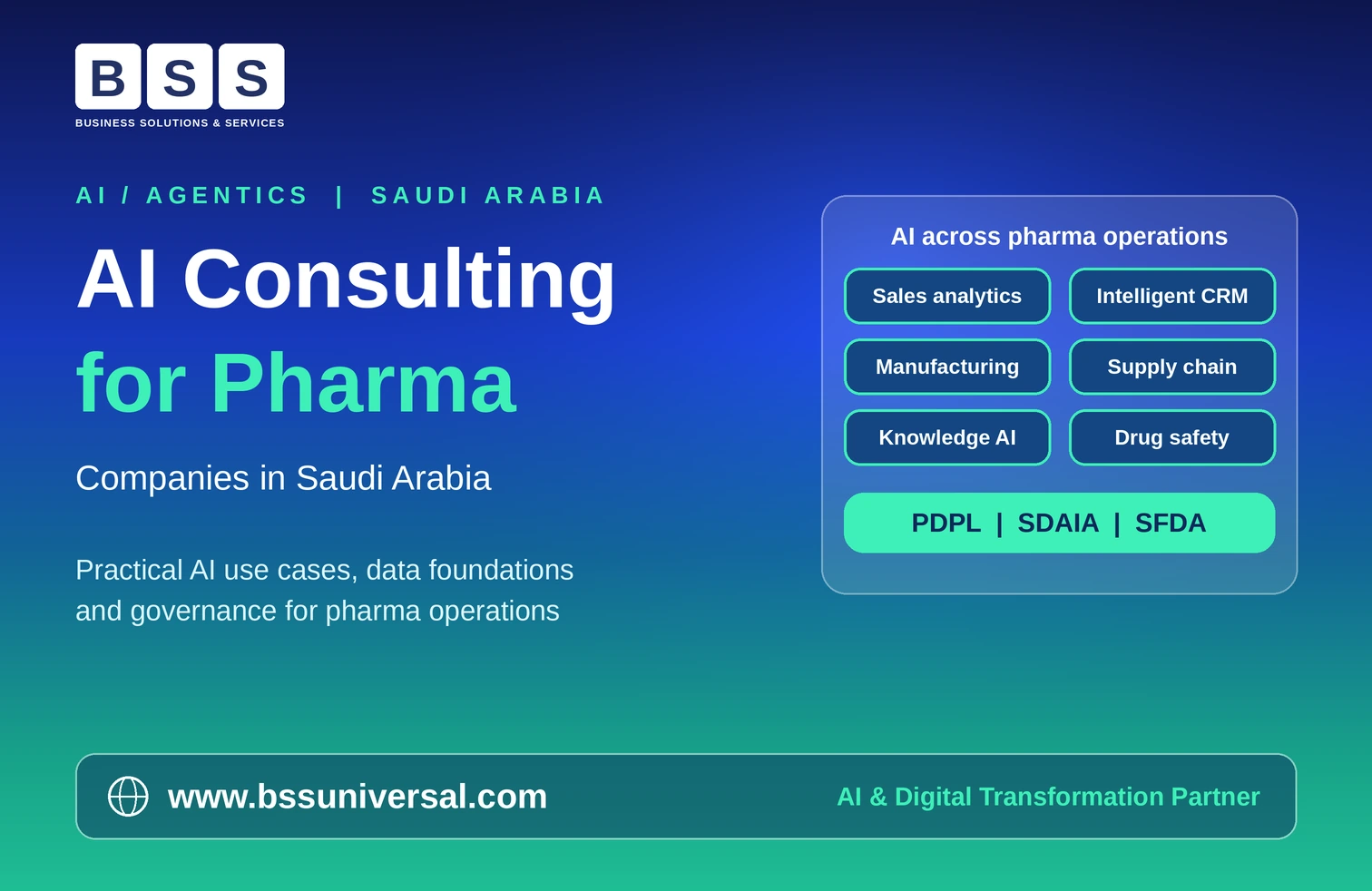
AI Consulting for Pharmaceutical Companies in Saudi Arabia
Pharmaceutical companies in Saudi Arabia are managing increasingly complex operations, from coordinating healthcare professionals and pharmaceutical sales teams to maintaining regulatory documentation, analysing market performance and managing large volumes of business data. As these operations expand, traditional systems and disconnected workflows can make it difficult for organisations to maintain visibility, respond to market changes and make informed decisions.
This is where AI consulting for pharmaceutical companies in Saudi Arabia becomes commercially valuable. Artificial intelligence can help pharmaceutical organisations identify patterns in business data, improve forecasting, automate repetitive processes and create more connected commercial operations. However, successful adoption requires more than introducing AI tools. Companies need reliable data foundations, integrated enterprise systems, appropriate governance and a clear implementation strategy.
Saudi Arabia's growing focus on digital transformation and artificial intelligence creates opportunities for pharmaceutical manufacturers, distributors and life sciences organisations to modernise their operations. The Saudi Data and Artificial Intelligence Authority (SDAIA) has established a national strategy for data and AI, while the Saudi Food and Drug Authority (SFDA) has also demonstrated the practical use of AI in pharmaceutical risk management.
For pharmaceutical businesses, the priority is to identify where AI can solve genuine operational challenges and deliver measurable business value.
Why Pharmaceutical Companies in Saudi Arabia Are Exploring AI Consulting
Pharmaceutical operations involve multiple departments, systems and stakeholders. Research teams, regulatory professionals, manufacturing units, medical representatives, commercial departments and distribution networks all generate information that contributes to business decisions.
When these departments operate through disconnected platforms, organisations may struggle to access consistent information.
For example, a pharmaceutical company's commercial team might use a CRM platform to manage healthcare professional relationships, while its marketing department maintains separate campaign reports and its management team relies on manually prepared sales dashboards. Although each system contains useful information, the lack of integration limits the organisation's ability to understand overall performance.
AI consulting helps businesses identify these gaps and develop an implementation strategy that connects data, technology and business processes.
Common challenges include:
- Disconnected enterprise systems: Information is distributed across CRM, ERP, reporting and operational platforms.
- Limited commercial visibility: Management teams struggle to obtain a consolidated view of sales performance, market activity and customer engagement.
- Manual reporting processes: Employees spend considerable time collecting, cleaning and consolidating business information.
- Demand forecasting difficulties: Historical sales data may not provide sufficient insight into changing market conditions.
- Complex regulatory workflows: Pharmaceutical organisations must manage documentation, approvals, audit trails and controlled information.
- Limited AI readiness: Existing data infrastructure may not support reliable analytics or enterprise AI applications.
An experienced AI consulting partner helps organisations evaluate these challenges before recommending technology investments.
Key AI Applications Across Pharmaceutical Operations
AI can support different stages of the pharmaceutical business lifecycle. The most appropriate applications depend on the organisation's objectives, available data, technology infrastructure and regulatory responsibilities.
1. AI-Powered Pharmaceutical Commercial Analytics
Commercial performance depends on understanding market activity, customer relationships, product demand and sales team effectiveness.
Traditional reporting often focuses on historical performance. AI-powered analytics can extend this capability by identifying patterns, highlighting potential changes and helping management teams evaluate commercial opportunities.
Pharmaceutical companies can explore AI applications for:
- Sales performance analysis across territories and product categories.
- Identification of changes in prescription and market demand trends using appropriate, lawful data sources.
- Healthcare professional engagement analysis.
- Regional market opportunity assessment.
- Sales forecasting and performance monitoring.
- Commercial campaign evaluation.
For example, a pharmaceutical manufacturer operating across Riyadh, Jeddah and Dammam may collect sales information from several regional teams. An integrated analytics environment can consolidate this information and help management compare territory performance, identify underperforming products and understand regional demand patterns.
Why it matters: Commercial teams can make decisions using consolidated business intelligence rather than relying entirely on separate spreadsheets and manually prepared reports.
2. Intelligent CRM and Sales Force Effectiveness
Customer relationship management is particularly important in pharmaceutical businesses because commercial teams interact with healthcare professionals, distributors, pharmacies and institutional customers.
However, a CRM platform becomes less effective when customer information, field activities and sales performance are not properly connected.
AI-enabled CRM environments can support:
- Customer segmentation and prioritisation.
- Sales territory analysis.
- Field team activity monitoring.
- Customer engagement insights.
- Sales pipeline visibility.
- Personalised communication planning.
- Automated reporting and workflow recommendations.
Consider a pharmaceutical company with a large medical representative network. Management may want to understand which territories require additional attention, whether field activities align with commercial priorities and how effectively customer engagement is being managed.
By integrating CRM data with business intelligence and appropriate analytics models, organisations can develop a more consistent view of commercial operations.
BSS Universal's CRM Implementation, Business Analytics and Omni-Channel Engagement expertise provides relevant foundations for organisations looking to modernise these workflows.
3. AI for Pharmaceutical Manufacturing and Quality Operations
Pharmaceutical manufacturing requires controlled processes, consistent quality standards and reliable operational records.
AI and machine learning can support manufacturing teams by analysing production information and identifying patterns that may indicate operational problems.
Potential applications include:
- Predictive maintenance for manufacturing equipment.
- Production performance monitoring.
- Process anomaly detection.
- Quality trend analysis.
- Inventory and production planning.
- Supply chain performance forecasting.
For instance, manufacturing equipment may generate operational information such as temperature, pressure, operating duration and maintenance records. Predictive analytics can examine these variables to identify patterns associated with equipment performance.
This can help maintenance teams investigate potential issues before they develop into more serious operational disruptions.
However, AI-generated recommendations should not automatically replace established quality assurance procedures. Pharmaceutical manufacturers must assess whether an AI application affects validated processes, product quality or regulated records and apply the appropriate controls.
4. AI-Enabled Supply Chain and Demand Forecasting
Pharmaceutical supply chains involve several interconnected activities, including procurement, manufacturing, warehousing, distribution and inventory management.
Poor demand forecasting can contribute to excess inventory, stock shortages and inefficient distribution planning.
AI-powered forecasting can analyse relevant historical and operational information to help organisations understand demand patterns.
Useful applications include:
- Product-level demand forecasting.
- Inventory optimisation.
- Distribution planning.
- Supplier performance analysis.
- Identification of unusual demand patterns.
- Stock movement and replenishment insights.
For example, a pharmaceutical distributor may experience different product demand across regions due to seasonal patterns, purchasing behaviour and changes in market requirements.
A forecasting model can combine historical sales, inventory information and relevant external variables to generate planning estimates.
These estimates should be reviewed against business knowledge and actual market conditions. AI forecasting is a decision-support capability, not a guarantee of future demand.
5. Generative AI for Pharmaceutical Knowledge Management
Pharmaceutical organisations manage substantial amounts of internal documentation, including product information, standard operating procedures, training materials, commercial documentation and regulatory records.
Finding relevant information across these resources can consume valuable employee time.
Generative AI and retrieval-augmented generation (RAG) can help employees access approved internal information through natural-language searches.
Potential applications include:
- Internal knowledge assistants.
- Document search and summarisation.
- Employee training support.
- Information retrieval from approved company repositories.
- Draft preparation for internal business documentation.
- Workflow assistance for administrative teams.
For example, an employee could ask an internal knowledge assistant to locate a specific approved procedure or summarise relevant sections of an internal training document.
A properly designed system should retrieve information from authorised sources, preserve document permissions, identify source material and avoid presenting generated answers as approved regulatory or medical guidance.
This distinction is important because pharmaceutical information must remain accurate, traceable and appropriately controlled.
6. AI for Research, Clinical Development and Drug Safety
AI also has applications in pharmaceutical research and development, including molecular analysis, drug candidate screening, clinical trial planning and pharmacovigilance.
Potential applications include:
- Analysis of scientific and research datasets.
- Drug discovery and molecular modelling.
- Clinical trial data analysis.
- Identification of potential safety signals.
- Literature review and evidence organisation.
- Post-market safety monitoring support.
These applications can involve specialised scientific models, validated data and substantial domain expertise.
The World Health Organization (WHO), in its 2024 publication on AI in pharmaceutical development and delivery, discusses both the opportunities and risks of applying AI throughout the medicine lifecycle.
For pharmaceutical organisations, the important consideration is that AI-generated findings must undergo appropriate scientific, clinical and regulatory review.
BSS Universal's broader data engineering, analytics and AI transformation capabilities can help organisations evaluate their data foundations and enterprise integration requirements. Specialised drug discovery or clinical AI development should be assessed separately according to the required scientific capabilities.
Understanding Saudi Arabia's Regulatory and AI Governance Environment
AI adoption in the pharmaceutical industry requires careful consideration of data protection, information security, regulatory responsibilities and system governance.
Saudi Arabia has established several important frameworks that organisations should consider when planning digital transformation initiatives.
Saudi Food and Drug Authority (SFDA)
The SFDA plays an important role in regulating medicines and protecting public health in Saudi Arabia.
Its use of AI also demonstrates how intelligent technologies can support pharmaceutical oversight.
One example is the Regulatory AI System for Incoming Drugs (RASID), which uses AI to help verify controlled medications carried into Saudi Arabia by travellers.
The SFDA has also highlighted the potential of AI and computer simulation to support drug development and clinical trial efficiency.
These developments demonstrate that AI has applications beyond commercial automation. However, pharmaceutical businesses must distinguish between AI used for internal operational support and applications that may influence regulated decisions.
For companies implementing AI, relevant considerations include:
- Maintaining accurate and traceable records.
- Establishing appropriate human review.
- Evaluating the intended use of AI systems.
- Protecting sensitive pharmaceutical and patient information.
- Assessing applicable SFDA requirements for regulated activities.
Personal Data Protection Law (PDPL)
Saudi Arabia's Personal Data Protection Law establishes requirements for processing personal data.
This is particularly relevant to pharmaceutical companies handling patient information, healthcare professional information, employee records and other identifiable data.
Organisations should evaluate:
- The legal basis for processing personal data.
- Data collection and retention practices.
- Access permissions and user responsibilities.
- Data processing agreements with service providers.
- Privacy controls throughout AI workflows.
- Procedures for handling personal data transfers outside Saudi Arabia.
An important distinction is that the PDPL does not establish an unconditional requirement that every category of personal data must always remain inside Saudi Arabia. International transfers are subject to specific regulatory conditions, safeguards and applicable requirements.
Therefore, cloud architecture and AI deployment decisions should be reviewed against the actual data processing activities and transfer arrangements.
SDAIA AI Ethics and Governance Principles
The Saudi Data and Artificial Intelligence Authority provides national guidance for responsible AI adoption.
Its AI ethics principles address important considerations such as:
- Integrity and fairness.
- Privacy and security.
- Reliability and safety.
- Transparency and interpretability.
- Accountability and responsibility.
These principles are particularly important in pharmaceutical environments, where an inaccurate recommendation or poorly governed automated process could create significant consequences.
Organisations should establish clear responsibilities for AI development, deployment, monitoring and review.
The practical takeaway: Regulatory considerations should be part of AI architecture and implementation planning from the beginning, rather than being treated as a final approval step.
How Pharmaceutical Companies Can Implement AI Successfully
Introducing AI across pharmaceutical operations requires a structured approach. Buying an AI platform without understanding existing systems, data quality and business requirements can create additional complexity rather than solving operational problems.
A practical AI transformation programme should progress through several stages.
1. Assess Existing Technology and Data Infrastructure
The first step is understanding how information currently moves across the organisation.
Pharmaceutical companies should review their existing:
- CRM and ERP platforms.
- Sales and commercial reporting systems.
- Manufacturing and inventory databases.
- Document management environments.
- Cloud infrastructure.
- Data integration processes.
The assessment should identify disconnected systems, duplicate records, inconsistent reporting and gaps in data accessibility.
For example, if sales information is maintained separately from customer engagement records, the organisation may need data integration and CRM improvements before introducing advanced AI analytics.
2. Identify and Prioritise High-Value AI Use Cases
Not every pharmaceutical process needs AI.
Organisations should identify opportunities based on their potential business impact, implementation complexity, available data and associated risks.
The following table illustrates how different opportunities can be evaluated.
AI application
Business objective
Potential value
Commercial analytics
Understand sales and market performance
Better commercial visibility
Intelligent CRM
Improve customer relationship management
More coordinated engagement
Demand forecasting
Estimate future product requirements
Better inventory planning
Predictive maintenance
Identify potential equipment issues
Improved maintenance planning
Document intelligence
Retrieve information from approved documents
Less manual information searching
Business intelligence
Consolidate operational reporting
Faster management decisions
Workflow automation
Reduce repetitive administrative activities
More efficient processes
A pharmaceutical company should begin with use cases that have clear business owners, accessible data and measurable outcomes.
3. Build a Reliable Data Foundation
AI systems depend on the quality and accessibility of their underlying data.
If information is incomplete, inconsistent or duplicated, AI-generated insights may be unreliable.
This is why data engineering is an essential part of pharmaceutical AI transformation.
A suitable data foundation may include:
- Data integration across enterprise applications.
- Standardised data structures.
- Data cleansing and validation.
- Master data management.
- Data governance and access controls.
- Secure data storage and processing.
- Analytics-ready data pipelines.
For instance, a company may need to consolidate product, customer and regional sales information from multiple systems before developing a reliable commercial forecasting model.
Data engineering makes these connections possible and creates a foundation for future AI applications.
4. Design Secure and Scalable AI Architecture
Once business requirements and data readiness are established, organisations can design the technology architecture.
The architecture should consider:
- Cloud infrastructure and hosting requirements.
- Enterprise application integration.
- Data access and security.
- Model selection and deployment.
- Monitoring and performance management.
- Regulatory and privacy requirements.
- Scalability across departments and locations.
For pharmaceutical companies in Saudi Arabia, data transfer arrangements and applicable PDPL requirements should be evaluated when selecting cloud platforms and third-party AI services.
Architecture decisions should also consider whether sensitive information can be processed using anonymised, pseudonymised or appropriately restricted datasets.
5. Develop a Proof of Concept Before Scaling
A proof of concept (PoC) allows a pharmaceutical organisation to evaluate whether an AI solution can address a specific business problem.
For example, a company could initially test an AI-based commercial reporting solution using a limited dataset from selected business units.
The PoC should have clear evaluation criteria, including:
- Accuracy and reliability of outputs.
- Data quality requirements.
- Integration feasibility.
- Security and governance controls.
- Employee usability.
- Operational impact.
- Estimated implementation and maintenance costs.
A successful PoC provides evidence for a broader deployment decision. It does not automatically establish that the system is ready for production or regulated use.
6. Integrate AI into Existing Enterprise Workflows
AI creates greater business value when employees can use its outputs within their existing operational processes.
For example, a commercial analytics model should connect with relevant reporting or CRM workflows instead of creating another disconnected dashboard.
Integration may involve APIs, cloud platforms, enterprise data pipelines and customised application development.
This stage also requires appropriate user permissions, workflow ownership and human review mechanisms.
7. Monitor Performance and Improve Adoption
AI implementation is not a one-time technology deployment.
Organisations should continuously monitor:
- Model performance and accuracy.
- Data quality and availability.
- Changes in business requirements.
- Security and access controls.
- User adoption.
- Operational outcomes.
- Model drift and unexpected behaviour.
Employees should also receive relevant training so they understand how to use AI outputs, identify limitations and escalate questionable recommendations.
Common Challenges in Pharmaceutical AI Transformation
Even when organisations recognise the value of AI, implementation can become difficult when foundational business and technology issues are overlooked.
Disconnected Data and Legacy Systems
Many pharmaceutical organisations operate with different systems across commercial, manufacturing, distribution and administrative departments.
Integrating these environments requires careful data mapping, architecture planning and system-level coordination.
Without reliable integration, AI projects may produce isolated results that cannot support organisation-wide decision-making.
Insufficient Data Quality
AI models depend on relevant and reliable information.
Duplicate customer records, inconsistent product identifiers, incomplete reporting and outdated information can reduce the usefulness of AI-generated insights.
Businesses should establish data quality standards and ownership before expanding AI adoption.
Regulatory and Information Security Risks
Pharmaceutical organisations may process commercially sensitive information, personal data and regulated records.
Using external AI platforms without evaluating their data processing practices can create privacy, confidentiality and security concerns.
Companies should assess vendors, access controls, retention practices, integration methods and applicable regulatory requirements before deployment.
Limited Internal AI Expertise
AI transformation requires coordination between business leaders, data engineers, technology architects, security specialists and domain professionals.
An organisation may have a clear business objective but lack the internal resources to design and implement the required technology.
Working with an experienced technology partner can help bridge this gap through architecture advisory, development, implementation and ongoing support.
Unclear Business Objectives
A common mistake is selecting AI tools because they are popular rather than because they solve a defined operational problem.
Before approving an initiative, pharmaceutical leaders should identify the existing process, expected improvement, implementation cost and performance indicators.
The objective should be measurable business improvement, not simply the introduction of new technology.
How to Evaluate an AI Consulting Partner in Saudi Arabia
Selecting an AI consulting company requires more than comparing software platforms or development costs.
Pharmaceutical organisations should evaluate whether a technology partner understands enterprise systems, data architecture, integration requirements and the practical challenges of regulated industries.
Consider the following criteria:
Evaluation criteria
What to look for
Industry understanding
Familiarity with pharmaceutical and life sciences business processes
AI strategy
Ability to identify realistic, high-value AI opportunities
Data engineering
Experience building integrated and analytics-ready data environments
CRM expertise
Capability to modernise commercial workflows and customer data
Cloud architecture
Knowledge of scalable enterprise infrastructure
Security and governance
Appropriate information security and data protection practices
Integration capabilities
Ability to connect existing enterprise platforms
Implementation approach
Structured assessment, PoC, deployment and support
Business alignment
Focus on measurable operational and commercial outcomes
It is also important to distinguish between general enterprise AI consulting and specialist pharmaceutical technology services.
For example, an organisation looking to modernise its commercial CRM environment needs different expertise from one developing AI models for molecular discovery or clinical research.
The consulting partner should be transparent about its capabilities and involve appropriate pharmaceutical specialists when the project requires them.
How BSS Universal Supports AI and Digital Transformation in the Pharmaceutical Industry
BSS Universal helps enterprises modernise their digital environments through connected capabilities across artificial intelligence, data, cloud, CRM and custom development.
For pharmaceutical and life sciences organisations, these capabilities are relevant to the underlying technology requirements of commercial transformation, enterprise analytics and intelligent business operations.
With its MENA regional headquarters in Riyadh, Saudi Arabia, BSS provides a regional point of contact for organisations exploring enterprise technology initiatives.
Rather than approaching AI as an isolated software investment, BSS focuses on preparing business systems, data environments and operational workflows to support sustainable transformation.
AI Transformation Readiness
Successful AI implementation starts with understanding organisational readiness.
BSS supports AI transformation readiness through the assessment of business requirements, existing technology environments and opportunities for intelligent automation.
For pharmaceutical companies, this can help identify where AI may support commercial analytics, operational reporting, workflow optimisation and enterprise decision-making.
Data Engineering and Business Intelligence
Reliable data is essential for useful AI applications.
BSS provides data engineering and business intelligence capabilities that help organisations integrate information, establish trusted data foundations and develop actionable reporting environments.
Potential pharmaceutical applications include consolidated sales reporting, regional performance dashboards and operational analytics.
CRM Implementation and Commercial Excellence
Pharmaceutical commercial teams need connected systems to manage customer relationships, monitor field activities and understand business performance.
BSS's CRM implementation and Omni-Channel Engagement capabilities can support organisations seeking to unify customer information and improve commercial workflows.
These capabilities are particularly relevant to pharmaceutical companies managing distributed sales teams and multiple customer engagement channels.
Business Analytics and Data Visualisation
Enterprise decision-makers need clear visibility into operational and commercial performance.
BSS supports business analytics and data visualisation to transform complex information into understandable dashboards and management insights.
For pharmaceutical organisations, relevant applications may include:
- Regional sales performance reporting.
- Product-level business analysis.
- Customer engagement monitoring.
- Operational performance dashboards.
- Management reporting and decision support.
Cloud Architecture and Custom Development
AI initiatives often require modern infrastructure and integration between existing enterprise applications.
BSS offers cloud architecture advisory, cloud-based proof-of-concept deployment and custom development services.
These capabilities can help pharmaceutical organisations evaluate new technology solutions, integrate existing systems and develop scalable enterprise environments.
An Integrated Approach to Enterprise Transformation
BSS brings together CRM, data, cloud, analytics and AI capabilities within a structured transformation approach.
Its implementation methodology includes:
- Analysing the organisation's current technology environment.
- Identifying and prioritising business use cases.
- Designing the required solution architecture.
- Building and implementing the selected solutions.
- Integrating systems while addressing security and governance.
- Supporting adoption, training and change enablement.
- Providing ongoing support and managed services.
BSS also states that it has ISO 27001 certification and reports a global delivery footprint spanning more than 70 countries.
For pharmaceutical businesses, this integrated approach can help connect technology investments with operational requirements and longer-term digital transformation objectives.
What Pharmaceutical Companies Should Do Before Investing in AI
Before committing to an enterprise AI programme, pharmaceutical executives should answer several practical questions.
- What business problem needs solving? Identify whether the priority is commercial performance, reporting, forecasting, manufacturing visibility or workflow automation.
- Are existing systems ready? Review CRM, ERP, data warehouses and reporting platforms.
- Is the required data accessible? Evaluate data quality, ownership, permissions and integration requirements.
- What regulatory considerations apply? Review PDPL, relevant SFDA requirements and applicable data governance obligations.
- How will success be measured? Define operational KPIs, implementation costs and expected business outcomes.
- Can the solution scale? Consider whether the architecture can support additional departments, business units and AI applications.
A well-defined implementation strategy helps prevent disconnected technology investments and gives leadership a clearer understanding of the expected value.
Conclusion: Building an AI-Ready Pharmaceutical Enterprise in Saudi Arabia
AI is creating opportunities for pharmaceutical companies to improve commercial operations, strengthen business intelligence, modernise enterprise systems and make better use of organisational data.
However, achieving these outcomes requires more than adopting individual AI applications. Businesses need reliable data foundations, connected CRM environments, scalable cloud architecture and responsible governance practices.
For pharmaceutical organisations in Saudi Arabia, the most effective starting point is to identify operational challenges, prioritise realistic AI opportunities and establish the technology infrastructure required for long-term adoption.
BSS Universal brings together AI transformation readiness, CRM implementation, data engineering, business intelligence, analytics and cloud architecture to support enterprise digital transformation.
Looking to explore AI opportunities for your pharmaceutical business in Saudi Arabia? Connect with BSS Universal to discuss your technology challenges, assess your AI readiness and identify a practical roadmap for enterprise transformation.
Explore BSS Universal
Website: BSS Universal – AI Digital Transformation
Email: businessops@bssuniversal.com
Regional Headquarters: Riyadh, Saudi Arabia
Frequently Asked Questions
1. What is AI consulting for pharmaceutical companies in Saudi Arabia?
AI consulting helps pharmaceutical organisations identify, plan and implement artificial intelligence solutions across their business operations. Services may include AI readiness assessments, data engineering, CRM modernisation, business intelligence, workflow automation and enterprise AI architecture.
2. How can AI improve pharmaceutical business operations?
AI can support commercial forecasting, sales performance analysis, inventory planning, predictive maintenance, document intelligence and automated reporting. These applications help businesses identify patterns, improve operational visibility and support more informed decisions.
3. How is AI used in the Saudi pharmaceutical industry?
AI applications in Saudi Arabia include pharmaceutical risk monitoring, controlled medication verification, research support, clinical development and business analytics. The SFDA's RASID initiative is an example of AI being used to support pharmaceutical oversight in the Kingdom.
4. Does pharmaceutical AI need to comply with Saudi PDPL?
Yes, when an AI solution processes personal data within the scope of Saudi Arabia's Personal Data Protection Law, organisations must meet applicable legal requirements. These include requirements concerning lawful processing, data subject rights, security and international data transfers.
5. Can AI improve pharmaceutical sales force effectiveness?
Yes. AI-powered analytics and CRM solutions can help pharmaceutical businesses evaluate territory performance, analyse customer engagement, identify commercial opportunities and improve sales reporting. The results depend on data quality and appropriate integration with existing CRM systems.
6. How can pharmaceutical companies use AI for demand forecasting?
AI models can analyse historical sales, inventory information, seasonal trends and other relevant business variables to estimate future product demand. These forecasts can support inventory planning and distribution decisions, although they should be evaluated against actual market conditions.
7. What should pharmaceutical companies consider before implementing AI?
Companies should evaluate data readiness, existing enterprise systems, security, regulatory requirements, integration capabilities, employee adoption and expected business value. Starting with a clearly defined proof of concept can help assess feasibility before wider deployment.
8. Why should pharmaceutical companies work with an AI consulting company?
An experienced AI consulting partner can help businesses assess technology requirements, develop implementation strategies, integrate enterprise systems and establish scalable data infrastructure. This reduces the risk of disconnected projects and aligns AI investments with commercial and operational objectives.
9. Does BSS Universal provide AI consulting for pharmaceutical businesses in Saudi Arabia?
BSS Universal offers enterprise AI transformation readiness, data engineering, CRM implementation, business intelligence, analytics, cloud architecture advisory and custom development. These capabilities can support pharmaceutical organisations planning enterprise digital transformation and AI adoption.