Why Pharmaceutical Supply Chains Need Better Data Visibility
A pharmaceutical company may have accurate inventory records in its ERP, sales information in its CRM, production schedules in manufacturing systems and distribution records maintained by regional partners. Yet, bringing these datasets together to understand product availability across different markets can remain difficult.
The problem becomes more significant when operations span multiple manufacturing facilities, warehouses, distributors and countries.
Supply chain leaders need to understand how much inventory is available, where demand is increasing, which products are approaching expiry and whether supply can meet expected requirements. Without connected information, these decisions may depend on delayed reports, separate spreadsheets and manual coordination between departments.
Pharmaceutical supply chain analytics provides a way to connect these operational data sources and turn fragmented information into actionable business insights.
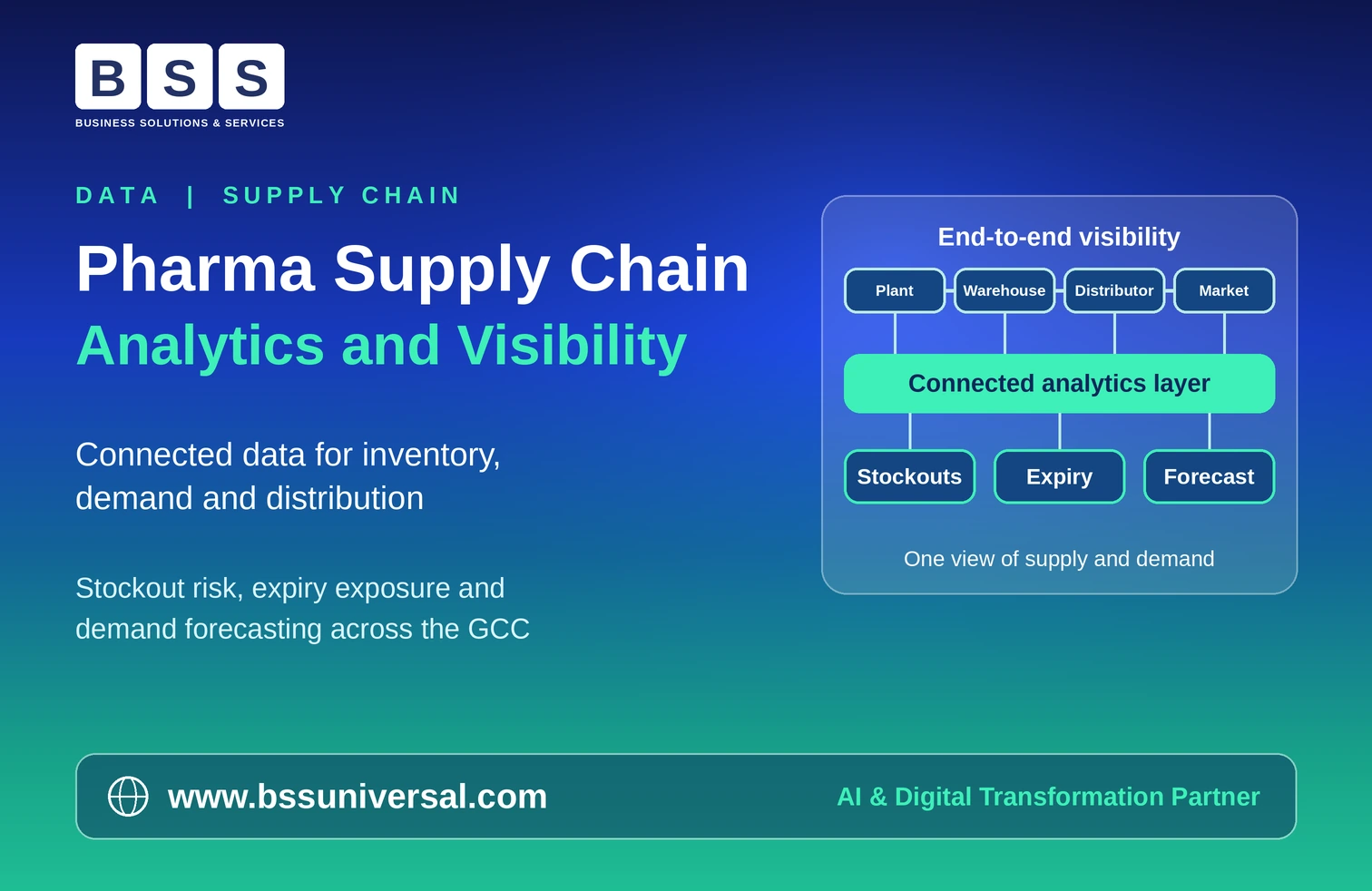
By integrating data from ERP, inventory management, manufacturing, CRM and distributor systems, pharmaceutical organisations can develop a more consistent view of supply and demand across their operations.
For pharmaceutical enterprises in Saudi Arabia, the UAE and other GCC markets, this capability can support better inventory planning, demand forecasting, distributor visibility and country-level performance monitoring.
However, digital visibility is not the same as physical supply chain control. Analytics supports operational decisions; it does not replace warehouses, logistics providers, transportation systems or cold-chain operations.
What Is Pharmaceutical Supply Chain Analytics and Visibility?
Pharmaceutical supply chain analytics involves collecting, integrating and analysing information across the processes involved in manufacturing, distributing and supplying medicines.
Supply chain visibility focuses on understanding the status of these activities through accessible and sufficiently current data.
Together, they help organisations understand what is happening across their supply networks and identify where management attention may be required.
A connected pharmaceutical supply chain data environment can combine:
- Demand information: Historical sales, order volumes, consumption patterns and market demand.
- Inventory information: Available stock, reserved quantities, batch numbers and expiry dates.
- Manufacturing information: Production schedules, output and material availability.
- Distribution information: Distributor orders, shipment records, delivery status and regional stock positions.
- Procurement information: Supplier orders, lead times, purchasing activity and material availability.
- Country-level information: Regional demand, product availability and market-specific operational performance.
The objective is to establish a consistent view of supply chain performance rather than requiring every department to maintain independent reports.
Supply Chain Visibility vs Supply Chain Analytics
These concepts are related but serve different purposes.
CapabilityMain purposeExampleSupply chain visibilityUnderstand current operational statusView inventory across regional distributorsSupply chain analyticsAnalyse patterns and performanceIdentify recurring demand changesPredictive analyticsEstimate potential future outcomesForecast medicine demandBusiness intelligenceCommunicate operational informationMonitor stock and distribution KPIsData integrationConnect information from different systemsCombine ERP and distributor records
For example, a dashboard may show that a particular medicine has declining inventory in the UAE.
Analytics can take this further by comparing consumption trends, incoming orders, historical demand and replenishment lead times to help determine whether the situation requires attention.
Why Pharmaceutical Companies Struggle With End-to-End Supply Chain Visibility
The main challenge is not necessarily the absence of technology. It is the difficulty of obtaining consistent information across systems, departments and external partners.
Fragmented ERP, Manufacturing and Distribution Data
Pharmaceutical organisations often operate different systems for procurement, production, inventory, sales and distribution.
Manufacturing teams may have visibility into production output, while commercial teams monitor sales and regional distributors maintain separate inventory records.
When these systems are disconnected, leadership may struggle to establish a reliable picture of product availability.
Distributor data integration can help combine relevant information from internal and external systems, subject to partner connectivity, data-sharing agreements and access permissions.
Limited Visibility Across Distributors
Regional distributors play an important role in pharmaceutical supply networks, but manufacturers may not always receive consistent and timely information about downstream inventory.
For example, a manufacturer might know how many units it has shipped to a distributor without knowing the distributor's current stock, sales to customers or remaining inventory across individual regions.
This creates a gap between manufacturer-level supply visibility and actual market-level availability.
Integrating distributor information can help provide a broader view of inventory movement and demand, although the depth of visibility depends on the information partners agree and are able to share.
Inconsistent Country-Level Reporting
Pharmaceutical organisations operating across Saudi Arabia, the UAE and other GCC markets may maintain separate reporting structures for different countries.
Differences in product identifiers, reporting periods, distributor classifications and business definitions can make regional comparisons difficult.
A connected analytics environment needs consistent master data, common KPI definitions and appropriate country-level access controls.
Without these foundations, consolidated dashboards may present misleading comparisons.
Delayed Demand and Inventory Information
Supply chain decisions depend on accurate information about product consumption, open orders, available stock and incoming supply.
When data is updated through delayed manual reporting or separate integration processes, planners may identify demand changes after they have already affected inventory availability.
More frequent and reliable data integration can improve the timeliness of operational reporting and help decision-makers respond earlier.
How Integrated Data Improves Pharmaceutical Inventory Visibility
Inventory visibility requires more than knowing the total quantity of a product held by a company.
Pharmaceutical organisations need to understand stock availability by product, batch, location, ownership and expiry date.
A connected data environment can combine information from ERP, warehouse management systems, manufacturing applications and distributor platforms.
Monitoring Inventory Across Multiple Locations
A regional inventory dashboard can provide a consolidated view of available stock across participating facilities, countries and distribution partners.
For example, a pharmaceutical business operating in Saudi Arabia and the UAE could monitor:
- Available and reserved inventory by product.
- Stock positions across participating warehouses and distributors.
- Incoming purchase and replenishment orders.
- Products approaching expiry.
- Changes in inventory levels over reporting periods.
- Differences between planned and actual stock availability.
This helps supply chain directors identify imbalances and investigate whether inventory planning needs adjustment.
Identifying Expiry and Stockout Risks
Inventory analytics can help identify products that may face stock shortages or expiry-related losses.
For example, a product may have sufficient total inventory at the regional level but limited availability in a particular market.
Similarly, a warehouse may have high inventory levels while product demand has slowed.
By combining inventory age, expiry dates, historical consumption and replenishment information, analytics can support earlier investigation of these situations.
The quality of the resulting insights depends on accurate batch records, inventory updates and consistent product identifiers.
Measuring Inventory Performance
Useful pharmaceutical inventory KPIs include:
KPIWhat it measuresInventory turnoverHow frequently inventory is consumed or soldDays of inventory on handEstimated number of days current inventory can support demandStockout rateFrequency or proportion of products experiencing unavailable stockExpiry exposureInventory approaching its expiry dateOrder fill rateProportion of customer or distributor demand fulfilledInventory accuracyAgreement between recorded and verified stockBackorder volumeUnfulfilled demand awaiting supply
These measures help leaders evaluate inventory performance across products, locations and business units.
Improving Pharma Demand Forecasting With Connected Data
Demand forecasting is particularly important for pharmaceutical supply chains because supply planning must account for changes in consumption, market requirements and product availability.
Historical sales data alone may not provide a complete picture.
A more useful forecasting model can consider several information sources.
Connect Demand Drivers Across Business Systems
Pharmaceutical demand forecasting may use:
- Historical sales and consumption.
- Distributor orders and inventory.
- Hospital and pharmacy demand information where available.
- Seasonal patterns.
- Product launches and market expansion.
- Tender awards and contract requirements.
- Promotional and commercial activities.
- Product availability and previous stockouts.
These variables help distinguish actual changes in demand from changes caused by temporary supply limitations.
For instance, lower historical sales do not always indicate lower customer demand. A medicine may have experienced repeated stockouts, preventing customers from purchasing the expected quantities.
A forecasting model that ignores this constraint could underestimate future demand.
Use Predictive Analytics to Support Planning
Predictive analytics can help supply chain teams estimate future demand and identify products requiring additional planning attention.
Depending on data availability and business requirements, organisations can evaluate statistical forecasting methods and machine learning models.
These models may identify seasonal patterns, changes in consumption and relationships between different demand indicators.
However, forecasting outputs should not be treated as guaranteed future outcomes.
Their accuracy depends on historical data quality, assumptions, market changes, model selection and ongoing validation.
Supply chain planners should combine predictive outputs with commercial knowledge and operational constraints before making procurement or replenishment decisions.
Pharmaceutical Supply Chain Visibility Across Saudi Arabia and the UAE
GCC pharmaceutical operations involve country-level distribution networks, regulatory processes, local partners and cross-border supply arrangements.
A regional analytics architecture should provide a consolidated business view while preserving the requirements of individual markets.
Saudi Arabia: Integrating Supply Chain and Track-and-Trace Information
Saudi Arabia's SFDA operates the Drug Track and Trace System (RSD) to support pharmaceutical product tracking.
For manufacturers, distributors and other relevant stakeholders, regulatory tracking information is an important consideration when developing connected supply chain data environments.
Pharmaceutical organisations may need to assess how authorised RSD-related information can be reconciled with their internal product, inventory, order and distribution records.
This can support broader operational reporting, provided that the required data access and integration arrangements are available.
UAE: Connecting Pharmaceutical Tracking and Enterprise Data
The UAE uses Tatmeen, the Ministry of Health and Prevention's pharmaceutical tracking platform.
Its ecosystem involves pharmaceutical marketing authorisation holders, licensed agents, third-party logistics providers and dispensing organisations.
Tatmeen also provides business-to-business integration capabilities for organisations using compatible ERP, warehouse management or point-of-sale systems.
For pharmaceutical enterprises, this creates an important data consideration: regulatory tracking information and internal supply chain reporting should be understood as related but distinct information environments.
Relevant information can be incorporated into wider reporting architectures where permissions, platform interfaces and regulatory requirements allow.
Building Cross-Border GCC Reporting
Consider a multinational pharmaceutical company with manufacturing operations outside the GCC, a regional distribution centre in the UAE and distributors serving Saudi Arabia and other Gulf markets.
Its management team may need to compare:
- Product demand across individual countries.
- Regional inventory positions.
- Open orders and incoming supplies.
- Distributor sales and stock information.
- Product expiry exposure.
- Actual versus planned supply performance.
A connected data platform can bring these information sources into a consistent reporting environment.
However, regional consolidation should not mean that every country's information is automatically transferred or stored in another country.
Data residency, privacy, contractual requirements and applicable regulatory restrictions must be assessed for each relevant data flow.
What Pharmaceutical BI Dashboards Should Show
A well-designed pharmaceutical supply chain dashboard should answer operational questions rather than simply display large volumes of data.
Different roles need different levels of visibility.
Business roleImportant dashboard informationChief Supply Chain OfficerRegional supply performance, stockout exposure and supply risksSupply Chain DirectorInventory levels, replenishment and order fulfilmentHead of PlanningForecast accuracy, demand changes and supply gapsDistribution ManagerDistributor inventory, orders and delivery performanceCIOData integration health, source availability and reporting consistencyHead of AnalyticsData quality, model performance and KPI definitions
For example, an executive dashboard could highlight products with declining stock coverage across countries.
A planning dashboard could investigate forecast deviations and incoming supply.
A distributor dashboard could compare reported inventory, sales and replenishment requirements across participating partners.
The underlying data should refresh according to the operational needs of each dashboard. Not every business metric requires real-time updates.
Building a Connected Pharmaceutical Supply Chain Data Architecture
A connected analytics environment requires reliable integration between systems, consistent business definitions and appropriate governance.
A practical implementation can follow five stages.
1. Map existing data sources
Identify where demand, inventory, production, procurement and distribution information is maintained. Document data owners, update frequencies and access requirements.
2. Establish data integration
Connect relevant ERP, CRM, manufacturing, warehouse and distributor systems using appropriate APIs, integration services and data pipelines.
3. Standardise pharmaceutical data
Align product identifiers, country codes, distributor records, units of measurement, inventory definitions and reporting periods.
4. Develop analytics and forecasting
Create reliable datasets, business intelligence dashboards and suitable predictive models based on validated historical and operational information.
5. Establish governance and continuous monitoring
Monitor data quality, reporting accuracy, source availability, access permissions and model performance.
This approach helps organisations build a scalable analytics foundation without requiring every operational system to be replaced.
How BSS Helps Pharmaceutical Organisations Improve Supply Chain Visibility
Pharmaceutical supply chain analytics requires more than building dashboards. Organisations need connected data sources, reliable information flows, analytics capabilities and governance across their enterprise environments.
BSS provides enterprise data engineering, integration, business intelligence and analytics services to help organisations address these requirements.
Its capabilities include:
- Enterprise Data Engineering & Integration: Connect fragmented enterprise systems and establish reliable data flows.
- Enterprise Data Analytics & BI: Develop analytical views and dashboards that support operational and management decisions.
- Data Governance & Quality: Improve data consistency, reliability, accessibility and control.
- AI-Ready Data Foundations: Prepare enterprise information for advanced analytics and predictive AI use cases.
- Cloud Architecture: Support scalable enterprise data platforms and connected technology environments.
For pharmaceutical organisations, these capabilities can support integrated reporting across inventory, manufacturing, demand and distributor information, depending on source-system access and project requirements.
BSS focuses on the digital data and analytics layer. Warehouse operations, transportation, cold-chain equipment and physical pharmaceutical distribution remain the responsibility of the relevant operational organisations and specialist providers.
Explore BSS capabilities:
Making Pharmaceutical Supply Chain Decisions More Data-Driven
Pharmaceutical supply chain visibility depends on connecting information across the systems and partners involved in demand planning, manufacturing, inventory and distribution.
When these sources remain disconnected, organisations may struggle to identify stock imbalances, understand changing market requirements and compare performance across countries.
Integrated data engineering, business intelligence and predictive analytics can help address these challenges by creating a more consistent view of enterprise supply chain operations.
For pharmaceutical companies operating across Saudi Arabia, the UAE and wider GCC markets, the priority should be to build a governed analytics foundation that supports country-level reporting and regional decision-making.
Improve pharmaceutical supply chain visibility with BSS data engineering, integration and analytics services. Discuss your enterprise data challenges and explore an architecture aligned with your business requirements.
Frequently Asked Questions
1. What is pharmaceutical supply chain analytics?
Pharmaceutical supply chain analytics involves collecting and analysing information from manufacturing, inventory, procurement, distribution and demand systems. It helps pharmaceutical organisations monitor performance, identify operational risks and improve supply planning.
2. What is pharmaceutical supply chain visibility?
It is the ability to access and understand relevant supply chain information across different locations, systems and partners. This may include inventory availability, order status, distributor stock and product movement information.
3. How does data integration improve pharmaceutical inventory management?
Data integration connects inventory information from ERP, warehouse, manufacturing and distributor systems. This can provide a consolidated view of stock positions, replenishment requirements and potential expiry or stockout risks.
4. How is predictive analytics used in pharmaceutical demand forecasting?
Predictive analytics uses historical consumption, sales, inventory, seasonal patterns and other relevant business variables to estimate future demand. Its outputs require validation against market conditions, data quality and operational assumptions.
5. What causes limited visibility across pharmaceutical distributors?
Common causes include disconnected reporting systems, inconsistent product identifiers, delayed inventory updates, different business processes and limited data-sharing arrangements between manufacturers and distribution partners.
6. What KPIs should pharmaceutical supply chain dashboards monitor?
Important KPIs include inventory turnover, days of inventory on hand, stockout rate, order fill rate, backorder volume, expiry exposure, forecast accuracy and distributor inventory performance.
7. How can pharmaceutical companies improve supply chain visibility across the GCC?
They can integrate relevant ERP, manufacturing, inventory and distributor information into a governed enterprise analytics environment. Country-specific reporting, consistent product definitions, regulatory considerations and appropriate data-sharing arrangements are also important.
8. What is the difference between pharmaceutical supply chain visibility and logistics management?
Visibility provides information about supply chain activities, inventory and product movement. Logistics management involves physically storing, handling and transporting medicines. Analytics can improve decisions about logistics operations but does not perform physical distribution.
9. Can AI predict pharmaceutical medicine shortages?
AI models can help identify potential shortage risks by analysing demand, inventory, supplier lead times and supply constraints. Their reliability depends on data availability, model validation and the quality of underlying assumptions. They support planning decisions rather than guaranteeing that shortages will be prevented.