How CRM Drives Sales & Marketing Alignment in Enterprises
Introduction: Why Sales & Marketing Alignment Matters More Than Ever
In many enterprises, sales and marketing teams still operate in silos. Marketing focuses on generating leads, while sales teams prioritize closing deals. This disconnect often creates friction, poor lead quality, inconsistent customer experiences, and lost revenue opportunities.
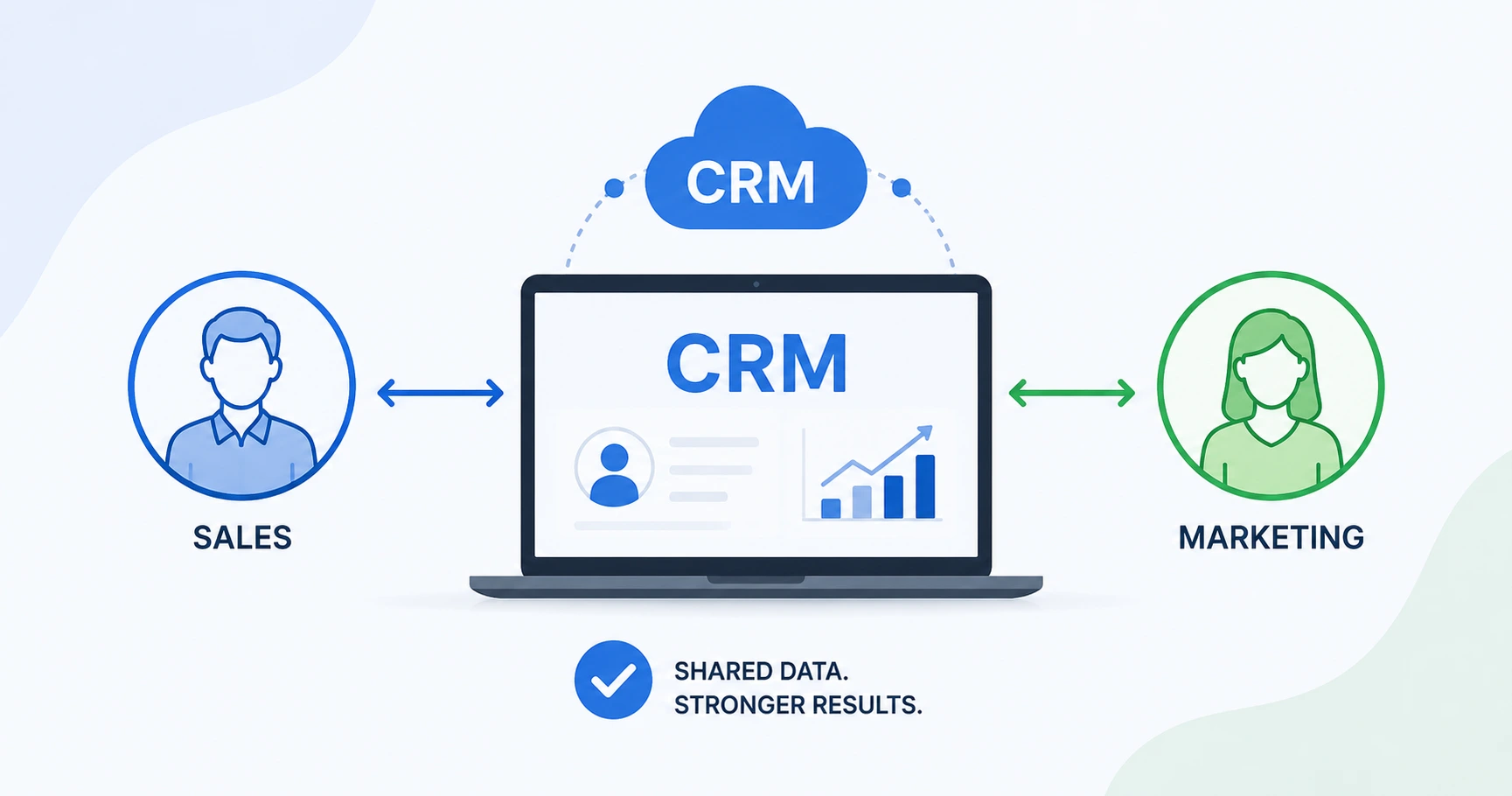
Modern CRM platforms are solving this challenge by creating a unified system where both departments work toward shared business goals. Through centralized customer data, automated workflows, lead scoring, and real-time reporting, CRM systems help organizations align revenue operations more effectively.
Today, CRM sales and marketing alignment is no longer just an operational improvement—it has become a strategic requirement for enterprises seeking scalable growth, stronger customer relationships, and predictable revenue performance.
What is CRM Sales & Marketing Alignment?
CRM sales and marketing alignment refers to the process of synchronizing sales and marketing teams through a unified CRM ecosystem. The goal is to ensure both departments collaborate around shared revenue targets, customer journey visibility, and lead management processes.
Instead of operating independently, aligned teams use centralized customer data and shared KPIs to improve communication, lead quality, and customer engagement throughout the entire buyer journey.
This alignment is often supported by modern RevOps (Revenue Operations) strategies that integrate sales, marketing, customer success, and operations into one connected revenue engine.
Why Enterprises Struggle with Sales & Marketing Alignment
Despite investing in enterprise CRM systems, many organizations still face alignment challenges due to fragmented processes and disconnected technologies.
Common problems include:
- Poor communication between departments
- Lack of shared performance metrics
- Inconsistent lead qualification criteria
- Delayed lead handoffs
- Siloed customer data
- Limited visibility into the customer journey
When sales and marketing teams are misaligned, businesses experience slower deal cycles, lower conversion rates, and inefficient use of marketing budgets.
How CRM Creates a Single Source of Truth
One of the biggest advantages of enterprise CRM platforms is the ability to create a centralized customer data ecosystem.
Both sales and marketing teams gain access to:
- Customer interaction history
- Email engagement data
- Website activity
- Campaign performance
- Purchase history
- Sales conversations
This unified visibility improves collaboration and ensures every department works with consistent, real-time information.
Modern CRM platforms like Salesforce, HubSpot, and Microsoft are widely used to support enterprise-wide alignment strategies.
The Role of RevOps in CRM Alignment
What is RevOps?
Revenue Operations (RevOps) is a business framework that aligns sales, marketing, and customer success teams under one operational strategy.
RevOps focuses on:
- Shared revenue goals
- Process standardization
- Data consistency
- Workflow automation
- Cross-functional collaboration
CRM systems act as the foundation of RevOps by connecting customer data, communication channels, and operational processes into one platform.
Why RevOps Matters for Enterprises
Enterprises adopting RevOps benefit from:
- Faster revenue growth
- Improved forecasting accuracy
- Better customer lifecycle management
- Reduced operational silos
- Enhanced reporting visibility
CRM-enabled RevOps creates a more predictable and scalable revenue model.
How CRM Improves Lead Management
Lead management is one of the most important areas where CRM drives sales and marketing alignment.
Defining Lead Stages Clearly
CRM systems help enterprises define clear lead stages such as:
- Visitor
- Lead
- Marketing Qualified Lead (MQL)
- Sales Qualified Lead (SQL)
- Opportunity
- Customer
This standardized structure eliminates confusion and improves accountability between teams.
Automated Lead Routing
Modern CRM platforms use automation to assign leads instantly based on:
- Territory
- Industry
- Lead score
- Company size
- Buying intent
Automated handoffs reduce response times and prevent missed opportunities.
Lead Scoring for Better Qualification
CRM-based lead scoring helps marketing and sales teams identify high-intent prospects more accurately.
Points are assigned based on:
- Website visits
- Content downloads
- Email engagement
- Demo requests
- Purchase behavior
This improves lead quality and helps sales teams prioritize high-value opportunities.
CRM and Customer Journey Visibility
A connected CRM system provides full visibility into the customer journey from first interaction to post-sale engagement.
Both departments can track:
- Marketing campaign engagement
- Sales conversations
- Customer support interactions
- Purchase history
- Renewal activity
This visibility improves personalization, communication consistency, and customer experience across all touchpoints.
How Marketing Automation Strengthens Alignment
Marketing automation is a major component of CRM sales and marketing alignment.
Automated Campaign Nurturing
CRM-integrated automation platforms allow businesses to nurture leads automatically through:
- Personalized email sequences
- Behavioral triggers
- Retargeting campaigns
- Workflow automation
This keeps prospects engaged until they are ready for sales outreach.
Real-Time Engagement Tracking
Marketing teams can monitor:
- Email opens
- Link clicks
- Webinar participation
- Website behavior
Sales representatives can then use these insights to deliver more personalized conversations.
Closed-Loop Reporting
CRM systems provide closed-loop analytics that connect marketing campaigns directly to revenue outcomes.
This helps organizations measure:
- Campaign ROI
- Lead conversion rates
- Pipeline contribution
- Customer acquisition cost (CAC)
Both sales and marketing teams can make data-driven decisions using the same performance insights.
Key Benefits of CRM Sales & Marketing Alignment
Increased Revenue Growth
When sales and marketing teams work from the same CRM system, they generate higher-quality leads and improve conversion rates. Better alignment helps enterprises close deals faster, improve upselling opportunities, and create more predictable revenue growth.
Faster Deal Cycles
CRM automation and real-time customer visibility reduce delays between lead generation and sales follow-up. Automated lead routing and shared customer insights help sales teams engage prospects at the right time with the right messaging.
Improved Customer Experience
Aligned teams create a smoother and more personalized customer journey. Customers receive consistent communication across marketing campaigns, sales interactions, and post-sale engagement, which improves trust, satisfaction, and long-term loyalty.
Better Forecasting Accuracy
Unified CRM data gives both departments real-time visibility into pipeline activity, lead quality, and customer behavior. This improves sales forecasting, revenue planning, and strategic decision-making across the organization.
Higher Operational Efficiency
CRM systems automate repetitive tasks, streamline workflows, and eliminate duplicate processes between sales and marketing teams. This improves collaboration, reduces manual workload, and increases overall business productivity.
Common Challenges in CRM Alignment
Misaligned KPIs
Sales and marketing teams often focus on different performance metrics, which creates conflicting priorities. Marketing may focus on lead volume, while sales prioritizes revenue generation. Shared KPIs are essential for proper alignment.
Poor CRM Adoption
Low CRM adoption limits the effectiveness of the entire alignment strategy. If teams fail to update customer data or follow CRM workflows consistently, businesses lose visibility into the customer journey and revenue pipeline.
Inconsistent Lead Definitions
Without clearly defined MQL (Marketing Qualified Lead) and SQL (Sales Qualified Lead) criteria, lead qualification becomes inconsistent. This often creates friction between teams and reduces lead conversion efficiency.
Fragmented Data Systems
Using disconnected tools across departments creates incomplete customer profiles and operational inefficiencies. A centralized CRM platform helps enterprises maintain a single source of truth for customer data.
Lack of Feedback Loops
Sales teams provide valuable insights into lead quality, customer objections, and buying behavior. Without structured feedback loops, marketing teams struggle to improve targeting, messaging, and campaign performance effectively.
Best Practices for CRM Sales & Marketing Alignment
Establish Shared Revenue Goals
Both teams should operate around common business outcomes rather than isolated departmental metrics.
Create Service Level Agreements (SLAs)
SLAs define:
- Lead delivery expectations
- Sales response times
- Follow-up responsibilities
- Revenue targets
This improves accountability across departments.
Build Unified Dashboards
Shared CRM dashboards provide visibility into:
- Pipeline performance
- Campaign ROI
- Lead conversion rates
- Customer acquisition metrics
Focus on Customer-Centric Processes
CRM workflows should prioritize customer experience rather than internal departmental structures.
Continuously Optimize Workflows
Regularly reviewing lead management, automation, and reporting processes ensures long-term CRM success.
How AI is Transforming CRM Sales & Marketing Alignment
Artificial Intelligence is rapidly reshaping enterprise CRM ecosystems.
Predictive Lead Scoring
AI identifies which leads are most likely to convert based on behavioral and historical data.
Intelligent Workflow Automation
AI automates repetitive processes such as:
- Lead assignments
- Email follow-ups
- Meeting scheduling
- Customer segmentation
Personalized Customer Engagement
AI enables hyper-personalized marketing and sales experiences at scale.
Predictive Revenue Forecasting
AI-driven analytics improve forecasting accuracy and pipeline visibility significantly.
Enterprise CRM Platforms Supporting Alignment
Popular CRM solutions used for sales and marketing alignment include:
- Salesforce
- HubSpot
- Microsoft Dynamics 365
- Zoho CRM
These platforms support automation, analytics, customer journey tracking, and enterprise RevOps strategies.
How BSS Universal Helps Enterprises Align Sales & Marketing
At BSS Universal, we help enterprises build CRM ecosystems that connect sales, marketing, and customer success teams into one unified revenue engine.
Our CRM commercial excellence solutions include:
- CRM strategy & consulting
- RevOps implementation
- Marketing automation integration
- Lead management optimization
- CRM adoption & training
- AI-powered CRM transformation
We help businesses improve customer journey visibility, streamline lead management, and achieve scalable revenue growth through modern CRM strategies.
Conclusion
Sales and marketing alignment is no longer optional for modern enterprises. Businesses that continue operating with disconnected teams, siloed data, and fragmented customer experiences risk losing revenue opportunities and operational efficiency.
Enterprise CRM platforms help organizations unify customer data, automate lead management, improve collaboration, and create a seamless customer journey across every touchpoint.
By combining CRM systems with RevOps strategies, marketing automation, and AI-driven insights, enterprises can build scalable revenue operations that drive long-term growth and stronger customer relationships.
Organizations that prioritize CRM sales and marketing alignment today will be far better positioned to compete in the data-driven economy of 2026 and beyond.
FAQs: CRM Sales & Marketing Alignment
1. What is CRM sales and marketing alignment?
CRM sales and marketing alignment is the process of connecting sales and marketing teams through a unified CRM platform so both departments work toward shared revenue goals. It helps businesses centralize customer data, improve lead management, and create a seamless customer journey from first interaction to final conversion.
With aligned CRM processes, marketing teams can generate better-qualified leads while sales teams gain complete visibility into prospect behavior, engagement history, and buying intent. This reduces operational silos and improves overall business performance.
2. How does CRM improve collaboration between sales and marketing teams?
CRM systems improve collaboration by creating a single source of truth for customer data and interactions. Both sales and marketing teams can access the same information, including campaign engagement, lead activity, customer communication history, and pipeline updates.
Modern CRM platforms also support:
- Shared dashboards and reporting
- Automated lead routing
- Real-time activity tracking
- Closed-loop analytics
- Cross-department communication
This transparency improves accountability, reduces friction, and ensures teams remain aligned throughout the customer lifecycle.
3. Why is lead scoring important in CRM alignment?
Lead scoring helps enterprises identify which prospects are most likely to convert into customers. CRM systems assign scores based on customer behavior such as email engagement, website visits, content downloads, and demo requests.
This process helps:
- Prioritize high-intent leads
- Improve sales efficiency
- Reduce wasted outreach efforts
- Strengthen marketing and sales coordination
By establishing clear MQL and SQL criteria, businesses can eliminate confusion around lead quality and improve conversion rates significantly.
4. What role does marketing automation play in CRM sales alignment?
Marketing automation is a critical component of CRM alignment because it helps businesses nurture leads consistently before they are handed over to sales teams.
CRM-integrated marketing automation enables:
- Personalized email campaigns
- Automated lead nurturing workflows
- Behavioral targeting
- Real-time engagement tracking
- Automated follow-up processes
These capabilities help enterprises improve customer engagement, shorten sales cycles, and maintain consistent communication across the customer journey.
5. What are the biggest challenges in CRM sales and marketing alignment?
The most common challenges include poor CRM adoption, disconnected data systems, inconsistent lead definitions, and lack of shared KPIs between teams.
Many enterprises also struggle with:
- Siloed departments
- Weak communication processes
- Delayed lead handoffs
- Limited customer journey visibility
- Lack of feedback loops between sales and marketing
To overcome these challenges, organizations need a centralized CRM strategy, strong executive support, standardized workflows, and continuous optimization of their RevOps processes.